
Home Solar Installation: System Type, Cost, Payback Period, Size, Roof Suitability, Panel Efficiency, Warranty, Battery Storage, Grid Connection Requirements, Installer Credentials
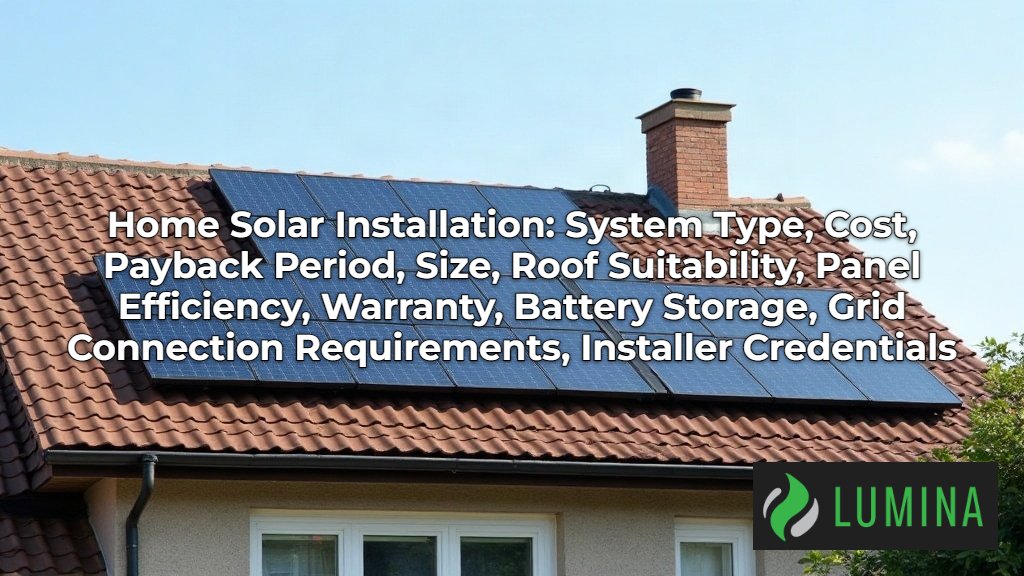
Before you commit to “home solar installation“, weigh up cost, system type, size, payback period, panel efficiency, roof suitability, battery storage, warranty, installer credentials, and grid connection requirements. Transitioning to renewable energy begins with a professional home solar installation, a process that typically requires 1 to 3 days for a standard residential solar system. According to the National Renewable Energy Laboratory, the total installed cost for residential solar photovoltaic systems typically ranges between $2.50 and $3.50 per watt depending on system size and location. While navigating the technical specifications of your hardware can feel overwhelming, understanding how to plan a solar installation for your home ensures you avoid common pitfalls. By carefully evaluating your energy needs and system efficiency, you can make an informed decision that maximizes your long-term savings. This guide provides the essential knowledge you need to manage your transition to solar power with confidence and financial clarity.
Key Takeaways
- A tier-1 solar panel costs approximately 22–28 per watt for your home solar installation.
- Modern monocrystalline solar panels typically offer 20% to 23% efficiency ratings.
- A standard residential solar installation takes 1 to 3 days to complete.
- Systems typically provide 25 to 30 years of power with proper annual maintenance.
- You can expect a 4 to 7 year payback period for your investment in a solar system.
On-Grid, Hybrid, and Off-Grid Solar Systems: Which One Fits Your Home?
Choosing between an on-grid, hybrid, and off-grid solar system depends on your reliance on the utility network and your need for continuous power during outages. An on-grid solar system connects directly to the utility, utilizing net metering to offset costs without requiring battery storage. Per the US Department of Energy, on-grid systems remain the most common residential configuration because they allow homeowners to offset electricity costs through net metering programs without the high capital expense of battery storage. A hybrid solar system integrates battery storage, allowing you to store excess energy for use during grid failures or peak pricing hours. An off-grid solar system operates entirely independently, necessitating a robust battery bank to manage all energy demands without any utility connection. When you are installing solar panels on your home, selecting the correct architecture ensures your energy goals align with your local infrastructure capabilities.| System Type | Utility Connection | Battery Storage | Primary Benefit |
|---|---|---|---|
| On-Grid | Yes | No | Lower upfront cost |
| Hybrid | Yes | Yes | Energy independence |
| Off-Grid | No | Yes | Total autonomy |
What Does a Home Solar Installation Cost Per Watt for Tier-1 Panels?
A home solar installation costs approximately 22 to 28 per watt when using tier-1 solar panels. This figure represents the base cost for high-quality, imported equipment, though your final expenditure will fluctuate based on the specific hardware chosen and the complexity of your site. Understanding these costs is a foundational step when you determine how to set up a home solar system that aligns with your financial goals.Cost per Watt Range (Tier-1 Panels)
Low Estimate
22
High Estimate
28
- Tier-1 solar panels: The core cost, accounting for the primary generation capacity.
- Solar inverter: The equipment that converts direct current to usable alternating current.
- Mounting and racking hardware: The structural components required for a secure roof attachment.
- Balance of system: Electrical wiring, safety switches, and monitoring equipment.
How to Calculate the Right Solar System Size for Your Home
Calculating the right solar system size for your home involves evaluating your historical electricity consumption against your property’s generation potential to ensure your investment meets your specific energy needs. A beginner’s guide to home solar installation requires you to balance your current utility usage with future load expectations to avoid both under-sizing and over-spending.Estimated Solar System Efficiency Losses
Minimum Loss
15%
Maximum Loss
20%
- Review your previous 12 months of electricity bills to determine your total annual kilowatt-hour (kWh) consumption. Per the Department of Energy, calculating your total annual electricity consumption in kilowatt-hours is a necessary step for determining system size, which can be accomplished by reviewing your utility bills from the past twelve months.
- Identify your peak usage hours and determine if your energy consumption patterns are likely to increase due to new appliances or electric vehicle charging.
- Divide your total annual kWh consumption by the local average peak sun hours to estimate the required system capacity.
- Adjust the result for system losses, such as inverter efficiency drops and wiring resistance, which typically account for a 15% to 20% reduction in output.
- Compare this required capacity against the physical space available on your roof to ensure the calculated array can be safely and effectively mounted.
Choosing the Right Solar Panel Efficiency Rating Before You Request a Quote
Choosing the right efficiency rating for your solar panel requires balancing your available roof space against your energy needs before you request a solar installation quote for your home solar installation.Solar Panel Efficiency Ranges
Standard Efficiency
20%–21%
Premium Efficiency
21%–22.5%
Maximum Efficiency
>22.5%

Why Efficiency Numbers Matter More Than Panel Count
Choosing the right solar panel efficiency rating before you request a quote ensures you maximize limited roof space. Efficiency refers to the percentage of sunlight a solar panel converts into usable electricity; modern monocrystalline solar panels typically offer an efficiency range of 20% to 23%. According to the Department of Energy, higher efficiency panels generally require less physical roof space to generate the same amount of electricity as lower efficiency panels. When you prioritize higher efficiency, you require fewer panels to achieve your target energy output, which simplifies the physical work during what to expect during a home solar installation.Reading the Efficiency Range on a Manufacturer Data Sheet
- 20%–21%: Standard efficiency for high-quality residential panels.
- 21%–22.5%: Premium efficiency, ideal for roofs with restricted surface area.
- Above 22.5%: Maximum efficiency, typically reserved for high-output tier-1 solar panel models.
How Do Monocrystalline Solar Panels Compare to Other Options?
Monocrystalline solar panels are the industry standard due to their superior heat tolerance and longevity compared to older polycrystalline or thin-film technologies. Because they are cut from a single crystal structure, they provide consistent performance over a 25 to 30 year lifespan. While other technologies may have a lower upfront cost, they often require more surface area to produce the same wattage, which can increase the complexity of your mounting hardware and labor costs.What Efficiency Rating Should You Prioritize on a Tight Budget?
If you are constrained by budget, you should prioritize a balance between cost per watt and panel efficiency rather than chasing the absolute highest percentage. While high-efficiency panels reduce the total number of units, mid-range tier-1 solar panel options often provide the best return on investment for standard residential system sizes. Focus on selecting panels that maintain their efficiency rating in high-temperature conditions to ensure your system continues to offset your electricity consumption effectively throughout its entire operational life. Verify that your chosen panel specifications explicitly state their performance degradation rate to ensure your long-term energy yields remain consistent with your financial projections.Does Your Roof Direction Affect What You Get From a Home Solar Installation?
Yes, your roof direction significantly affects what you get from a home solar installation because the orientation of your panels determines the intensity and duration of sunlight exposure throughout the day. In regions located in the northern hemisphere, a south-facing roof is generally considered ideal as it captures the most direct solar radiation for the majority of daylight hours. Per the U.S. Department of Energy, solar panels installed on south-facing roofs in the Northern Hemisphere receive the most direct sunlight throughout the day and typically generate the highest energy output. When planning a solar installation for your home, you must account for these variations in geometry to ensure your system reaches its maximum energy yield. The efficiency of your system is influenced by both the compass direction of your roof faces and the tilt angle of the mounted modules. While south-facing roofs provide the highest output, east and west orientations can still be viable, albeit with slightly reduced generation capacity. Consider the following impact of roof orientation on energy production:- South-facing: Maximizes annual energy production by receiving consistent sunlight throughout the day.
- East-facing: Generates higher output during morning hours but experiences a decline in performance as the sun moves toward the west.
- West-facing: Produces peak energy during the afternoon, which often aligns well with high-demand periods for residential electricity usage.
- North-facing: Generally discouraged for solar arrays in the northern hemisphere as panels receive limited direct sunlight, leading to significantly lower efficiency.
How Long It Takes for a Solar Installation to Pay for Itself Through Savings
The process of getting solar installed at home typically results in a payback period of 4 to 7 years, depending on your local electricity tariff rates, the size of your system, and available financing options. Per the Department of Energy, the typical period for a residential solar system to achieve a full return on investment through electricity bill savings ranges from six to ten years. Because solar panels have a lifespan of 25 to 30 years, the remainder of that duration represents a period of significant utility bill reduction or credit accumulation through net metering. Rising electricity tariffs shorten this window, as the value of the energy generated by your system increases relative to the cost of purchasing power from the grid.Solar Payback and Lifespan Timeline (Years)
Payback Period
7 Years
Panel Lifespan
30 Years
- Tariff Structure: Higher retail electricity prices accelerate the recovery of your initial investment.
- Net Metering Policies: The difference between the rate you pay for energy and the credit rate for exported energy impacts monthly savings.
- System Maintenance: Annual upkeep ensures the solar panels maintain peak efficiency, preventing energy production drops that would otherwise extend the payback timeline.
- Financing Terms: Interest rates on loans or leases add to the total cost, extending the time required to reach a break-even point.