
Timeline of Solar Cells: Efficiency Gains, Price Decline, Origins, Modern Panels, Market Growth, Silicon Breakthrough, Scientific Theory, Future Technology, Space Use
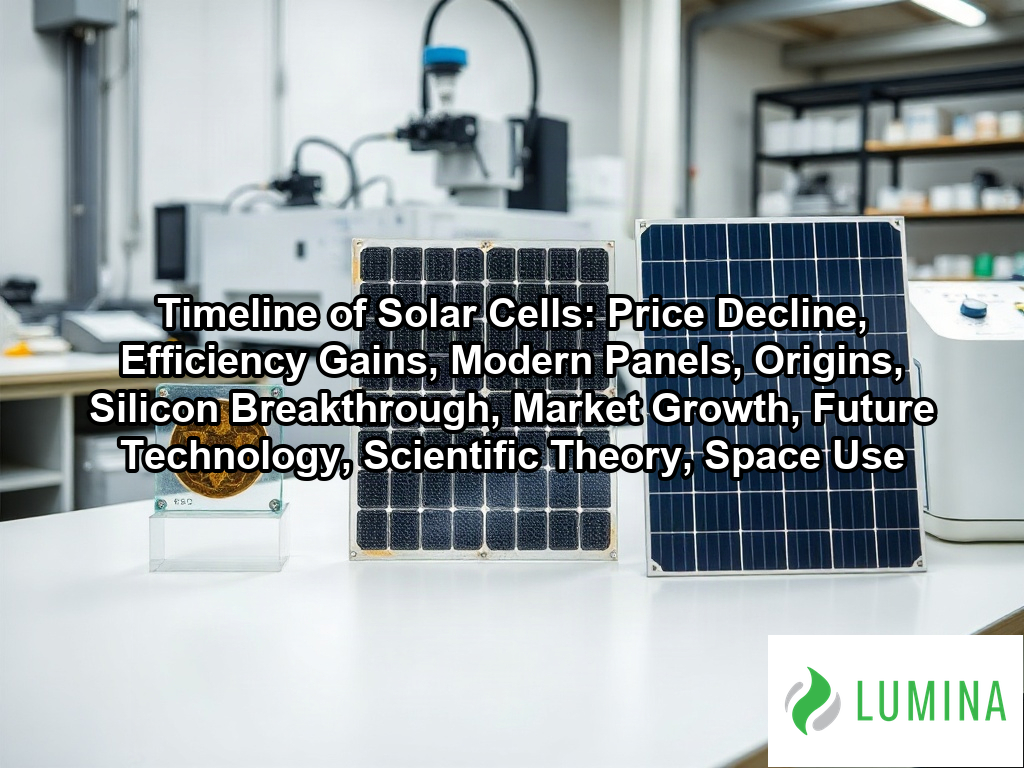
A timeline of solar cells is a chronological record of key discoveries, inventions and improvements in turning sunlight into electricity. Key aspects include price decline, efficiency gains, modern panels, origins, silicon breakthrough, market growth, future technology, scientific theory, and space use. The story begins in 1839 with the photovoltaic effect, and it moves through early selenium cells in the 1870s and 1880s. The 1954 silicon cell marked the breakthrough that made practical electricity generation from sunlight possible. Over the following decades, manufacturing scale pushed prices down sharply while efficiency climbed from about 6 percent to above 20 percent in common panels. Today, you can find monocrystalline, PERC, and heterojunction panels on roofs, and Delaware solar companies install these designs within the state’s climate and net metering rules. Each stage within solar panels depends on the earlier stages, so the article covers origins, the silicon breakthrough, price decline, efficiency gains, and modern panels in that order.
Key Takeaways
- The 1883 solar cell marked the start of the timeline of solar cells at 1% efficiency.
- Practical silicon solar cell efficiency reached 6% in 1954, rising to roughly 11%.
- Solar cell prices fell from about $300 per watt in the 1950s to $0.20-$0.40 by 2020.
- Current commercial solar panel efficiency reaches between 22% and 25%.
- Perovskite-silicon tandem lab efficiency has surpassed 33% today.
Who Discovered the Photovoltaic Effect and Built the First Solar Cell?
Edmond Becquerel discovered the photovoltaic effect in 1839, while Charles Fritts built the first true solar cell in 1883 with an efficiency of about 1%, marking a pivotal point in the timeline of solar cells.
| Milestone Event | Year | Key Contributor | Scientific Significance |
|---|---|---|---|
| Discovery of the Photovoltaic Effect | 1839 | Edmond Becquerel | Observed electric current generation via light-exposed silver chloride electrodes. |
| Creation of the First Solar Cell | 1883 | Charles Fritts | Utilized selenium coated with thin gold to produce functional electricity from light. |
| Photoelectric Effect Theory | 1905 | Albert Einstein | Provided the quantum framework for electron liberation essential for semiconductors. |
Solar Cell Development Timeline (Year Founded)
Edmond Becquerel and the Photovoltaic Effect
The photovoltaic effect was discovered by Edmond Becquerel in 1839, while the first true solar cell was built by Charles Fritts in 1883, marking the foundational moments in the timeline of solar cells. Becquerel, at age 19, observed that a small electric current developed when light struck silver chloride electrodes submerged in an electrolyte. This discovery identified the core principle that light could be directly converted into electricity.
Why the Photoelectric Effect Mattered Later
While the initial discovery focused on current in electrolytes, the underlying theory for how photons liberate electrons was solidified in 1905 when Albert Einstein explained the photoelectric effect. This theoretical framework provided the necessary understanding for how light particles interact with matter to create electrical flow, proving essential for future semiconductor development.
How Did Charles Fritts Build the First True Solar Cell?
In 1883, Charles Fritts constructed the first true solar cell by coating selenium with a thin, semi-transparent layer of gold. According to Smithsonian Institution, Charles Fritts produced the first working selenium-based solar cell in 1883, which demonstrated that light could be converted directly into electricity. This device achieved an efficiency of about 1%, demonstrating that solid-state materials could serve as power generators without the need for liquid electrolytes.
Selenium Cells and Their Early Limits
Research into selenium progressed significantly between 1873 and 1876, when developers began to map the potential of photoconductive materials. The limitations of these early cells, however, constrained their practical application, as summarized below:
- 1873-1876: Willoughby Smith identified photoconductivity in selenium, while William Adams and Richard Day confirmed its ability to produce current from light.
- Efficiency constraints: The early selenium-based technology peaked at about 1% efficiency, making widespread electricity generation unfeasible.
- Material stability: Early cells faced degradation issues when exposed to varying environmental conditions, unlike later silicon-based technologies.
Evaluate the material stability of light-harvesting components in your own setup to ensure you understand how degradation rates impact your long-term energy yield.
The following list outlines key technical challenges that defined the early evolution of solar technology:- Selenium was selected as the semiconductor material due to its inherent light-sensitive properties, despite its high resistance.
- Gold was applied in an ultra-thin layer to serve as a conductive contact while allowing sufficient light transmission to the junction.
- Device scalability remained limited because researchers lacked the industrial processes to create large-area, uniform semiconductor junctions.
- Initial energy conversion was hindered by the narrow spectral sensitivity of early materials, capturing only a small fraction of the solar spectrum.
Why the 1954 Silicon Cell Was a Turning Point in the Timeline of Solar Cells
The 1954 silicon solar cell was a turning point in the timeline of solar cells because it introduced the first practical, high-efficiency device capable of converting sunlight into electricity at a level viable for real-world applications. Per the American Physical Society, researchers at Bell Labs demonstrated the first practical silicon photovoltaic cell in 1954, achieving an energy conversion efficiency of approximately 6 percent. Prior to this, selenium-based devices were limited by extremely low performance, but the introduction of a doped p-n junction in silicon created a stable platform for energy generation. This breakthrough shifted the trajectory of energy research from purely experimental observations to functional power production, eventually enabling the use of solar energy for spacecraft such as the 1958 Vanguard 1 satellite.
| Technological Milestone | Year | Material Composition | Energy Conversion Efficiency | Primary Application |
|---|---|---|---|---|
| First Photovoltaic Experiment | 1883 | Selenium | ~1% | Laboratory Observation |
| Initial Bell Labs Device | 1954 | Doped Silicon | ~6% | Proof-of-Concept |
| Optimized Photovoltaic Cell | Late 1954 | Refined Doped Silicon | ~11% | Functional Power Generation |
| Satellite Power Array | 1958 | Silicon Semiconductor | Validated | Spacecraft Instrumentation |
Solar Cell Efficiency Gains (1883–1954)
The transition from early materials to silicon created a distinct shift in technical capabilities:
- First selenium cell (1883): Approximately 1% efficiency.
- Initial Bell Labs silicon cell (1954): Approximately 6% efficiency.
- Improved silicon cell (late 1954): Approximately 11% efficiency.
- Spacecraft power standard: Reliable, long-duration energy for early satellites.
By moving to a semiconductor architecture, scientists established a framework that allowed for incremental scaling and physical optimization that previous metallic or mineral-coated cells could not support. This shift fundamentally altered the timeline of solar cells by proving that silicon could consistently power electronic equipment, setting the stage for every subsequent advancement in commercial energy harvesting. Examine the p-n junction architecture of your current panels to understand the longevity and performance capacity inherited from these early 1950s designs.
The following factors were critical to the successful commercialization and development of silicon-based solar technology:- The transition from selenium to crystalline silicon provided a significantly wider bandgap, which allowed for better thermal stability and higher photon absorption rates.
- Bell Labs researchers, specifically Gerald Pearson, Calvin Fuller, and Daryl Chapin, utilized lithium diffusion techniques to create precise p-n junctions within the silicon wafers.
- The implementation of boron-doped layers established the necessary internal electric field required to separate photo-generated charge carriers effectively.
- Refinement of the manufacturing process reduced crystal lattice defects, which directly enabled the leap from 6% to 11% efficiency within a single year.
How Solar Cell Efficiency Improved From the First Cell to Modern Lab Records
The history of efficiency gains across the timeline of solar cells reflects a progression from basic material discovery to highly optimized multi-material structures. Early efforts to harness light energy faced significant physical limitations, whereas contemporary laboratory setups now utilize complex architectures to capture vast portions of the light spectrum.
| Era or Milestone | Photovoltaic Technology Type | Efficiency Percentage | Development Context |
|---|---|---|---|
| 1883 | Selenium | 1% | First true solar cell discovery |
| 1954 | Silicon | 6% | Practical silicon unveiling |
| 1976 | Amorphous Silicon | 2% | Thin-film electronics target |
| 1985 | PERC | 20% | Laboratory efficiency breakthrough |
| Current Era | TOPCon / HJT / Back-Contact | 22-25% | Commercial standard panels |
| Current Era | Perovskite-Silicon Tandem | 33%+ | Cutting-edge research architecture |
| Current Era | Multi-junction | 47% | Concentrated light laboratory cell |
Solar Cell Efficiency Progression
- 1883: The first true solar cell, constructed from selenium, achieved an efficiency of about 1%.
- 1954: Practical silicon solar cells were unveiled, starting at about 6% efficiency and soon rising to roughly 11%.
- 1976: Early amorphous silicon thin-film cell development reached 1.1-2% efficiency, targeting low-power consumer electronics.
- 1985: The introduction of PERC-type designs pushed silicon solar cell efficiency beyond 20% in laboratory environments.
- Current Era: Standard commercial panels using TOPCon, heterojunction, or back-contact technology now reach about 22-25% efficiency.
- Current Era: Cutting-edge research into perovskite-silicon tandem cells has demonstrated lab efficiency over 33%.
- Current Era: Advanced multi-junction lab cells designed for use under concentrated light have achieved efficiency over 47%. Per National Renewable Energy Laboratory, research-scale multijunction cells have reached approximately 47 percent efficiency under concentrated light conditions.
Monitor the gap between your current hardware’s nameplate rating and these peak laboratory records to determine if your setup is nearing the physical limits of its specific semiconductor material.
The following factors have been instrumental in pushing photovoltaic performance beyond basic material thresholds:- Surface passivation techniques that minimize electron recombination losses at the cell boundaries.
- Light-trapping textures and anti-reflective coatings that maximize photon absorption within the active layers.
- Bandgap engineering strategies that allow for the specialized tuning of materials to capture specific solar spectrum segments.
- Advanced manufacturing processes, such as chemical vapor deposition, which improve material purity and structural consistency.
- Bifacial module designs that capture reflected light from the ground to increase overall energy yield.
Solar Panels on Homes Now Compared With Earlier Generations
Solar panels on homes now compared with earlier generations represent a massive transition from niche, space-bound technology to high-performance infrastructure in the timeline of solar cells. You can see how these advancements have changed your equipment options in the table below.
Solar Panel Efficiency Over Time
| Feature | Early Generations | Current Generation |
|---|---|---|
| Primary Material | Polycrystalline silicon | Monocrystalline silicon |
| Commercial Efficiency | 15-18% | 22-25% |
| Dominant Tech | Standard p-n junction | TOPCon, heterojunction, back-contact |
| Price per Watt | $4-$5 (1990s) | $0.20-$0.40 (2020s) |
You can clearly observe that your residential options have moved away from less efficient polycrystalline silicon toward advanced designs that capture more energy within the same physical footprint. Per the US Energy Information Administration, the average cost of residential solar photovoltaic systems has dropped by more than 80% since 2010 as a result of larger production scales and better semiconductor manufacturing. Modern installations frequently utilize monocrystalline silicon, which provides superior electron mobility compared to the legacy materials used when solar power was first moving from remote sites to rooftop adoption. While early generation cells were limited by basic manufacturing constraints, today’s hardware utilizes refined light-trapping architectures to maximize output in diverse weather conditions.
Compare the temperature coefficient of different panel models to ensure your system maintains high performance during the hottest months of the year.
Modern residential solar systems offer several performance advantages beyond raw efficiency gains:- Improved temperature coefficients allow panels to maintain higher energy output during extreme heat.
- Enhanced low-light sensitivity enables power generation to begin earlier in the morning and continue later into the evening.
- Advanced glass coatings reduce reflection and self-clean more effectively, minimizing output losses from dirt or debris.
- Superior degradation rates ensure that modern panels retain more of their original capacity after 25 years of service.
- Bifacial module designs can capture reflected sunlight from ground surfaces, increasing total energy harvest in specific mounting configurations.
Why Solar Cell Prices Fell So Far From the 1950s to Today
The reason solar cell prices fell so far from the 1950s to today, marking a major shift in the timeline of solar cells, is due to the progression from expensive, niche space-grade components to high-volume industrial manufacturing. In the late 1950s, solar cell technology cost about $300 per watt, restricting its application primarily to satellite power, such as the Vanguard 1, and remote research sites. Over the following decades, deliberate efforts to improve manufacturing processes, scale production, and diversify materials led to a consistent decline in costs. Per the Department of Energy, technological advancements in manufacturing processes, such as the transition to monocrystalline and polycrystalline silicon wafers, have significantly improved solar cell efficiency and reduced material waste over several decades.
| Evolutionary Phase | Historical Context | Cost per Watt | Primary Driver |
|---|---|---|---|
| Early Space-Era | Late 1950s Satellite Power | $300.00 | Niche, specialized production |
| Terrestrial Transition | 1970s Research & Early Utility | $55.00 | Design simplification |
| Rapid Scaling | 2000s Production Boom | $2.00–$4.00 | Economies of scale |
| Commercial Maturity | 2020 High-Efficiency Era | $0.30 | Advanced architecture (TOPCon) |
Solar Cost Per Watt Over Time
- Early Space-Era Pricing: Roughly $300 per watt in the late 1950s, dictated by limited, specialized production.
- Transition to Terrestrial Use: Adoption of cheaper designs during the 1970s brought prices down to a range of $100 to $10 per watt.
- Rapid Scaling Phase: Annual growth of 30-40% in global solar production throughout the 2000s catalyzed significant economies of scale.
- Commercial Maturity: By 2020, module prices reached roughly $0.20-$0.40 per watt, representing an 80-90% decrease compared to 2010.
- Efficiency and Economics: The shift from polycrystalline silicon to higher-efficiency architectures like TOPCon and heterojunction cells has further improved the value proposition for you.
Compare the current module price per watt against the historical lifetime energy yield to determine if an installation upgrade offers enough financial benefit to replace your existing system.
Several key factors beyond manufacturing scale contributed to the drastic reduction in solar energy costs:- Standardization of cell form factors allowed for the automation of panel assembly lines.
- Implementation of advanced anti-reflective coatings significantly improved photon capture without adding proportional cost.
- Investment in metallurgical-grade silicon purification processes reduced the energy and financial input required for raw materials.
- Government-led subsidies and feed-in tariffs created the stable market demand necessary for long-term private sector investment.
Frequently Asked Questions
How did Einstein’s photoelectric effect explanation shape the timeline of solar cells and set the efficiency limit?
Einstein’s 1905 explanation of the photoelectric effect shaped the timeline of solar cells by identifying that light quanta free electrons to create current. This theory provided the fundamental physical basis for how photons interact with materials to generate electricity, guiding subsequent developments in efficiency toward modern limits.
How did satellites like Vanguard 1 influence the early timeline of solar cells?
Satellites like Vanguard 1 influenced the early timeline of solar cells by proving that solar power was a reliable standard for spacecraft. Following the 1958 launch, solar power became essential for missions because these cells operated successfully for years in space, despite the high price per watt during that era.
When did solar cells move from space use to homes and utility-scale power plants?
Solar cells moved from space use to homes and utility-scale power plants during the 1970s and 1980s, spurred by oil embargoes and terrestrial research. Prices fell from roughly $300 per watt in the late 1950s to reach 1 MW utility-scale arrays by the 1980s and grid-connected rooftop programs by the 1990s.
What comes next in the timeline of solar cells, such as perovskite tandems and flexible cells?
Next in the timeline of solar cells are high-efficiency technologies like perovskite-silicon tandem cells, which have exceeded 33% efficiency in the lab. These innovations follow current commercial panels using TOPCon, heterojunction, or back-contact cells, which typically achieve an efficiency of about 22-25% in various modern solar panel applications.
Do solar cells need heat to work, and how did early inventors discover that light is what matters?
No, solar cells do not need heat to work, as early inventors discovered that light alone triggers the photovoltaic effect. In 1839, Edmond Becquerel observed current when light hit electrodes, and in 1876, researchers confirmed selenium produced current from light, establishing the technical foundation for the entire timeline of solar cells.