
Automobile Auxiliary Power Outlet: Switched or Always-on, Wattage Limit, Fuse Rating, Solar Charging Use, Compatible Devices, Voltage, Power Station Charging, Inverter Capacity, Socket Size and Polarity

An automobile auxiliary power outlet is a 12-volt socket in a vehicle that supplies direct current to portable electrical accessories. Key aspects include wattage limit, switched or always-on, solar charging use, fuse rating, voltage, compatible devices, inverter capacity, power station charging, and socket size and polarity. The outlet draws power from the vehicle’s battery through a fused circuit, so the current you can pull is limited by the fuse rating and the wiring behind it. Most circuits are rated between 10 and 20 amps at roughly 12 to 14.4 volts, which sets a wattage ceiling of about 120 to 240 watts. Some outlets switch off with the ignition while others stay live, and that difference decides whether a connected device can keep running when the engine is off. In a small solar panel installation, the outlet often serves as the entry point for a compact panel or charge controller that tops up the battery or powers accessories. This article explains the wattage limit, fuse rating, voltage, switched or always-on behavior, and how these factors apply to solar charging use.
Key Takeaways
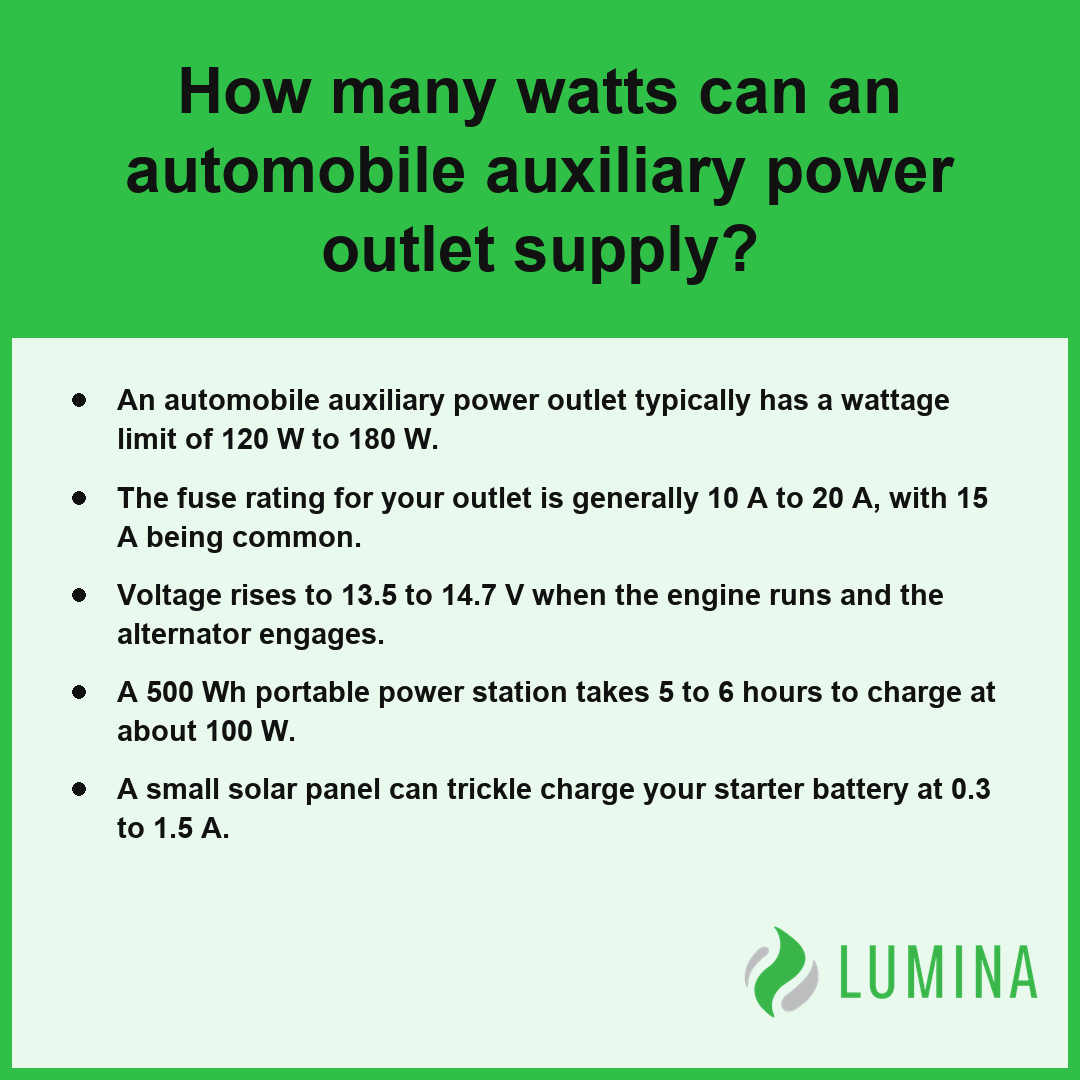
- An automobile auxiliary power outlet typically has a wattage limit of 120 W to 180 W.
- The fuse rating for your outlet is generally 10 A to 20 A, with 15 A being common.
- Voltage rises to 13.5 to 14.7 V when the engine runs and the alternator engages.
- A 500 Wh portable power station takes 5 to 6 hours to charge at about 100 W.
- A small solar panel can trickle charge your starter battery at 0.3 to 1.5 A.
How Many Watts Can an Automobile Auxiliary Power Outlet Supply?
An automobile auxiliary power outlet can supply a wattage limit of approximately 120 W to 180 W, depending on the specific electrical configuration of your vehicle. While the receptacle itself is standardized with an inner diameter of about 21 mm (0.83 in) per SAE J563, the total power available is strictly governed by the protective components installed by the manufacturer. Per SAE International, standardized auxiliary power outlets in United States vehicles are typically fused for 10 to 20 amperes at 12 volts direct current, which results in a maximum output capacity of approximately 120 to 240 watts.
| Accessory Type | Power Consumption Range (Watts) | Operating Compatibility |
|---|---|---|
| Mobile Charging Devices | 5 W – 60 W | Highly Compatible |
| Portable Refrigeration Units | 60 W | Compatible (Verify Startup Surge) |
| Automotive Tire Inflators | 100 W – 150 W | Near Maximum Capacity |
| Plug-in Power Inverters | Up to 180 W | Circuit Limit Reached |
Typical Power Consumption of Accessories (Watts)
Why the Fuse Rating and Wiring Set the Wattage Limit
The wattage limit is defined by the fuse rating of the circuit, which typically ranges from 10 A to 20 A, with 15 A being the most common. Because power is the product of voltage and current, you must calculate your load based on the system voltage, which fluctuates from 12 V DC when the vehicle is off to 13.5 to 14.7 V while the engine runs. Exceeding these thresholds will cause the fuse to blow, interrupting power to the auxiliary power outlet.
What Can You Run Within the Wattage Limit?
You can operate a variety of common electronic devices, provided their consumption remains under the ceiling defined by your vehicle’s fuse. Common accessory power requirements include:
- Phone chargers: 5 W to 60 W
- Tire inflators: 100 W to 150 W
- Portable fridges: 40 W to 60 W (while the compressor runs)
- Plug-in inverters: Roughly 150 W to 180 W
Plug-In Inverter Loads Through the Cigarette Lighter Socket
If you use a plug-in inverter, you must ensure your device does not exceed the circuit’s capacity. Any appliance requiring more than 180 W necessitates a direct connection to the starter battery using heavy-gauge cables, rather than relying on the auxiliary power outlet.
Portable Fridge and Portable Power Station Draw
A portable power station typically accepts charging at approximately 8 A, or about 96 to 120 W. At this rate, recharging a 500 Wh unit takes roughly 5 to 6 hours. To prevent premature depletion of your starter battery during this process, perform such high-draw tasks only while the engine is running.
Check your vehicle owner’s manual for the specific fuse rating of your auxiliary power outlet before plugging in high-draw devices like tire inflators or large portable power stations.
To ensure the safe and optimal use of your vehicle’s auxiliary power outlet, observe the following maintenance and operational precautions:- Verify the specific fuse rating located in your owner’s manual before connecting high-draw devices to prevent blown circuits.
- Inspect the power plug and the receptacle for signs of corrosion or debris, which can increase electrical resistance and heat buildup.
- Avoid using multi-port splitters that exceed the total amperage capacity of the individual circuit.
- Disengage power-drawing accessories before starting the engine to protect sensitive electronics from voltage spikes.
- Ensure the plug is fully seated in the socket to prevent arcing and potential damage to the contact points.
Which Fuse Protects the Automobile Auxiliary Power Outlet and What a Replacement Costs
The fuse that protects an automobile auxiliary power outlet is typically a blade-style automotive fuse housed within your vehicle’s integrated power distribution center, and the cost to replace one is generally quite low, often ranging from under one dollar for a single fuse to five dollars for a variety pack. These fuses ensure that the wiring connected to your automobile auxiliary power outlet does not overheat, functioning by breaking the circuit if the current draw exceeds the specified safety threshold. Per the Society of Automotive Engineers, auxiliary power outlets in vehicles are typically protected by dedicated fuses rated between 15 and 20 amperes to prevent electrical circuit overloads. You will find that these fuses are standardized by color and numerical rating, allowing for quick identification when you need to inspect the circuit for potential failure.
Typical Fuse Amperage Range (Amperes)
| Component | Standard Specification |
|---|---|
| Typical fuse rating | 10 A to 20 A (15 A is most common) |
| Replacement cost | $0.50 to $5.00 |
| Socket inner diameter | About 21 mm (0.83 in) |
When investigating a lack of power, identify the specific fuse box location by consulting your vehicle owner’s manual, which will also provide a diagram to locate the correct slot for the automobile auxiliary power outlet. Because these fuses are inexpensive, it is often practical to keep a small collection of common ratings in your glove box to address unexpected outages immediately. Verify the integrity of the fuse element by checking for a broken metal wire inside the transparent plastic casing before assuming the socket or your connected device has suffered a more permanent internal failure.
Follow these steps to safely inspect and replace a blown automotive fuse:- Turn off the vehicle ignition and remove the key to ensure the circuit is de-energized.
- Use the fuse puller tool—often stored inside the fuse box cover—to extract the fuse without damaging adjacent components.
- Examine the metal filament inside the clear plastic casing; a broken or melted wire indicates a blown fuse.
- Insert a new fuse with the identical amperage rating to maintain the integrity of the electrical system.
- Test the auxiliary power outlet to verify that the connection has been restored.
Is an Automobile Auxiliary Power Outlet 12 V DC, and Why Does Voltage Rise With the Engine Running?
An automobile auxiliary power outlet is a 12 V DC power source, and the voltage rises with the engine running because the alternator generates higher potential to replenish the electrical system. While the nominal rating is 12 V DC, the actual system voltage fluctuates based on whether the engine is idling or under load, as the alternator maintains a state of charge higher than the battery’s resting level. This standardized socket, typically adhering to an inner diameter of about 21 mm (0.83 in), utilizes a center pin for positive contact and an outer shell for the negative return, ensuring compatibility across most modern vehicle platforms.
Typical Voltage (Average Midpoints)
When the vehicle is stationary and the engine is off, the voltage typically reflects the state of the starter battery, often sitting closer to 12.0 V to 12.6 V. Once the ignition is engaged and the alternator begins spinning, the system voltage increases to 13.5 to 14.7 V to effectively power vehicle electronics and force current back into the battery. Per the National Institute of Standards and Technology, it is an approximation that the alternator charging process typically causes the outlet voltage to rise to between 13.5 V and 14.5 V while the engine is running. The following table illustrates the variance in system voltage based on operational status:
| Condition | Typical Voltage Range |
|---|---|
| Engine Off | 12.0 V to 12.6 V DC |
| Engine Running | 13.5 V to 14.7 V DC |
Confirm the operational voltage range of your sensitive electronic devices to ensure they are compatible with the slight surge in power that occurs immediately upon starting your vehicle.
Keep in mind these additional considerations for power outlet compatibility and safety:- Ensure devices draw less than the typical 10 to 20-amp limit to prevent blowing the vehicle’s circuit fuse.
- Avoid using the outlet for high-drain devices while the engine is off to prevent battery depletion.
- Check for loose connections if voltage fluctuates significantly, as vibrations can cause intermittent contact within the socket.
- Verify that the accessory plug matches the standard diameter to prevent short-circuiting the center pin against the outer shell.
Will Your Automobile Auxiliary Power Outlet Keep Working When the Car Is Off, and How Can You Tell?
Your automobile auxiliary power outlet will keep working when the car is off if it is wired as an always-on outlet, or it will cease function if it is a switched outlet. Many modern vehicles use an always-on outlet to allow for charging mobile devices or maintaining a connection to a portable power station while parked, while others disconnect power to the socket when you remove the ignition key to protect your starter battery from accidental discharge. Per IEEE Standards Association, the electrical architecture of modern vehicles often uses a body control module to manage power distribution, which may cut off auxiliary outlets after a programmed time delay to prevent excessive discharge of the starter battery. You can determine the behavior of your specific outlet through the following observations:
| Outlet Configuration | Power Status (Key Removed) | Primary Risk | Ideal Usage Case |
|---|---|---|---|
| Always-On | Continuous Flow | Starter Battery Discharge | Portable Power Stations/Devices |
| Switched | Immediate Cut-off | None (System Protected) | Short-term Phone Charging |
| Timed-Delay (BCM Controlled) | Delayed Shut-off | Moderate Drain Risk | Active Accessory Management |
- Observe the status light on your phone charger or plugged accessory after you turn the ignition off and remove the key.
- Test the socket by plugging in a small device, such as a phone or a portable power station, to see if it continues to pull a charge while the vehicle remains stationary and unpowered.
- Consult your vehicle owner’s manual, which often specifies if particular sockets in the dash, console, or cargo area are always-on or switched.
- Check for a small battery or plug icon printed next to the automobile auxiliary power outlet housing, which sometimes denotes a constant power connection.
Monitor the voltage levels of your starter battery if you frequently leave accessories connected to an always-on outlet to ensure you do not prevent the engine from starting later.
Follow these additional steps to safely verify your outlet’s configuration:- Check your vehicle owner’s manual under the “Fuses” or “Interior Electrical” section, as manufacturers often label auxiliary sockets as “Battery” or “Ignition” powered.
- Use a digital multimeter set to DC voltage to confirm if the socket maintains a 12V reading after the vehicle enters sleep mode.
- Verify if your interior lighting or infotainment system also shuts down simultaneously, as these often share the same power distribution relay as auxiliary outlets.
Can a Small Solar Panel Plugged Into an Automobile Auxiliary Power Outlet Charge Your Starter Battery?
Yes, a small solar panel plugged into an automobile auxiliary power outlet can charge your starter battery, provided the vehicle is equipped with an always-on outlet. Because the automobile auxiliary power outlet creates a direct physical path to the battery, the electrical current flows in reverse from the panel into the storage cell. When exposed to full sun, a typical 5 to 20 W panel will generate a trickle charge ranging from 0.3 to 1.5 A, which is sufficient to compensate for the natural self-discharge of the battery or the minor parasitic draws from the vehicle’s onboard computer systems.
| Solar Panel Capacity | Estimated Current Output (Amps) | Primary Maintenance Function |
|---|---|---|
| 5 Watts | 0.3 A – 0.4 A | Offsetting parasitic battery drain |
| 10 Watts | 0.6 A – 0.8 A | Long-term storage maintenance |
| 20 Watts | 1.2 A – 1.5 A | Rapid trickle charging/desulfation support |
Solar Panel Power Output (Watts)
To ensure this process is effective and safe for your electrical system, consider these operational requirements:
- Ensure the automobile auxiliary power outlet is an always-on outlet; if it is a switched outlet, the connection will break the moment you remove the ignition key.
- Verify the solar kit includes a built-in charge controller or blocking diode to prevent the battery from discharging back through the panel during nighttime or low-light conditions. According to National Highway Traffic Safety Administration, automotive electrical systems use specific voltage regulations for lead-acid batteries that necessitate a charge controller to avoid overcharging and electrolyte boiling if the solar output exceeds the maintenance float level.
- Confirm your vehicle’s specific wiring allows for bidirectional current flow, as some modern power management modules may reject incoming currents through the auxiliary circuit.
- Place the solar panel in a location with unobstructed sunlight to maintain the target trickle charge current of 0.3 to 1.5 A.
Verify whether your specific vehicle model cuts power to the socket when the ignition is off before relying on solar maintenance for your starter battery.
Follow these best practices to maintain your vehicle’s electrical health while using solar equipment:- Position the panel on the dashboard using suction cups to maximize direct sun exposure through the windshield.
- Inspect the cigarette lighter plug periodically to ensure a tight connection, as vibration can cause intermittent charging.
- Use a window shade or reflective screen if temperatures are extreme, as excessive heat can reduce solar efficiency and shorten battery lifespan.
- Clean the surface of the panel with a damp cloth monthly to remove dust and debris that could impede light absorption.
- Monitor the battery’s voltage during extended storage to ensure the trickle charge is sufficient for your specific climate.
Frequently Asked Questions
What size is an automobile auxiliary power outlet and which pin is positive?
An automobile auxiliary power outlet features an inner diameter of about 21 mm (0.83 in), and the center pin is the positive contact. The outer shell of the socket serves as the negative contact for the plug’s spring-loaded side contacts, which receive 12 V DC.
What devices can I safely run from an automobile auxiliary power outlet, and which appliances are too powerful?
You can safely run devices such as phone chargers, tire inflators, and portable fridges from an automobile auxiliary power outlet, but you cannot power appliances exceeding the typical wattage limit of 120 W to 180 W, as these would exceed the 10 A to 20 A fuse rating.
What size inverter can I plug into an automobile auxiliary power outlet before I need to connect to the battery?
You can plug a small plug-in inverter with a limit of roughly 150 to 180 W into an automobile auxiliary power outlet. Any larger inverter, ranging from 300 W to 3,000 W, must be connected directly to the battery using heavy cables to handle the required electrical load.
How long does it take to charge a 500 Wh portable power station from an automobile auxiliary power outlet?
It takes roughly 5 to 6 hours to charge a 500 Wh portable power station from an automobile auxiliary power outlet when drawing about 100 W. It is best to perform this task with the engine running, which provides a system voltage of 13.5 to 14.7 V.
How long can a portable fridge run from an automobile auxiliary power outlet before it drains the car battery?
A portable fridge drawing about 40 to 60 W can run for 8 to 10 hours before potentially draining the starter battery to a critical level. Because the automobile auxiliary power outlet may be an always-on outlet, you must monitor the battery to ensure you retain sufficient starting power.