
Delaware Solar Incentives: Rebate Amount, Cost, Federal Credit Status, Eligibility Requirements, SREC Trade-Off, Payback Period, Ownership Vs. Lease Options, Net Metering Terms, Home Value Impact
When researching “delaware solar incentives“, the key factors are cost, rebate amount, eligibility requirements, federal credit status, payback period, SREC trade-off, net metering terms, ownership vs. lease options, and home value impact. Delaware solar incentives can feel overwhelming when you are trying to calculate the true installation cost of a solar panel system that ranges from $29,282 to $39,616 before any savings. You want to reduce your long-term energy expenses, but navigating the eligibility requirements and understanding how to claim your benefits is a complex process. Lumina Solar acts as your clear guide, simplifying the path to renewable energy by identifying the exact rebates and credits available for your specific home. We help you evaluate your options so you can confidently determine how Delaware solar incentives can reduce your installation costs. By choosing the right approach today, you secure a clean energy future and enjoy a system built to last for a minimum expected lifespan of 25 years.
A standard 14 kW solar panel system costs between $29,282 and $39,616 before incentives. Learn how to accurately calculate your total installation cost.
You can secure rebates of $0.70 per watt, up to a $6,000 maximum. Discover how these funds significantly lower your initial investment.
Whether through the standard Green Energy Program or the LMI Solar Pilot Program, find out which specific requirements you must meet to qualify.
The federal tax credit is no longer available for systems installed after 2025. See how state-level options are now your primary path to savings.
With an estimated payback period of 8.5 to 11 years and a 25-year lifespan, your solar panel system provides decades of reliable value.
Claiming certain rebates requires you to transfer your Solar Renewable Energy Credits to the utility. Weigh this trade-off against your long-term financial goals.
Transitioning to renewable energy requires a clear strategy, and understanding the full range of Delaware solar incentives is essential for any homeowner looking to manage a system cost that typically spans between $29,282 and $39,616. According to the Delaware Department of Natural Resources and Environmental Control, residential customers served by Delmarva Power can receive a solar grant of $0.70 per watt, up to a maximum rebate of $6,000. You might wonder how Delaware solar incentives can reduce your installation costs when navigating various utility programs and grant eligibility requirements. By carefully evaluating whether you qualify for the LMI Solar Pilot Program or the Green Energy Program, you can determine which financial paths align with your specific property needs. This guide explains how to leverage these programs so you can accurately calculate the payback period for your residential solar panel system. You will finish this article with a comprehensive roadmap to maximizing your savings while avoiding common pitfalls in the grant application process.
Key Takeaways
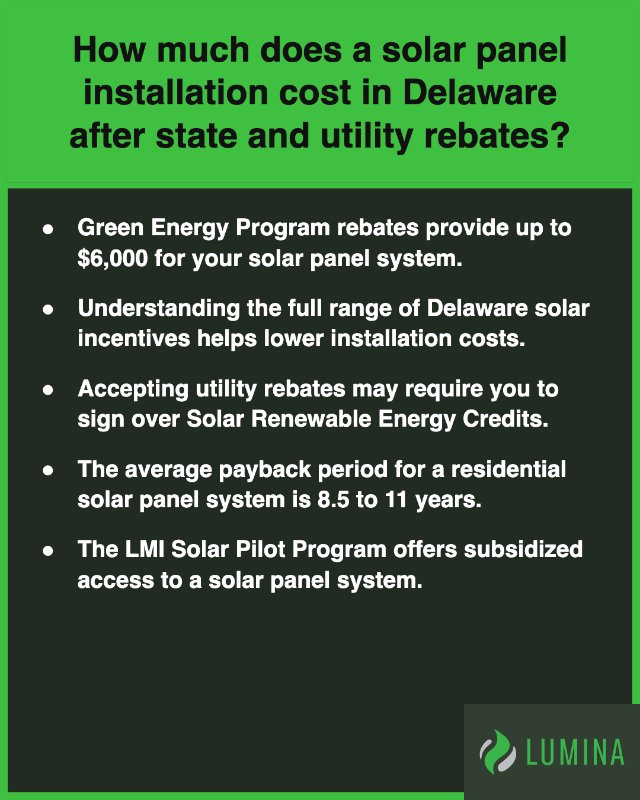
- Green Energy Program rebates provide up to $6,000 for your solar panel system.
- Understanding the full range of Delaware solar incentives helps lower installation costs.
- Accepting utility rebates may require you to sign over Solar Renewable Energy Credits.
- The average payback period for a residential solar panel system is 8.5 to 11 years.
- The LMI Solar Pilot Program offers subsidized access to a solar panel system.
How Do Delaware Solar Incentives Reduce Your Installation Cost?
Delaware solar incentives reduce your installation cost by combining the federal investment tax credit with state-specific options like the Green Energy Program, which provides a rebate of $0.70 per watt up to a maximum of $6,000, alongside ongoing financial benefits from net metering and the sale of Solar Renewable Energy Credits that shorten your estimated payback period to 8.5 to 11 years.
“Homeowners can participate in the Solar Renewable Energy Credit (SREC) program to earn income over time, with credits generated for every 1,000 kilowatt-hours of electricity produced as of 2026.” — Delaware Sustainable Energy Utility
Federal Tax Credit, State Rebates, and Net Metering Working Together
Delaware solar incentives reduce your installation cost by layering various financial mechanisms that lower the total expenditure of a project typically ranging from $29,282 to $39,616. To understand what solar incentives are available in Delaware right now, you must look at how local rebates and utility-managed net metering operate in tandem to offset the $2.46 per watt average cost of a solar panel system.
What Roof Orientation and System Size Mean for Your Final Numbers
Your ultimate financial outcome depends heavily on the physical characteristics of your property. Efficiency varies based on your roof orientation and the total capacity of the equipment you select.
Why a 14 kW Solar Panel System Is the Benchmark for Full Offset
The following table illustrates how system sizing affects your baseline expenditure:
| Metric | Standard Value |
|---|---|
| Typical System Size | 14 kW |
| Average Cost Per Watt | $2.46 |
| Estimated System Range | $29,282 – $39,616 |
Which Incentives Stack and Which Cannot Be Combined?
Careful planning is required to navigate incentive stacking, as certain programs have mutually exclusive requirements. While net metering is generally available to all grid-connected residents, other state-level programs may restrict your eligibility if you have already accepted specific utility-provided cash incentives.
- Green Energy Program rebates are often capped at $6,000 per residential installation.
- Accepting a utility-provided rebate frequently requires the transfer of your Solar Renewable Energy Credits to the utility provider.
- Net metering remains accessible regardless of whether you receive an upfront installation rebate.
Review the specific terms of your utility interconnection agreement to confirm if you must relinquish future energy credit rights in exchange for an immediate rebate payment.
What Is the Maximum Rebate Available From Delaware Utility Programs?
The maximum rebate available from utility programs through the Green Energy Program is capped at $6,000 for a residential solar panel system. Understanding how Delaware solar incentives can reduce your installation costs requires evaluating how these specific utility-level offerings interact with your project size, as the financial benefit is tied to the capacity of your installation.
“Effective April 1, 2024, the residential solar grant for Delaware Electric Cooperative customers is capped at a maximum of $2,000 per service address.” — Delaware Sustainable Energy Utility
| Utility Program Metric | Value or Limit |
|---|---|
| Rebate rate per watt | $0.70 |
| Maximum residential rebate | $6,000 |
| Typical system size for full offset | 14 kW |
| Average installation cost range | $29,282 – $39,616 |
While the program provides a rate of $0.70 per watt, the total payout is limited by the $6,000 ceiling. For a standard 14 kW system, the theoretical rebate based on the per-watt rate would exceed the maximum threshold, meaning your actual benefit will be fixed at the program cap. You should verify your specific utility provider’s current funding availability through the Green Grant Delaware portal before finalizing your equipment selection to ensure you do not overestimate your total rebate eligibility.
Understanding the SREC Trade-Off Before You Accept a Utility Rebate
Understanding the SREC trade-off before you accept a utility rebate involves weighing the immediate reduction in your installation cost against the long-term value of the energy your system generates. When you participate in the Green Energy Program, you may be required to sign over your Solar Renewable Energy Credits to the utility provider as a condition of receiving the upfront rebate. Because these credits represent a tradable commodity based on the electricity produced by your solar panel system, relinquishing them means you forfeit the ability to sell them on the open market for the duration of the agreement. For a homeowner, this decision requires a careful assessment of whether the immediate cash incentive outweighs the cumulative earnings potential of those credits over the minimum expected system lifespan of 25 years.
“To participate in the Green Energy Program and receive an upfront solar grant, homeowners must sign over ownership of all Solar Renewable Energy Credits (SRECs) generated by their system to the Delaware Sustainable Energy Utility for a period of 20 years, as of 2026.” — DNREC
- Upfront benefit: Immediate reduction of installation cost via the Green Energy Program.
- Long-term cost: Loss of ownership of Solar Renewable Energy Credits for the life of the agreement.
- Market volatility: Potential for future fluctuations in the trading value of credits.
- System output: Higher production capacity increases the long-term value of retained credits.
When you are evaluating the full range of Delaware solar incentives, you must determine if the utility-specific rebate provides enough capital to justify the loss of this passive revenue stream. Compare the total dollar amount of the rebate against an estimate of your system’s annual production to see if the trade-off aligns with your financial goals. Review your utility contract to confirm how many years you are required to surrender your credits before finalizing your installation agreement.
Do You Qualify for the LMI Solar Pilot Program?
Yes, you qualify for the LMI Solar Pilot Program if your household income meets specific thresholds defined by regional median income standards. This initiative is designed to provide accessibility to renewable energy for homeowners who may otherwise find the typical installation cost of $29,282 to $39,616 prohibitive. By participating, you may receive a system that is fully subsidized or heavily supported, effectively removing the financial barriers associated with standard market options. These Delaware solar incentives that homeowners should know about serve as a primary pathway for those who do not have the liquid capital for a full purchase but wish to benefit from a system with a 25-year minimum expected lifespan.
“Low-income households are eligible for a cost-free solar system of up to 4.0 kW if they meet the Weatherization Assistance Program income guidelines of 200% or below the federal poverty income level as of 2026.” — DNREC
Eligibility is determined by evaluating your household size against the following criteria:
- Total annual gross household income must fall at or below 80% of the area median income.
- Proof of income documentation, such as tax filings or pay stubs, is required during the application process.
- The property must be your primary residence and meet structural requirements for a 14 kW solar panel system or smaller.
- The site must have a viable roof orientation and minimal shading to ensure sufficient energy production over the life of the system.
Review your most recent federal tax return to verify if your total household income aligns with the current area median income limits before submitting your application through the designated state portal.
How Long Does It Take To Pay Off a Solar Panel System in Delaware?
The payback period for a solar panel system in Delaware typically ranges from 8.5 to 11 years, a timeframe determined by your initial installation cost and the ongoing value generated by your equipment over its minimum expected system lifespan of 25 years. Because your total installation cost for a 14 kW system often falls between $29,282 and $39,616, the speed at which you recoup your capital depends on your ability to optimize energy production and effectively manage the process of claiming Delaware solar incentives for your residential system.
“The average solar payback period for residential systems in Delaware ranges from 9 to 11 years as of 2026.” — DelawareSolar.org
- Calculate your net installation cost by subtracting any applicable Green Energy Program rebates from your total system quote of $2.46 per watt.
- Assess your roof orientation and local shading to determine if your output will reach the expected performance levels required for a standard 14 kW system.
- Enroll in net metering to ensure you receive credit for excess energy sent to the grid, which directly accelerates your return on investment.
- Evaluate whether your utility agreement requires you to relinquish your Solar Renewable Energy Credits, as this trade-off alters your long-term earnings.
- Monitor your monthly utility statements to compare your actual energy savings against your projected annual offset to confirm you remain on track for the 8.5 to 11-year target.
Compare your anticipated annual electricity production against current utility rate hikes to see how rising energy costs might shorten your specific return timeline.
Is Solar Worth It in Delaware Without the Federal Tax Credit?
Yes, solar is still worth it in Delaware without the federal tax credit because the long-term energy savings and state-level financial supports remain highly effective for a standard 14 kW solar panel system. Even with an installation cost ranging between $29,282 and $39,616, the 25-year minimum expected lifespan of your hardware ensures that you recoup your investment through consistent electricity production. When you follow a guide to qualifying for Delaware solar incentives, you can leverage local utility rebates and net metering to maintain a favorable payback period of 8.5 to 11 years. These mechanisms effectively lower your net installation cost, allowing the system to pay for itself well before the equipment reaches the end of its functional life.
“Delaware homeowners can expect to earn back their initial solar investment through electricity savings in about 10.74 years, based on data updated in 2026.” — EnergySage
- Utility-specific rebates: Accessing up to $6,000 in support through the Green Energy Program significantly reduces the upfront cost of your 14 kW system.
- Net metering: Selling excess energy back to your utility provider transforms your solar panel system into a revenue-generating asset rather than a simple expense.
- Asset appreciation: High-performance systems contribute to home equity, which provides a financial cushion that persists even if specific tax-based incentives are unavailable.
- Operational consistency: Modern equipment maintains high efficiency despite regional weather patterns, ensuring that the projected 8.5 to 11-year payback period remains a reliable metric.
Review your specific utility provider’s current per-watt rebate availability before finalizing your equipment selection to ensure you maximize your total incentive capture.
What Solar Incentives Are Available in Delaware Right Now
By understanding the full range of Delaware solar incentives, you can significantly lower your installation cost and reach your estimated payback period of 8.5 to 11 years. These programs, including the Green Energy Program rebate of up to $6,000, provide the financial foundation necessary to make your solar panel system a long-term asset. Review your specific property details and roof orientation to determine which of these options best aligns with your goals. Consult the Green Grant Delaware portal today to begin your application and secure your funding.
Get Started With Delaware Solar IncentivesFrequently Asked Questions
How does net metering work for Delaware homeowners with grid-tied solar systems?
Net metering allows you to sell excess energy back to the grid, which helps reduce your net electricity costs. When your solar panel system generates more power than your home consumes, the surplus energy flows back into the utility network, providing you with credits to offset your future energy usage.
How do I apply for a state solar grant through Delaware’s online portal before installation?
You apply for a state solar grant by submitting your project details through the Green Grant Delaware portal prior to beginning your installation. This process ensures your eligibility for available funds, which can help lower your total installation cost as you plan for your 14 kW solar panel system.
What is the difference between buying solar panels outright versus signing a lease or power purchase agreement in Delaware?
Buying a solar panel system outright grants you full ownership and access to financial benefits, whereas a lease or power purchase agreement involves a third party owning the equipment. Purchasing allows you to maximize long-term savings, while agreements often involve fixed payments or specific terms regarding energy production and maintenance.
Will adding solar panels increase my home’s resale value in Delaware if I own the system versus lease it?
Yes, owning a solar panel system generally increases home equity and resale value more effectively than a leased system. Because a 25-year minimum expected lifespan adds long-term value, owning your equipment simplifies the transfer process compared to the complexities often associated with transferring a lease or power purchase agreement.
What solar incentives are available in Delaware right now?
Delaware solar incentives include the Green Energy Program, which provides rebates of $0.70 per watt up to a $6,000 maximum, and the LMI Solar Pilot Program for eligible households. These options help offset the initial installation cost, which typically ranges from $29,282 to $39,616 for a standard system.