
Hybrid System: Battery Capacity, Cost, Inverter Size, Backup Behavior, Coupling Type, Power Output, Components, Lifespan, Limitations, Operating Modes
Everything you need to know about “hybrid system”: cost, battery capacity, backup behavior, inverter size, power output, coupling type, lifespan, components, operating modes, and limitations. Panels generate direct current electricity, and the inverter converts it for household use while directing extra energy into the battery or out to the grid. In the wider world of solar panels, this arrangement lets you use stored power in the evening and keep selected circuits running during an outage. A solar company in PA typically sizes these setups around your roof space, your daily energy use, and the local utility rules that apply. This article explains how cost, inverter size, battery capacity, power output, and backup behavior each shape the way the system performs day to day.
Key Takeaways
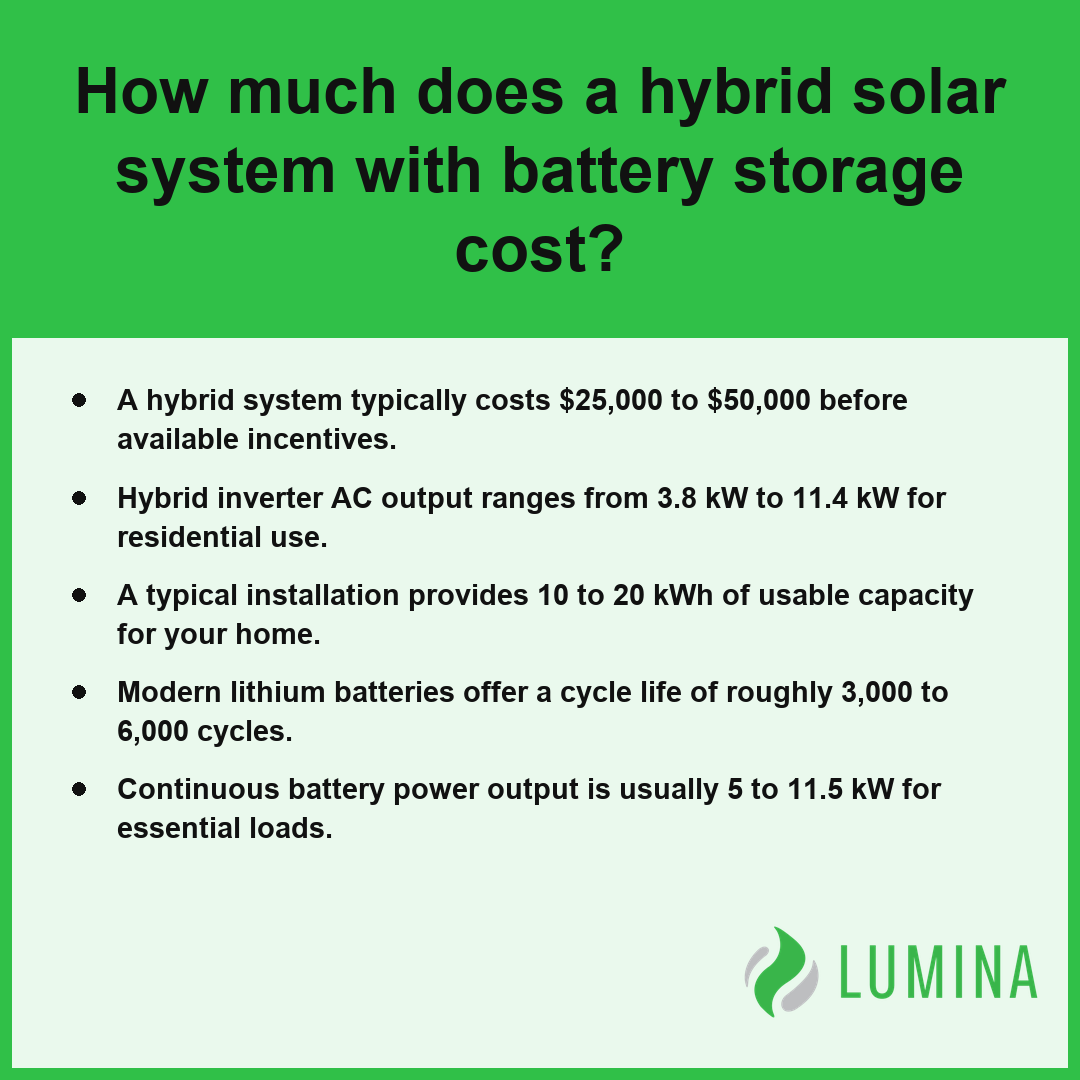
- A hybrid system typically costs $25,000 to $50,000 before available incentives.
- Hybrid inverter AC output ranges from 3.8 kW to 11.4 kW for residential use.
- A typical installation provides 10 to 20 kWh of usable capacity for your home.
- Modern lithium batteries offer a cycle life of roughly 3,000 to 6,000 cycles.
- Continuous battery power output is usually 5 to 11.5 kW for essential loads.
What Does a Hybrid System with Battery Storage Cost?
The cost of a hybrid system with battery storage typically ranges from $25,000 to $50,000 before incentives for a 6-10 kW solar array paired with 10-20 kWh of usable capacity. This investment covers the primary hardware, installation labor, and the integration of your solar array with the battery bank and grid connection. Per the National Renewable Energy Laboratory, the total installed cost for a residential solar-plus-storage system typically ranges between $2.50 and $3.50 per watt of solar capacity, depending heavily on battery chemistry and storage capacity sizing.
Cost Range by Component ($)
| Component | Estimated Cost Range |
|---|---|
| Complete hybrid system (6-10 kW array + 10-20 kWh battery) | $25,000 – $50,000 |
| Battery bank only (installed) | $9,000 – $18,000 |
| Hybrid inverter (unit cost range) | Variable based on capacity |
While the total project cost fluctuates based on the scale of your solar array and the complexity of your electrical integration, the battery bank remains the most significant variable cost. Most modern lithium iron phosphate installations are designed for a cycle life of roughly 3,000 to 6,000 cycles, providing a long-term return on your initial capital expenditure. When assessing these price points, evaluate the specific warranty throughput guarantees to ensure your chosen hardware matches your expected frequency of daily use.
Consider these additional factors that influence the final investment price of your installation:- Permitting and Inspection Fees: Local government charges for electrical and building permits can add $500 to $2,500 to the total.
- Main Panel Upgrades: Older homes may require a service panel upgrade or sub-panel installation to safely accommodate hybrid integration.
- Structural Reinforcement: Roof inspections may necessitate structural work to ensure the mounting system can support the additional weight of the panels.
- Distance and Labor: Increased wiring runs between the solar array, battery storage, and the main service entrance can significantly drive up electrical labor costs.
Choosing the Right Hybrid Inverter Size for Your Hybrid System
Choosing the right hybrid inverter size for your hybrid system involves balancing the total power output of your solar array with the continuous power needs of your household appliances. Because residential hybrid inverter AC output typically ranges from 3.8 kW to 11.4 kW, you must select a unit that can handle the maximum wattage produced by your panels while simultaneously managing the charge and discharge demands of your battery bank. If you undersize the inverter, you risk clipping your solar production during peak sunlight; if you oversize it, you may pay for electrical capacity you never actually utilize.
| Residence Size | Recommended Inverter Capacity | Primary Usage Context |
|---|---|---|
| Small Households | 3.8 kW – 5.0 kW | Minimal electrical loads and modest solar array configurations. |
| Standard Homes | 6.0 kW – 8.0 kW | Average appliance concurrency and moderate solar production. |
| Large Residences | 9.0 kW – 11.4 kW | High-output solar arrays and heavy concurrent power demand. |
Typical Hybrid Inverter Power Ranges (kW)
- 3.8 kW to 5.0 kW: Suitable for small households with minimal electrical loads or modest solar arrays.
- 6.0 kW to 8.0 kW: Ideal for standard family homes balancing average appliance usage and moderate solar production.
- 9.0 kW to 11.4 kW: Required for large residences with high solar output and heavy concurrent electrical demand.
You should also determine whether your installation will be DC-coupled or AC-coupled, as this dictates how the inverter manages power flow. A DC-coupled setup generally offers higher efficiency for new installations by converting panel energy directly to charge the battery bank, whereas an AC-coupled setup provides flexibility if you are adding storage to an existing solar array. Always verify that your chosen inverter’s continuous power rating matches or exceeds the combined wattage of the specific circuits identified for your backup loads panel.
Calculate your peak simultaneous load by adding up the wattage of every appliance you intend to run during a grid outage to ensure your inverter rating is sufficient. Per the Department of Energy, proper sizing of a hybrid system essentially requires an assessment of total household peak load demand to ensure the inverter capacity can support essential circuits during an off-grid transition or power outage.
To ensure optimal performance and longevity for your hybrid system, consider these additional technical factors:- Verify the inverter’s peak power rating (surge capacity) to ensure it can handle the temporary high starting currents of motors in appliances like refrigerators and HVAC systems.
- Check the battery voltage compatibility to confirm the inverter can effectively communicate and manage the charge cycles of your specific battery chemistry.
- Assess the DC-to-AC ratio, ensuring your solar array size does not exceed the manufacturer’s recommended limit for the inverter’s maximum input voltage.
- Ensure the unit features rapid shutdown capabilities to comply with local electrical codes and fire safety standards.
How Many kWh of Battery Capacity Your Hybrid System Needs
The number of kWh of battery capacity your hybrid system needs depends primarily on your intended balance between daily self-consumption and your requirement for backup power during outages. Most residential installations typically feature 10 to 20 kWh of usable capacity, which allows you to store excess energy from your solar array during the day to power your home through the evening. While the size of your battery bank directly influences how long you can sustain essential appliances, you must weigh this against the financial investment, as the battery alone often represents an installed cost of $9,000 to $18,000.
| System Tier | Usable Capacity | Primary Use Case | Backup Resilience |
|---|---|---|---|
| Small | 10 kWh | Time-of-Use rate optimization | Minimal (Short-term critical loads) |
| Mid-Range | 15 kWh | Evening self-consumption | Moderate (Standard power disruptions) |
| Large | 20 kWh | High-demand or off-grid usage | High (Extended outage support) |
Typical Battery Capacity Options (kWh)
- 10 kWh capacity: Ideal for smaller homes or users focused mainly on time-of-use shifting to avoid peak utility rates.
- 15 kWh capacity: Provides a versatile middle ground, offering enough energy to cover typical nighttime consumption and a solid buffer for short grid disruptions.
- 20 kWh capacity: Recommended if you have high nocturnal energy demands or reside in an area prone to extended outages where you require significant runtime for essential loads.
- Modular expansion: Since lithium iron phosphate units are stackable, you can start with a smaller capacity and increase your storage volume later as your needs evolve.
Analyze your most recent electricity bills to identify your nightly kilowatt-hour usage patterns to ensure your selected battery bank volume aligns with your actual consumption habits. To put these needs in perspective, the U.S. Energy Information Administration reports that the average annual electricity consumption for a typical U.S. residential utility customer is approximately 10,500 kilowatt-hours, which averages to about 29 kilowatt-hours per day.
Consider these additional factors when finalizing your battery capacity requirements:- Evaluate the startup surge wattage of heavy appliances like well pumps or HVAC units to ensure the inverter can handle the load.
- Check local utility interconnection agreements, as some regions limit the maximum energy storage capacity allowed for residential systems.
- Account for round-trip efficiency losses, which typically reduce the amount of stored energy actually available for use by 5–10%.
- Assess the physical space and temperature-controlled environment required for the battery installation to ensure optimal hardware longevity.
How Many Appliances Can a Hybrid System Run at Once During an Outage?
A hybrid system can run a limited number of appliances at once during an outage, typically restricted by the continuous power output of the battery bank and the hybrid inverter. Because these devices have fixed physical constraints, you must manage your electricity usage carefully to avoid overloading the system, which can trigger an automatic shutdown.
| Operational Metric | Technical Capacity Range | Functional Role During Outage |
|---|---|---|
| Continuous Power Output | 5.0 kW – 11.5 kW | Maintains steady-state operation for simultaneous loads |
| Inverter AC Output | 3.8 kW – 11.4 kW | Governs the total electronic throughput threshold |
| Surge Capacity | Variable (Momentary) | Provides initial power spikes for motor-driven appliances |
| Battery Storage | 10 kWh – 15 kWh | Determines the total duration of energy availability |
Continuous Power Output Range (kW)
What Limits the Number of Appliances You Can Run?
Continuous Output Versus Surge Output
The primary constraint is the continuous power rating, which ranges from 5 to 11.5 kW for most battery banks. Per Underwriters Laboratories, hybrid system inverters are tested specifically to determine the maximum combined wattage of appliances that can operate simultaneously before the equipment initiates a safety shutdown. If you attempt to power too many high-draw devices simultaneously, the hybrid system will reach its threshold. Beyond continuous limits, appliances with motors—such as refrigerators or air conditioners—require a temporary, higher surge current to start.
- Continuous power: The steady limit (5–11.5 kW) for simultaneous device operation.
- Surge power: The momentary, elevated capacity needed to start motor-based appliances.
- Inverter capacity: The hybrid inverter’s 3.8 to 11.4 kW AC output limit.
How Long Can the Battery Bank Keep Essential Loads Running?
When operating on stored energy during a grid failure, a 10–15 kWh battery typically provides enough power to keep essential loads running for about 12 to 24 hours. This duration depends entirely on your specific consumption rate and the number of appliances active at any given moment.
Which Loads Belong on the Backup Loads Panel
To ensure your hybrid system functions effectively, you must designate specific circuits for the backup loads panel. Prioritizing these circuits prevents non-essential, high-consumption devices from draining your reserve capacity too quickly.
- Refrigerator and freezer circuits to prevent food spoilage.
- Lighting circuits for visibility in key living areas.
- Internet modem and router for basic communication.
- Selected outlets for charging personal electronics.
Review the nameplate ratings on your major household appliances to compare their total potential draw against the continuous output limit of your installed equipment.
To optimize your system’s performance during an outage, consider these strategies for managing electrical loads:- Prioritize essential circuits to ensure critical medical or safety equipment remains powered first.
- Stagger the start times of high-draw appliances to prevent simultaneous startup currents from triggering a surge shutdown.
- Monitor real-time consumption through your inverter’s mobile application to identify which devices push the system toward its threshold.
- Utilize smart plugs or programmable timers to automate the cycling of non-essential loads.
- Calculate the total wattage of all active appliances to keep the combined draw comfortably below the 5.0 kW minimum output rating.
Why a Hybrid System Keeps Your Power On When Grid-Tied Solar Shuts Down
A hybrid system keeps your power on when a grid-tied system shuts down because it is engineered to disconnect from the utility grid automatically during a disturbance, a process known as islanding. While a grid-tied system lacks the physical components to manage power without a reference signal from the utility, a hybrid system uses its internal hybrid inverter and battery bank to serve as a local voltage source. Once the sensors detect a grid failure, the system performs a rapid transition to prevent back-feeding the grid and immediately draws energy from the battery to maintain electricity for your backup loads panel.
| Operational Attribute | Grid-Tied System | Hybrid Solar System |
|---|---|---|
| Grid Dependency | Requires external grid reference signal | Generates local AC voltage source |
| Response to Blackout | Mandatory total shutdown | Automatic islanding transition |
| Safety Mechanism | Prevents line-worker electrocution via disconnect | Prevents back-feeding via internal isolation |
| Energy Storage | None (No buffer capability) | Battery-backed (DC or AC coupled) |
| Load Management | System-wide power loss | Targeted backup loads panel support |
The technical differences between these setups define their behavior during a blackout:
- Grid-tied systems lack a battery bank, meaning they have nowhere to store or draw power when the grid is offline.
- Grid-tied systems are mandated to shut down during outages to protect utility workers from accidental electrocution by exported power. Per the U.S. Department of Energy, grid-tied solar systems are legally and technically required to disconnect from the electrical grid during a power outage to prevent back-feeding electricity that could endanger utility line workers.
- Hybrid systems achieve islanding within a fraction of a second to a few seconds, maintaining a stable AC waveform independently.
- Hybrid systems utilize DC-coupled or AC-coupled battery architecture to prioritize essential household circuits while the grid remains unavailable.
Verify that your backup loads panel is physically wired to isolate the essential circuits you need to keep active during an islanding event.
Consider these additional distinctions regarding how these systems interact with your home’s energy infrastructure:- Grid-tied inverters typically utilize MPPT (Maximum Power Point Tracking) that synchronizes exclusively with the grid’s frequency, whereas hybrid inverters support grid-forming capabilities to stabilize local micro-grids.
- Hybrid systems often support “peak shaving” to lower utility demand charges, a feature not possible with standard grid-tied setups due to the lack of energy buffers.
- Retrofitting a grid-tied system for blackout protection often necessitates adding an external automatic transfer switch (ATS), while hybrid systems feature integrated transfer relays within the inverter chassis.
Frequently Asked Questions
What parts make up a hybrid system for solar panels?
A hybrid system consists of a solar array, a hybrid inverter, a battery bank, a backup loads panel, and a monitoring system. This configuration stays connected to the utility grid, allowing you to manage solar energy production, battery storage, and grid interaction within one integrated unit.
Should a hybrid solar system be DC-coupled or AC-coupled?
You should choose DC-coupled systems for new installations because they avoid extra energy conversions for higher efficiency, whereas AC-coupled systems are better for retrofitting a battery bank to an existing solar array. Both methods allow you to effectively manage energy flow between your solar panels, battery, and home.
What is the difference between self-consumption, backup, and time-of-use modes in a hybrid solar system?
These modes manage energy differently: self-consumption stores midday surplus for evening use, backup maintains a reserve for grid outages, and time-of-use shifting discharges power during costly peak-rate hours. You can program your hybrid inverter to prioritize these specific functions based on your local utility rates and reliability needs.
How long does a hybrid solar system battery last and what does the warranty cover?
Modern lithium batteries typically last for 3,000 to 6,000 cycles, suggesting 10 to 15 years of daily use. Warranties generally run for 10 years, often guaranteeing 60 to 70 percent of original remaining capacity or a specific throughput in megawatt-hours over that period.
What are the limitations of a hybrid solar system, such as cold weather, cloudy days, and installation placement?
Limitations of a hybrid system include finite backup capacity, as a 10 to 15 kWh battery typically lasts about 12 to 24 hours during outages. Additionally, continuous power output is restricted to 5 to 11.5 kW, meaning you cannot run all heavy household appliances simultaneously during a grid failure.