
Investment Tax Credit (ITC): Eligible Costs, Expiration, Claim Process, Ownership Requirement, Property Type, Commercial Adders, Documentation

Everything you need to know about “investment tax credit (itc)”: expiration, eligible costs, ownership requirement, claim process, commercial adders, property type, and documentation. The credit is calculated as a percentage of qualifying project costs and is claimed on your federal income tax return for the year the system is placed in service. Within solar panels Maryland residential projects, it is one of the largest financial incentives tied to the upfront price of a system. Rules about when the credit ends, which costs count, and who must own the system determine how much you can claim. This article explains the expiration schedule, the eligible costs, and the ownership requirement in turn.
Key Takeaways
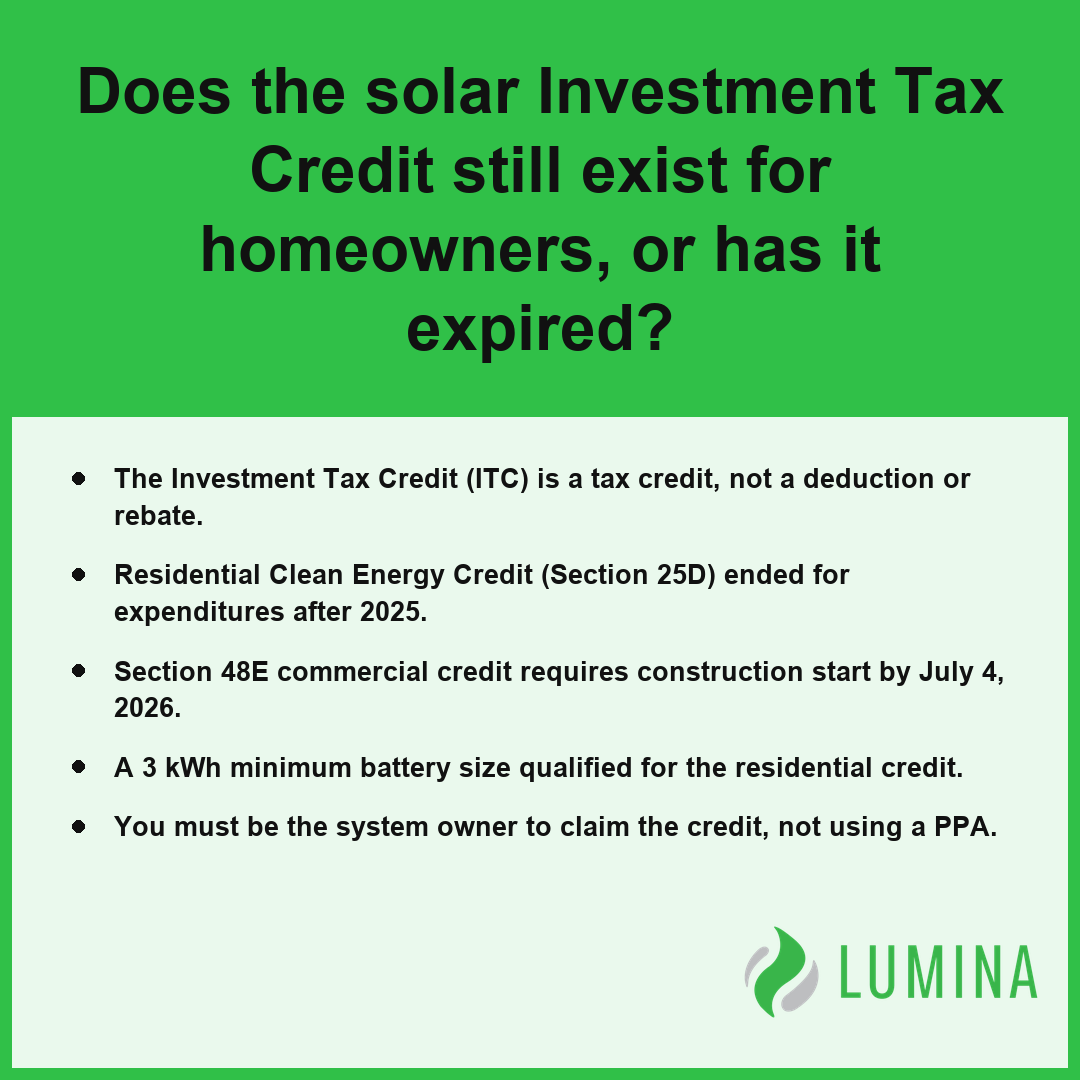
- The Investment Tax Credit (ITC) is a tax credit, not a deduction or rebate.
- Residential Clean Energy Credit (Section 25D) ended for expenditures after 2025.
- Section 48E commercial credit requires construction start by July 4, 2026.
- A 3 kWh minimum battery size qualified for the residential credit.
- You must be the system owner to claim the credit, not using a PPA.
Does the Solar Investment Tax Credit (ITC) Still Exist for Homeowners, or Has It Expired?
The Investment Tax Credit (ITC) for residential solar installations has expired for new expenditures made after December 31, 2025. While homeowners who had their systems placed in service between 2022 and 2025 were eligible for a 30% tax credit, the Residential Clean Energy Credit (Section 25D) no longer provides a benefit for projects installed after that cutoff date.
| Qualifying Expenditure Category | Inclusion Status (Pre-2026) | Financial Impact |
|---|---|---|
| Hardware (Panels, Inverters, Mounting) | Eligible | 30% of total cost |
| Installation Labor & Site Prep | Eligible | 30% of total cost |
| Permitting & Sales Tax | Eligible | 30% of total cost |
| Battery Storage (≥ 3 kWh) | Eligible | 30% of total cost |
| Any Expenditures After Dec 31, 2025 | Ineligible | 0% (Credit Expired) |
Solar System Investment vs. Tax Credit (Estimated)
What the Residential Clean Energy Credit (Section 25D) Covered
This credit applied to the total cost of your solar system. For a typical 7 kW residential system costing between $17,500 and $24,500, the 30% credit provided significant financial relief. For instance, a $24,000 system generated a $7,200 credit. Per Internal Revenue Service, qualifying solar electric property expenditures generally include the costs associated with solar panels, labor for onsite preparation, assembly, and original installation. Qualifying components included:
- Solar panels, inverters, and associated hardware
- Labor costs for site preparation and assembly
- Permitting fees and applicable sales taxes
- Battery storage units with a capacity of at least 3 kWh
Did Any Expenditures Qualify After the Cutoff Date?
No, expenditures made after December 31, 2025, do not qualify for the residential Investment Tax Credit (ITC). The program was strictly tied to the date the system was placed in service or the expense was incurred. Because the credit is nonrefundable, it can only reduce your federal tax liability to zero, and you cannot receive the remainder as a direct payment.
How a Carryforward Applied to Unused Credit Amounts
If your calculated credit exceeded your total federal income tax owed for the year the system was placed in service, you were permitted to apply the excess to future tax years. This carryforward mechanism allowed you to use the remaining balance until the total credit amount was exhausted, provided the original system purchase met all legal requirements during the active period of the credit.
Reporting the Credit on IRS Form 5695
You claimed this credit by filing IRS Form 5695 with your annual federal income tax return. You were required to calculate your eligible costs and enter the resulting tax credit amount on the form, which then transferred the final figure to your main tax filing document.
Review your historical tax records to ensure that any remaining carryforward balances from systems placed in service prior to the expiration date are correctly tracked for your current filing.
To qualify for the Residential Clean Energy Credit, taxpayers were required to meet specific Internal Revenue Service guidelines:- The solar system must have been installed on a primary or secondary residence located in the United States.
- The equipment must have been new and placed in service during the valid tax year.
- The property owner must have had sufficient tax liability to claim the non-refundable credit, with the ability to carry forward excess amounts to future years.
- The system must be intended for power generation for the residence rather than for commercial resale purposes.
Section 48E Commercial Credit Deadlines and What Beginning Construction Means
Section 48E commercial credit deadlines require that you either begin construction of your project by July 4, 2026, or place the system in service by the end of 2027 to remain eligible for the Investment Tax Credit (ITC). Per Congressional Research Service, this clean electricity investment credit is available for qualified facilities placed in service after the transition from Section 48, with eligibility periods primarily determined by greenhouse gas emission levels and the commencement of construction activities. Beginning construction is a specific legal standard defined by the Treasury, requiring you to show either that physical work of a significant nature has started at the project site or that you have paid or incurred at least 5% of the total system cost. Once this threshold is met, you must maintain a continuous program of construction to satisfy the requirements for claiming the credit.
| Compliance Category | Regulatory Requirement / Deadline | Documentation Evidence Required |
|---|---|---|
| Begin Construction (Physical) | July 4, 2026 | On-site construction logs, excavation records, or equipment installation photos |
| Begin Construction (Financial) | 5% of Total System Cost | Invoices, proof of payment, and binding procurement contracts |
| Placed in Service | December 31, 2027 | Operational certification and grid interconnection documentation |
| Continuous Progress | Post-threshold maintenance | Active contract milestones and project development progress reports |
Section 48E Key Regulatory Milestones
To verify your project meets these timelines, you must track the following milestones and documentation as part of your application for the Investment Tax Credit (ITC):
- Physical work commencement: On-site construction, excavation, or installation of equipment components.
- Financial expenditure: Proof of payments totaling at least 5% of the total project costs, excluding land and preliminary planning.
- Continuous progress: Documentation proving you have not experienced delays in project development, such as active contracts or procurement records.
- Placed in service status: The date your system is fully commissioned and capable of generating power for its intended purpose.
Review your binding equipment purchase agreements to confirm that delivery dates align with the necessary progress requirements to secure your status under the commercial credit rules.
To ensure your project remains eligible for the Section 48E credit, follow these administrative best practices:- Retain all records and documentation for at least six years after the tax return filing date to satisfy potential IRS audits.
- Consult with a qualified tax professional to verify that your specific technology qualifies as a zero-greenhouse gas emission facility.
- Establish a dedicated digital repository for project milestones to ensure a clear audit trail of the continuous construction requirement.
- Review all vendor contracts to confirm that procurement terms align with the “incurred costs” definition under current Treasury guidance.
Which Solar Costs Qualified for the Investment Tax Credit (ITC)
The costs that qualified for the Investment Tax Credit (ITC) encompassed the full capital expenditure required to install and integrate a functional solar energy system on a residential property. Because the credit was calculated as a percentage of your total project cost, identifying which specific items were eligible allowed for an accurate calculation of your potential tax savings. For a typical 7 kW residential system costing between $17,500 and $24,500, including all qualifying components ensured that the resulting credit—such as the $7,200 credit generated by a $24,000 system—was maximized based on the allowable 30% rate.
| Expense Category | Inclusion Status | Contextual Application |
|---|---|---|
| Photovoltaic Hardware | Fully Eligible | Panels, cells, and DC-to-AC inverters |
| Structural Infrastructure | Fully Eligible | Mounting, racking, and reinforcements |
| Electrical Integration | Fully Eligible | Wiring, safety disconnects, and utility interconnection |
| Professional Services | Fully Eligible | Labor, site preparation, and assembly |
| Administrative & Compliance | Fully Eligible | Permitting, inspection, and related sales taxes |
| Energy Storage | Conditional Eligibility | Battery units (min. 3 kWh capacity) charged by the array |
Estimated Solar Project Costs and Resulting ITC
- Solar photovoltaic panels and integrated cell technology.
- Inverters designed to convert direct current to alternating current for home use.
- Mounting hardware, racking systems, and structural reinforcements required to support the panel array.
- Wiring, disconnects, and safety equipment necessary for electrical interconnection.
- Labor costs for on-site preparation, assembly, and system installation.
- Permitting fees, inspection costs, and system-related sales taxes.
- Battery storage units with a capacity of at least 3 kWh.
Per the Department of Energy, qualifying expenses also include the costs of energy storage devices, such as battery backup systems, provided they are charged primarily by the associated solar array. Review your final invoice and itemized project agreement to ensure that all secondary expenses, such as permitting or specific racking components, are clearly distinguished from non-qualifying home improvements like roof repairs or electrical panel upgrades that were already required for the home’s general utility.
To ensure you maintain accurate documentation for your tax filings, consider these essential record-keeping practices:- Retain the final itemized invoice from your solar installer that clearly separates equipment costs from service fees.
- Keep a copy of the building permit and the local government’s final inspection certificate to verify the system’s operational date.
- Maintain a record of the manufacturer’s specifications for your battery storage unit to confirm it meets the minimum 3 kWh capacity requirement.
- Store digital or physical copies of all payment receipts and bank statements as proof of the actual capital expenditure made during the tax year.
Battery Storage and the Investment Tax Credit (ITC): What Size Qualified
Battery storage and the Investment Tax Credit (ITC) qualification is determined by a minimum capacity requirement of 3 kWh per installed unit. Under the Residential Clean Energy Credit (Section 25D), a standalone battery or a battery integrated into a solar array qualifies for the tax credit if it meets this size threshold and is charged by a renewable energy source. Per the Internal Revenue Service, these standalone storage systems qualify for the credit provided they are charged by renewable energy sources at least 75 percent of the time. Because the credit is nonrefundable, you can utilize the carryforward provision if your tax liability is lower than the calculated credit amount, allowing you to apply the remaining balance to future tax years.
| Qualification Metric | Regulatory Requirement | Applicability Notes |
|---|---|---|
| Capacity Threshold | Minimum 3 kWh per unit | Check installer specification sheets for rated capacity |
| Energy Source | 75% Renewable Charging | Must be charged by renewable energy to qualify |
| Credit Status | Nonrefundable | Applied strictly against federal income tax liability |
| Future Utilization | Carryforward Provision | Excess credit balance rolls over to future tax years |
Battery Tax Credit Qualification Metrics
When calculating your eligibility for the Investment Tax Credit (ITC) regarding storage, consider how the following criteria impact your claim:
- Minimum capacity: 3 kWh per battery unit
- System configuration: Must be charged by renewable energy sources
- Tax application: Nonrefundable credit applies against federal income tax liability
- Carryforward: Unused portions may be applied to subsequent tax years
Verify the technical specification sheets provided by your installer to confirm the rated capacity of your battery unit matches the minimum requirements before filing your return.
To ensure your storage system is properly documented for tax filing, follow these procedural steps:- Obtain a detailed receipt or invoice from your installer confirming the specific kWh capacity of the unit.
- Request a written certification or performance statement from the installer verifying the system is configured to prioritize renewable charging.
- Retain documentation of your solar array’s production versus the battery’s energy throughput to support the 75% renewable usage requirement.
- Consult IRS Form 5698, Residential Energy Credits, to calculate the specific credit amount based on your total system installation costs.
Can You Claim the Investment Tax Credit (ITC) If You Lease Panels or Use a Power Purchase Agreement (PPA)?
No, you cannot claim the Investment Tax Credit (ITC) if you lease panels or use a power purchase agreement (PPA), because the legal requirement for this incentive is that you must be the system owner. Under the Residential Clean Energy Credit (Section 25D), the tax credit is exclusively reserved for the entity that purchases and owns the solar hardware. Per the Department of Energy, in a lease or power purchase agreement model, the third-party system owner—rather than the host site occupant—is the entity entitled to claim the federal tax credit. When you enter into a lease or a power purchase agreement (PPA), the third-party provider acts as the system owner and retains the right to claim the credit.
The following table clarifies the distinctions between ownership structures regarding federal incentives:
| Ownership Status | Eligibility for Credit | Primary Benefit Structure |
|---|---|---|
| Outright System Owner | Eligible to claim the Investment Tax Credit (ITC) | Direct tax liability reduction |
| Lease/PPA Participant | Ineligible for the credit | Reduced monthly utility rates |
Third-party owners often use the tax credit to lower their own costs, which they may then pass along to you in the form of more competitive pricing for the electricity generated by the system. Because the credit is nonrefundable and specifically tied to the tax liability of the system owner, these arrangements shift the financial benefit away from you and toward the service provider.
Review the specific language in your service contract to determine if the provider explicitly includes the value of the tax credit in their pricing model.
Before signing a solar agreement, consider these factors to understand how ownership impacts your financial obligations:- Verify if your contract includes an “escalator clause” that increases your monthly payments over the term of the agreement.
- Determine whether the contract includes a buyout option that allows you to purchase the system after a specific number of years.
- Assess how the presence of a third-party owned system might affect your ability to sell your home or transfer the contract to a new buyer.
- Confirm if the service provider is responsible for all maintenance, repairs, and insurance costs throughout the duration of the agreement.
Frequently Asked Questions
How do I claim the solar Investment Tax Credit on IRS Form 5695, and when will I get the money?
You claim the Investment Tax Credit (ITC) by filing IRS Form 5695 with your tax return to reduce your tax liability directly. Because this is a tax credit and not a refund, you will not receive a check; it lowers your tax bill to zero and allows any remaining amount to carryforward.
Does the solar Investment Tax Credit apply to rental properties and second homes?
Yes, the Investment Tax Credit (ITC) applies to second homes under the Residential Clean Energy Credit (Section 25D), while rental properties qualify under the Section 48E commercial credit. You must be the system owner to claim the credit, as leased systems or those under a power purchase agreement (PPA) do not qualify.
How do the solar Investment Tax Credit base rate, prevailing wage rules, and domestic content or energy community adders work for businesses?
The Section 48E commercial credit features a 6% base rate that increases to 30% when projects meet prevailing wage and apprenticeship requirements. Businesses must ensure construction begins by July 4, 2026, or the project is placed in service by the end of 2027 to remain eligible for these tax credit incentives.
What records do I need to keep to prove my solar Investment Tax Credit claim and placed-in-service date?
You should maintain receipts for all eligible costs, including solar panels, inverters, racking, labor, and permitting fees to document your Investment Tax Credit (ITC) claim. Keep records confirming the system was placed in service, such as installation contracts or utility interconnection documents, to verify your eligibility for the tax credit.
How does the solar Investment Tax Credit reduce depreciable basis for a commercial system?
A commercial system reduces its depreciable basis by half of the credit amount received, which equals a 15% reduction when claiming a 30% credit. This adjustment is a mandatory step for any business using the Section 48E commercial credit to ensure compliance with the federal investment tax credit (itc).