
Lithium-Ion Battery: Capacity, Chemistry, Lifespan, Cost, Warranty, Power Rating, Safety, Coupling Type, Operating Temperature, Efficiency
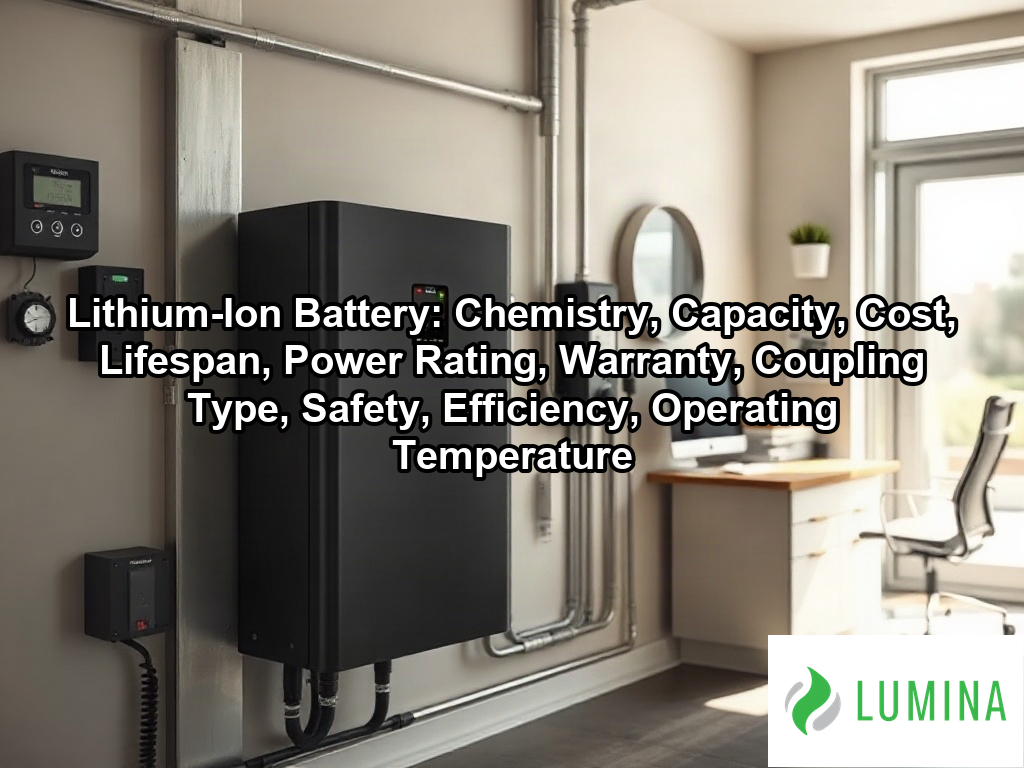
A lithium-ion battery is a rechargeable energy storage device that moves lithium ions between electrodes to store and release electricity. Key aspects include chemistry, capacity, cost, lifespan, power rating, warranty, coupling type, safety, efficiency, and operating temperature. In a solar energy system, this battery stores surplus electricity that your panels produce during the day so you can use it in the evening or during outages. Its chemistry, most often lithium iron phosphate or nickel manganese cobalt, shapes its safety, energy density and number of charge cycles. Capacity, measured in kilowatt-hours, tells you how much energy it holds, while power rating, measured in kilowatts, tells you how much it can deliver at once. Solar panel installers in Delaware typically size these figures around household usage, local utility rules and available roof space. The sections below explain chemistry, capacity, power rating, cost and lifespan in turn.
Key Takeaways
- A lithium-ion battery costs $10,000 to $20,000 for one installed unit.
- Installed costs range from $800 to $1,500 per kWh of usable capacity.
- LFP chemistries offer a cycle life of 3,000 to 8,000 cycles.
- Most systems provide 3 to 11.5 kW of continuous power output.
- You typically receive a 10 years warranty with your home storage unit.
How Many kWh of Lithium-Ion Battery Storage Do You Need for Your Solar Panel System?
The number of kWh of lithium-ion battery storage you need for your solar panel system depends primarily on your daily energy consumption patterns and whether you intend to rely on your stored energy for essential loads during grid outages or for daily self-consumption. According to the Department of Energy, the average United States household consumes approximately 29 kilowatt-hours of electricity per day, which provides a helpful baseline for sizing your system. Because of this typical consumption, a single lithium-ion battery unit with a common usable capacity of 10 to 13.5 kWh typically covers essential loads for 8 to 24 hours rather than powering an entire home for multiple days. To determine your specific requirement, you must evaluate the difference between the electricity generated by your solar panels and your total household usage during non-daylight hours.
Estimated Daily Energy Needs for Different Use Cases (kWh)
| System Goal | Typical Storage Range |
|---|---|
| Essential backup for critical circuits | 10 to 15 kWh |
| Moderate self-consumption and evening use | 20 to 30 kWh |
| Off-grid or heavy load autonomy | 40 kWh or more |
When calculating your needs, keep in mind that the battery management system will enforce a specific depth of discharge to protect the cells, meaning you should size your system based on the usable capacity rather than the total capacity listed by the manufacturer. You must also account for round-trip efficiency of 90% to 96% for AC-coupled systems, as this ensures you size your battery storage large enough to compensate for the 4% to 10% of energy lost as heat during the conversion process.
Review your utility bills to identify the exact number of kWh consumed during your peak evening hours to ensure your storage capacity matches your nighttime demand.
To refine your storage system planning, consider these additional technical factors:- Assess the peak surge power requirements of your appliances, such as HVAC compressors or well pumps, to ensure the inverter can handle starting loads.
- Evaluate the round-trip efficiency of the battery chemistry to account for energy lost as heat during the charge and discharge cycle.
- Review the warranty terms regarding cycle life, as frequent daily discharging will deplete the battery’s chemical capacity faster than emergency-only use.
- Verify local building codes and fire safety regulations, which may dictate specific installation clearances or outdoor-only placement for certain lithium-ion chemistries.
What Does a Lithium-Ion Solar Battery Cost Installed per kWh?
The installed cost of a lithium-ion battery for your solar panels typically ranges from $10,000 to $20,000 for a single unit, which translates to $800 to $1,500 per kWh of usable capacity. According to the National Renewable Energy Laboratory, installed costs for residential battery storage systems in the United States typically range between $1,000 and $1,500 per kilowatt-hour of capacity depending on system size and technology. This pricing reflects the total investment required to integrate the storage system, covering not just the battery pack itself, but also the essential hardware, site preparation, and professional labor required for a safe and compliant installation. While the internal components of a lithium-ion battery—specifically the cells—are significantly cheaper, costing roughly $100 to $150 per kWh, the final price you pay includes the integrated battery management system, thermal management, enclosure, and electrical components needed for grid-connected home operation.
| Cost Component | Estimated Contribution to Total Price | Description of Requirement |
|---|---|---|
| Battery Raw Materials | ~$150 per kWh | Base cost of internal lithium-ion cells only. |
| Integrated Balance of System | ~$650 – $1,350 per kWh | Battery management, thermal housing, inverters, and electrical components. |
| Soft Costs & Installation | ~$200 – $350 per kWh | Professional labor, site preparation, electrical configuration, and permitting. |
| Total Installed Market Price | $1,000 – $1,500 per kWh | Final turnkey cost for a grid-connected residential system. |
Cost Per kWh: Battery Components vs. Installed System
- Hardware Costs: Includes the battery modules, mounting brackets, and critical electrical components like the inverter if not already present.
- Installation Labor: Covers the time required for mounting, wiring, and configuring the system with your existing electrical panel.
- Permitting and Inspections: Accounts for the regulatory filings and safety checks necessary for residential energy storage systems.
- System Commissioning: Involves the technical setup and programming of the battery management system to ensure compatibility with your solar panels and local grid rules.
Compare the warranty throughput limits against the quoted installation price to determine the actual cost of each kilowatt-hour of energy you expect to store over the life of the system.
Several factors beyond physical hardware can influence the final project quote you receive from an installer:- Local utility incentive programs or state-level rebates that can reduce the net out-of-pocket expense.
- The complexity of your existing electrical panel, which may require upgrades to accommodate battery integration.
- Geographic location, as labor rates and permitting fees vary significantly by municipality.
- System warranty coverage and long-term service agreements included in the installation package.
- Potential federal tax credits, such as the Investment Tax Credit (ITC), which may offset a percentage of the total installation cost.
LFP vs. NMC Lithium-Ion Batteries for Home Solar Panels
When choosing a lithium-ion battery for your solar panels, you should weigh the superior cycle life and thermal stability of lithium iron phosphate (LFP) against the higher energy density of nickel manganese cobalt (NMC) to determine which technology best suits your home energy storage needs.
| Performance Metric | Lithium Iron Phosphate (LFP) | Nickel Manganese Cobalt (NMC) |
|---|---|---|
| Primary Advantage | Longevity & Thermal Stability | High Energy Density |
| Cycle Life Expectancy | 3,000 – 8,000 Cycles | Generally Lower |
| Nominal Cell Voltage | 3.2 V | Higher |
| Thermal Runaway Risk | Lower (Inherently Stable) | Higher (Requires Mitigation) |
| Best Installation Context | Indoor / Enclosed Spaces | Space-Constrained Areas |
Typical Cycle Life of LFP Batteries
How Lithium Iron Phosphate (LFP) Performs in Home Storage
Lithium iron phosphate (LFP) is a type of lithium-ion battery chemistry widely favored for home solar panels due to its longevity and reliability. These units typically provide 3,000 to 8,000 cycles before significant degradation, making them an ideal choice for daily cycling applications. The chemistry is noted for its lower nominal cell voltage of 3.2 V, contributing to a robust architecture that handles high-demand usage without excessive wear.
Safety and Thermal Runaway Risk by Chemistry
LFP chemistry is recognized for superior thermal stability compared to other compositions, which significantly lowers the risk of thermal runaway during operation. Underwriters Laboratories reports that safety standards for residential battery systems mandate rigorous testing for thermal runaway propagation, a metric where LFP chemistries generally exhibit lower risk profiles than high-nickel NMC cells. Because the phosphate-based cathode structure is inherently more stable under heat, these units are often preferred for indoor or enclosed installations.
How Nickel Manganese Cobalt (NMC) Performs in Home Storage
Nickel manganese cobalt (NMC) is a lithium-ion battery chemistry that prioritizes energy density over cycle life. With a nominal cell voltage between 3.6 V and 3.7 V, NMC packs offer a more compact physical footprint for the same amount of stored energy. While efficient, these units typically last 1,000 to 4,000 cycles, requiring more careful management to maintain capacity over a 10-year warranty period.
- LFP: 3,000–8,000 cycle life, higher thermal stability, 90–160 Wh/kg energy density.
- NMC: 1,000–4,000 cycle life, higher energy density (150–260 Wh/kg), faster capacity fade under heat.
Which Chemistry Fits Your Home Best?
Selecting the right chemistry depends on your available space and daily usage patterns. If you prioritize long-term durability and safety for frequent cycling, LFP is generally the superior choice. If you have limited physical space for the installation, the higher energy density of an NMC lithium-ion battery may be more practical.
Compare the total space constraints of your installation site against the cycle life requirements of your household energy habits before selecting a product.
Consider the following practical factors when determining the right battery chemistry for your residential solar installation:- Weight considerations: NMC batteries are generally lighter, making them easier to mount on walls or in attic spaces where structural load is a concern.
- Charging efficiency: LFP batteries maintain higher round-trip efficiency during low-current charging, which is common in trickle-charging scenarios from solar arrays.
- Environmental tolerance: LFP chemistry is more resilient to extreme ambient temperatures, reducing the need for active cooling systems in outdoor cabinets.
- Depth of Discharge (DoD): LFP units can frequently be discharged to near-zero capacity with minimal risk of permanent cell damage compared to older NMC variants.
Can a Lithium-Ion Solar Battery Run Your Air Conditioner and Well Pump at the Same Time?
Yes, a lithium-ion battery can run your air conditioner and well pump at the same time, provided your system’s power rating is sufficient to handle their combined starting surges. While your usable capacity determines how many hours these devices run, the continuous power output and surge capacity of your lithium-ion battery determine whether it can start high-draw motors without shutting down. Many air conditioners and well pumps require significantly more power to initiate operation than to maintain it, which can easily exceed the limits of a single small unit. Per the National Fire Protection Association, the National Electrical Code requires that battery storage systems be evaluated for their ability to handle high inrush currents, as motors in appliances like well pumps demand momentary power spikes that can exceed the steady-state load of a solar-plus-storage setup.
| Equipment Type | Steady-State Load | Estimated Surge Multiplier | Peak Load Consideration |
|---|---|---|---|
| Well Pump | Motor Running Wattage | 3x to 5x | Must match Inrush/Locked-Rotor Amperage |
| Air Conditioner | Compressor Running Load | High Momentary Spike | Requires soft-start compatibility |
| Battery System | 3.0 kW Continuous | Up to 11.5 kW Peak | Must exceed combined starting surges |
Continuous Power Output Range (kW)
To determine if your configuration supports these appliances, compare the total demand of your equipment against the technical specifications of your unit:
- Continuous power output: 3 to 11.5 kW.
- Typical well pump surge requirement: Often 3 to 5 times the running wattage.
- Standard air conditioner starting load: Frequently requires high momentary current.
- System monitoring: Controlled by the battery management system to prevent over-discharge or short-circuit damage.
Confirm the locked-rotor amperage listed on the nameplate of your specific motor equipment to ensure it falls within the surge rating of your inverter hardware.
Follow these steps to calculate your specific load requirements and verify system compatibility:- Sum the individual running wattages of all appliances you intend to operate simultaneously.
- Identify the locked-rotor amperage (LRA) or starting surge wattage listed on each appliance’s data plate.
- Verify that your inverter’s maximum surge rating exceeds the sum of the highest starting surge plus the running wattage of all other active devices.
- Consult with a licensed electrician to ensure your system’s circuit breakers are rated for the high inrush currents specific to motor-driven loads.
- Install a hard-start kit or soft-start device on your air conditioner to reduce its peak electrical demand.
How Many Years or Charge Cycles Will a Lithium-Ion Solar Battery Last?
A lithium-ion battery typically lasts for a service life of 10 years, though its internal longevity is measured by the number of charge cycles and the rate of capacity fade over time. Because both calendar aging and daily cycling contribute to wear, manufacturers design these units to retain 60% to 70% of their original storage capacity by the end of the standard 10-year warranty period. Per the International Renewable Energy Agency, lithium-ion batteries used for stationary power applications in the United States generally reach the end of their useful life once their capacity drops to between 70 and 80 percent of the original nameplate rating. The specific chemistry within your lithium-ion battery plays the most significant role in determining how many cycles you can expect before the unit reaches the end of its useful life.
Typical Cycle Life by Battery Chemistry (Upper Bound)
| Battery Chemistry | Typical Cycle Life | Primary Longevity Factor |
|---|---|---|
| Lithium iron phosphate (LFP) | 3,000 to 8,000 cycles | High thermal stability |
| Nickel manganese cobalt (NMC) | 1,000 to 4,000 cycles | High energy density |
While the cycle count defines how many times you can fully charge and discharge the unit, real-world longevity is also dictated by environmental conditions. Heat accelerates chemical degradation, so installing your system within the recommended discharge operating temperature range of 14 to 122°F (-10 to 50°C) is essential to maximize your investment. Because capacity fade is permanent, prioritize placing your storage unit in a shaded, climate-protected area to prevent premature loss of energy retention.
To maximize the lifespan of your lithium-ion battery system, consider these additional maintenance practices:- Maintain a partial state of charge between 20% and 80% to reduce voltage stress on the cells.
- Avoid keeping the battery at 100% capacity for extended periods when the system is not in use.
- Ensure adequate ventilation around the battery enclosure to prevent heat buildup during charging cycles.
- Limit the use of high-power charging rates if your system allows for adjustable current settings.
Frequently Asked Questions
What does a 10-year lithium-ion solar battery warranty actually guarantee?
A 10-year lithium-ion battery warranty guarantees that the unit retains approximately 60% to 70% of its original capacity over the decade. Manufacturers often apply these protections through specific cycle counts or throughput limits measured in MWh, ensuring the hardware performs reliably as the internal chemistry undergoes natural capacity fade.
How much energy is lost in round-trip efficiency when storing solar power in a lithium-ion battery?
Round-trip efficiency for AC-coupled home systems is 90% to 96%, meaning 4% to 10% of stored energy is lost as heat during conversion. This occurs as electricity shuttles between the chemical state within the battery and the grid-compatible current used to power your appliances throughout the day or night.
Should I choose a DC-coupled or AC-coupled lithium-ion battery to add to my existing solar panels?
You should choose an AC-coupled lithium-ion battery if you are adding storage to existing solar panels, as this setup integrates independently of your current equipment. DC-coupled systems typically require direct integration with the solar array, whereas AC-coupled options convert energy into a compatible form using their own dedicated inverters.
Is it safe to install a lithium-ion solar battery inside my home, and what is thermal runaway?
Yes, it is safe to install a lithium-ion battery indoors, provided you select thermally stable chemistries like lithium iron phosphate (LFP) which carry a lower risk of thermal runaway. Thermal runaway is a dangerous condition where a battery enters an uncontrollable, self-heating state that can potentially lead to fire.
Can I install a lithium-ion solar battery in a garage that gets freezing or very hot?
No, you should not install a lithium-ion battery in spaces outside the discharge operating temperature range of 14 to 122°F (-10 to 50°C). Charging cells below freezing can cause permanent damage, while excessive heat accelerates capacity fade, making climate-managed areas preferred over unconditioned garages for your energy storage system.