
Net Metering: Availability, Credit Rate, Billing Method, Policy Changes, Size Limits, Credit Rollover, Fees and Minimum Bills, Time-of-use Impact, Interconnection Approval, Battery Pairing
Net metering is a billing arrangement that credits solar system owners for surplus electricity sent back to the utility grid. Key aspects include credit rate, availability, policy changes, billing method, credit rollover, size limits, time-of-use impact, fees and minimum bills, battery pairing, and interconnection approval. When your system produces more power than you use, the extra electricity flows to the grid and your meter records it as a credit. At the end of the billing period, the utility subtracts those credits from the electricity you drew from the grid. For solar panels for home in Maryland, this arrangement is shaped by state rules and by the utility that serves your address. The article explains the credit rate, availability, billing method, credit rollover, and policy changes that affect how the credits are calculated and applied.
Key Takeaways
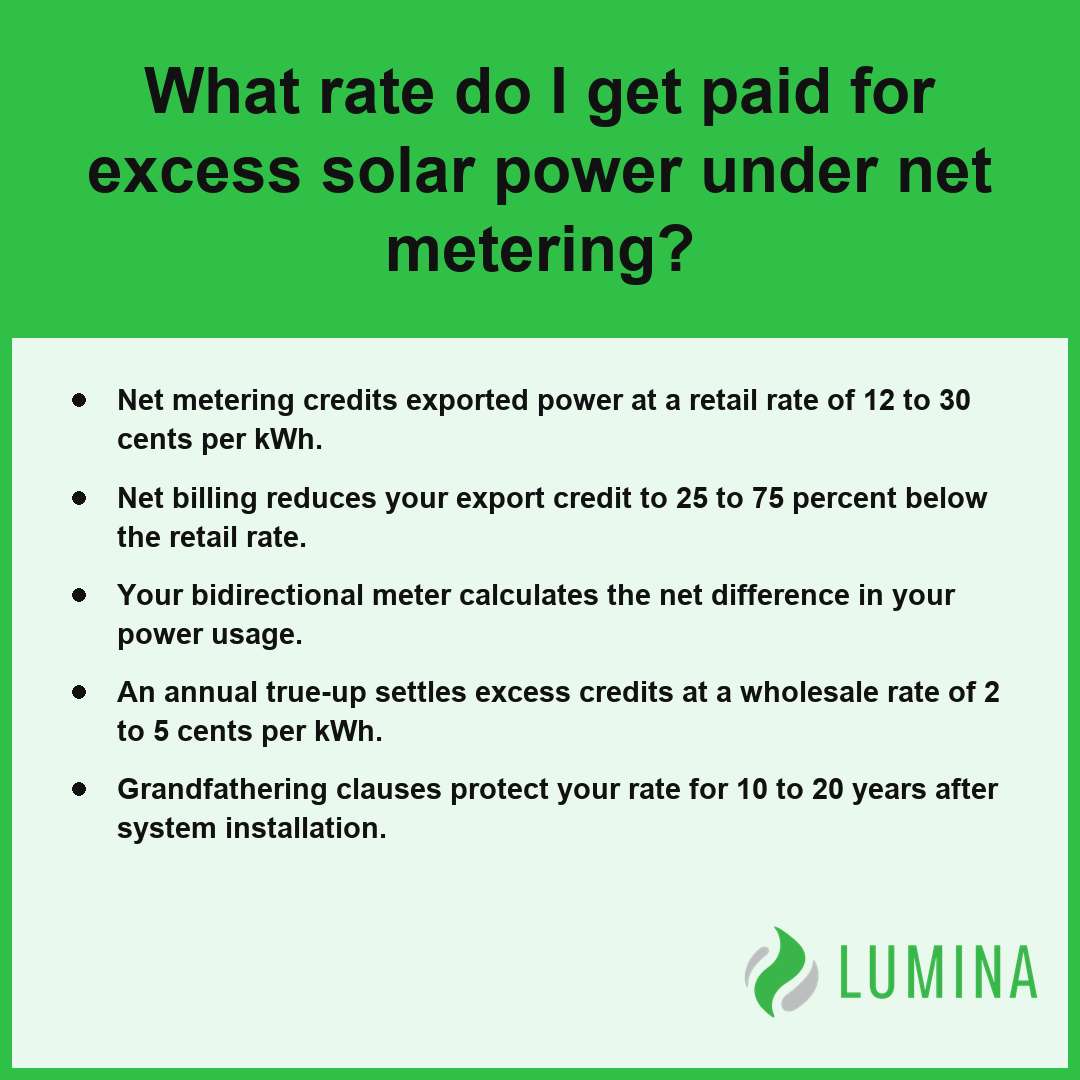
- Net metering credits exported power at a retail rate of 12 to 30 cents per kWh.
- Net billing reduces your export credit to 25 to 75 percent below the retail rate.
- Your bidirectional meter calculates the net difference in your power usage.
- An annual true-up settles excess credits at a wholesale rate of 2 to 5 cents per kWh.
- Grandfathering clauses protect your rate for 10 to 20 years after system installation.
What Rate Do You Get Paid for Excess Solar Power Under Net Metering?
Under net metering, you typically receive a one-to-one retail rate credit for your excess solar power, whereas under net billing, your export credit is often 25 to 75 percent below the retail rate.
| Compensation Model | Export Credit Value Type | Relative Value (% of Retail Rate) |
|---|---|---|
| Net Metering | Full Retail Rate | 100% |
| Net Billing (High Estimate) | Avoided-Cost Rate | 75% |
| Net Billing (Low Estimate) | Avoided-Cost Rate | 25% |
Export Credit Value Relative to Retail Rate
Traditional Net Metering at the Retail Rate
The rate you receive for excess power under net metering is typically a one-to-one credit at the full retail rate, meaning every kilowatt-hour (kWh) you export offsets a kilowatt-hour you would otherwise purchase. Because the average residential rate often ranges between 12 and 30 cents per kWh, this model provides the most direct financial benefit for your grid-tied system. In this arrangement, the utility tracks your net usage, and your export credit effectively cancels out your consumption charges at the same unit price.
How Does Net Billing Lower Your Export Credit?
Net billing represents a shift toward compensating solar exports at a lower, wholesale-adjacent rate rather than the retail rate. The National Renewable Energy Laboratory reports that net billing is increasingly replacing traditional net metering by compensating solar owners for excess generation at an avoided-cost rate instead of the full retail electricity rate. Under these policies, your exported electricity is valued at an avoided-cost rate, which is often 25 to 75 percent below your retail rate. This transition significantly alters the economics of your system by reducing the value of the energy you send back to the grid compared to what you pay when purchasing power.
Why Time-of-Use Rates Change the Value of Exports
When your utility uses time-of-use rates, the financial logic of net metering evolves, as the value of your exported power fluctuates based on demand. You should compare how these rates impact your system’s payback period:
- Midday exports: Credits may be lower when solar production is highest and grid demand is moderate.
- Evening peak consumption: Grid power can cost 30 to 50 cents per kWh or more, making self-consumption highly valuable.
- Export timing: Credits are often calculated by multiplying the exported kWh by the specific rate active during that hour.
Where a Solar Battery Changes the Math
Because a typical home system exports 30 to 60 percent of its production, installing a solar battery allows you to store excess energy for use during high-cost evening periods. By shifting your usage to these self-generated hours, you minimize the need to draw from the grid when rates are at their peak.
Review your utility’s latest interconnection agreement to confirm if they currently utilize a standard retail-rate credit or if they have shifted to a time-varying export structure.
Several external factors frequently influence which compensation model applies to your solar installation:- Utility Regulatory Status: Investor-owned utilities are more likely to transition to net billing than municipal or cooperative utilities.
- System Size Caps: Some jurisdictions reserve net metering exclusively for systems under a specific kilowatt capacity.
- Interconnection Timing: Policies are often “grandfathered,” meaning the compensation model you receive is determined by the date your system was approved for interconnection.
- Local Legislation: State-level public utility commissions often mandate the shift from retail-rate metering to avoided-cost billing based on solar market maturity.
How a Bidirectional Meter Calculates Net Metering on Your Electric Bill
A bidirectional meter calculates net metering by tracking the two-way flow of electricity between your grid-tied system and the utility provider, measuring both the energy you pull from the grid and the excess you push back. Per the Department of Energy, a bidirectional meter functions by measuring both the electricity pulled from the grid and the excess electricity exported back to the grid by a solar array. Unlike a standard meter that only tallies consumption, this device features two distinct registers. One register tracks electricity delivered to your home during the night or on cloudy days, while the second records the surplus electricity your panels export when your production exceeds your immediate usage. The difference between these two values determines your net usage, which is then used to calculate your bill.
| System Capacity | Annual Export Estimate (Low) | Annual Export Estimate (High) | Primary Meter Function |
|---|---|---|---|
| 6 kW to 10 kW | 30% of Total Output | 60% of Total Output | Dual-Register Credit Accounting |
Typical Annual Solar Export Percentage
- Imported kWh: Power drawn from the utility grid to run your appliances.
- Exported kWh: Excess solar energy sent to the grid, recorded as an export credit.
- Net Usage: The mathematical difference used to determine your monthly charges or bill credits.
Because typical home systems of 6 to 10 kW often export 30 to 60 percent of their annual output, your bidirectional meter serves as the essential ledger for these credits. By monitoring your consumption habits, you can align your highest energy use with the peak midday hours when your bidirectional meter is most actively recording your exported solar energy. Verify that your interconnection agreement specifies the installation of a bidirectional meter to ensure your utility accurately captures your net metering activity.
To optimize your net metering benefits, consider these additional factors regarding utility billing and system efficiency:- Confirm if your utility provider employs time-of-use (TOU) rates, which adjust credit values based on the time of day the energy is exported.
- Ensure your solar inverter is compatible with grid-synchronization standards to prevent system shutdowns during peak production hours.
- Verify if your local jurisdiction offers “net billing” (a market-rate purchase) rather than “net metering” (a 1:1 retail rate exchange), as this significantly impacts the financial value of your exported kWh.
- Monitor your bidirectional meter’s monthly statement to ensure exported credits are correctly applied to offset both consumption and fixed delivery charges.
Does Your Utility Offer Net Metering, and Do Co-ops and Municipal Utilities Have To?
Whether your utility offers net metering depends on state mandates and the structure of your provider, as not all entities are required to participate. While most states have legislation compelling investor-owned utilities to provide net metering, rural electric cooperatives and municipal utilities often operate under different regulatory frameworks that grant them local autonomy, allowing them to opt out of these programs or implement their own unique versions of net billing. Per the National Conference of State Legislatures, state policies requiring net metering often include exemptions or alternative compensation mechanisms specifically for smaller, municipally-owned or cooperatively-owned electric systems.
| Utility Provider Type | Regulatory Authority | Net Metering Obligation | Typical Compensation Model | Capacity Limit Scope |
|---|---|---|---|---|
| Investor-Owned Utility | State Utility Commission | Usually Mandated | Retail-rate to Net Billing | 10 kW – 25 kW |
| Electric Cooperative | Member-Elected Board | Discretionary / Opt-Out | Avoided Cost / Adjusted Credits | 10 kW – 25 kW |
| Municipal Utility | Local Municipality | Frequently Exempt | Direct Bill Credit / Buy-back | 10 kW – 25 kW |
Utility Solar System Capacity Caps (kW)
- Investor-Owned Utilities: Typically governed by state utility commissions and usually required to offer net metering, though many are transitioning toward net billing to lower the value of your export credit.
- Electric Cooperatives: Often managed by member-elected boards that may decide against offering full retail-rate net metering if they determine it shifts costs to non-solar members.
- Municipal Utilities: Frequently exempt from state-level mandates and may offer alternative compensation methods, such as direct bill credits or specific buy-back programs that differ significantly from standard net metering.
- System Size Caps: Regardless of utility type, many enforce capacity limits ranging from 10 kW to 25 kW, and may restrict installation sizes to approximately 100 percent of your previous annual consumption.
Review your specific utility provider’s tariff filings or their online interconnection agreement documents to confirm their current stance on solar compensation before finalizing your system design.
Follow these steps to determine your specific solar compensation structure:- Contact your utility provider directly to request their current Distributed Generation (DG) policy documentation.
- Verify whether your utility uses a bi-directional meter or requires a secondary meter to track exported solar energy.
- Confirm if your provider utilizes a “Time-of-Use” (TOU) rate schedule, which may devalue energy exported during off-peak hours.
- Inquire about “solar buy-back” rates, which may differ significantly from the retail electricity rate you pay for consumption.
- Ask if your system size necessitates a formal interconnection agreement or additional liability insurance coverage.
Do Net Metering Credits Expire, and What Happens at the Annual True-Up?
Net metering credits do expire, and they are typically settled during an annual true-up process at the end of a 12-month cycle. While many programs allow your excess kilowatt-hour credits to roll over from month to month, they rarely persist indefinitely. Per the U.S. Department of Energy, regulations governing whether solar credits expire or roll over to the following month are determined by individual state public utility commissions rather than federal law, leading to significant variability in true-up requirements across the country. When your 12-month cycle concludes, your utility conducts a reconciliation to determine if you have an outstanding balance of unused credits.
| Settlement Mechanism | Economic Outcome for Credits | Value at True-Up |
|---|---|---|
| Wholesale Payout | Converted to monetary credit | 2 to 5 cents per kWh |
| Credit Forfeiture | Account balance reset to zero | Zero value |
| Carryover Conversion | Partial retention at adjusted rates | Reduced monetary value |
Typical Wholesale Payout Range (cents/kWh)
The financial impact of this settlement depends heavily on your specific utility policy, as the value of your remaining credits often drops significantly once the true-up occurs. To understand how your leftover energy is treated, refer to the following common settlement outcomes:
- Wholesale Payout: Any remaining kilowatt-hour credits are purchased by the utility at a wholesale rate, typically 2 to 5 cents per kWh.
- Credit Forfeiture: Remaining credits are cleared from your account balance, effectively resetting your net metering status to zero for the start of the next cycle.
- Carryover Conversion: Some programs allow a portion of credits to persist, though these are often converted to a lower monetary value rather than remaining as full kilowatt-hour credits.
Review your interconnection agreement to identify the exact month designated for your annual true-up so you can plan for potential bill adjustments before the cycle resets.
Follow these steps to determine your specific true-up outcome:- Check your utility’s “Net Metering Tariff” document, specifically the section detailing “Annual Reconciliation” or “True-Up.”
- Locate your current interconnection agreement to verify if your system is classified under net metering or a net billing model.
- Review your monthly billing statement to identify the specific month designated as your annual true-up period.
- Contact your utility’s customer service department to confirm the exact monetary rate applied to excess generation at the end of your cycle.
Will Net Metering Rule Changes Affect Your Existing Solar System?
Yes, net metering rule changes can affect your existing solar system, but most utility programs incorporate protections known as grandfathering to shield you from immediate policy shifts. Per the Federal Energy Regulatory Commission, the specific rights and protections afforded to solar customers regarding net metering are largely determined by state-level public utility commissions, which dictate how legacy systems are treated when policies shift. When a jurisdiction transitions from traditional net metering to net billing, the new regulations typically apply only to future applicants. Your status remains secure for a designated period, often ranging from 10 to 20 years, ensuring the specific export credit structure you agreed to upon your initial interconnection agreement remains in place for that duration.
| Trigger Event | Potential Impact on Grandfathered Status | Risk Level for Tariff Reclassification |
|---|---|---|
| Significant System Expansion | Requires new interconnection application | High |
| Complete Equipment Overhaul | Classified as new system installation | High |
| Property Ownership Transfer | Policy-dependent transition to current rates | Moderate |
| Minor Inverter Replacement | Generally maintained under legacy terms | Low |
Grandfathering Protection Periods (Years)
However, specific actions can trigger a loss of this protected status. If you choose to expand your system significantly, the utility may require you to reapply for interconnection, which could force your entire system onto the current net billing tariff. To understand how your specific system is treated, compare the following factors that often influence whether a system remains under established rules:
- System capacity: Incremental increases often trigger a review of your interconnection agreement.
- Equipment replacement: Complete system overhauls may be treated as a new installation.
- Property transfer: Some utility policies require a transition to current tariffs when a home changes ownership.
- Tariff expiration: The end of the grandfathering period forces all legacy systems onto the latest rate structure.
Verify the specific expiration date of your current interconnection agreement to determine how much time remains before your system becomes subject to updated export credit regulations.
To maintain your grandfathered status, consider these proactive measures:- Verify your specific utility interconnection agreement for unique clauses regarding system modifications.
- Document all maintenance activities to prove minor repairs do not constitute a system overhaul.
- Consult with your local utility provider before installing battery storage to ensure it does not trigger a reclassification of your export agreement.
- Retain a copy of your original contract and initial approval documentation in a secure digital format.
Frequently Asked Questions
Is there a size limit on solar panel systems under net metering?
Yes, there is a size limit on solar panel systems under net metering, with common residential caps ranging from 10 kW to 25 kW. Many utilities further restrict system size to approximately 100 percent of your past annual electricity consumption, preventing you from oversizing your array to generate excess credits.
How do time-of-use rates change the value of net metering for solar panels?
Time-of-use rates change the value of net metering by making midday solar exports less valuable compared to evening grid power, which can cost 30 to 50 cents per kWh or more. Your midday production often earns lower credits, shifting the economic benefit toward using energy when utility prices are highest.
Why do I still get an electric bill with net metering and solar panels?
You still receive an electric bill with net metering and solar panels because you remain responsible for paying fixed utility charges regardless of your solar production. Even if your export credits offset your energy consumption, these mandatory monthly fees for grid maintenance and service infrastructure must be paid to the utility.
Do I need a battery if I have net metering for my solar panels?
No, you do not strictly need a battery if you have net metering, as the grid acts like a virtual battery to store your excess production. However, under net billing, adding a solar battery becomes more valuable because it allows you to store midday power for self-consumption during expensive evening hours.
How long does utility interconnection approval take before I can turn on my net metered solar system?
Utility interconnection approval times vary by region and utility provider, as they depend on the specific processing timelines for your required interconnection agreement. You must receive official permission to operate before activating your grid-tied system to ensure your bidirectional meter correctly records your participation in net metering.