
Solar Energy: Cost, Efficiency, Output, Payback, Sunlight Hours, Sizing, Lifespan, Weather Effects, Orientation, Storage

Solar energy is radiant light and heat from the sun that technology can convert into electricity or usable thermal energy. Key aspects include efficiency, cost, payback, output, sizing, sunlight hours, weather effects, lifespan, storage, and orientation. Solar panels MD systems capture sunlight with photovoltaic cells, which release electrons that flow as direct current and pass through an inverter to become household alternating current. Within the field of solar panels, the output you receive depends on cell efficiency, sunlight hours, roof angle, shading and temperature. The article goes on to explain panel efficiency ratings, upfront and installed cost, payback periods, expected annual output and how system size is matched to your electricity use.
Key Takeaways
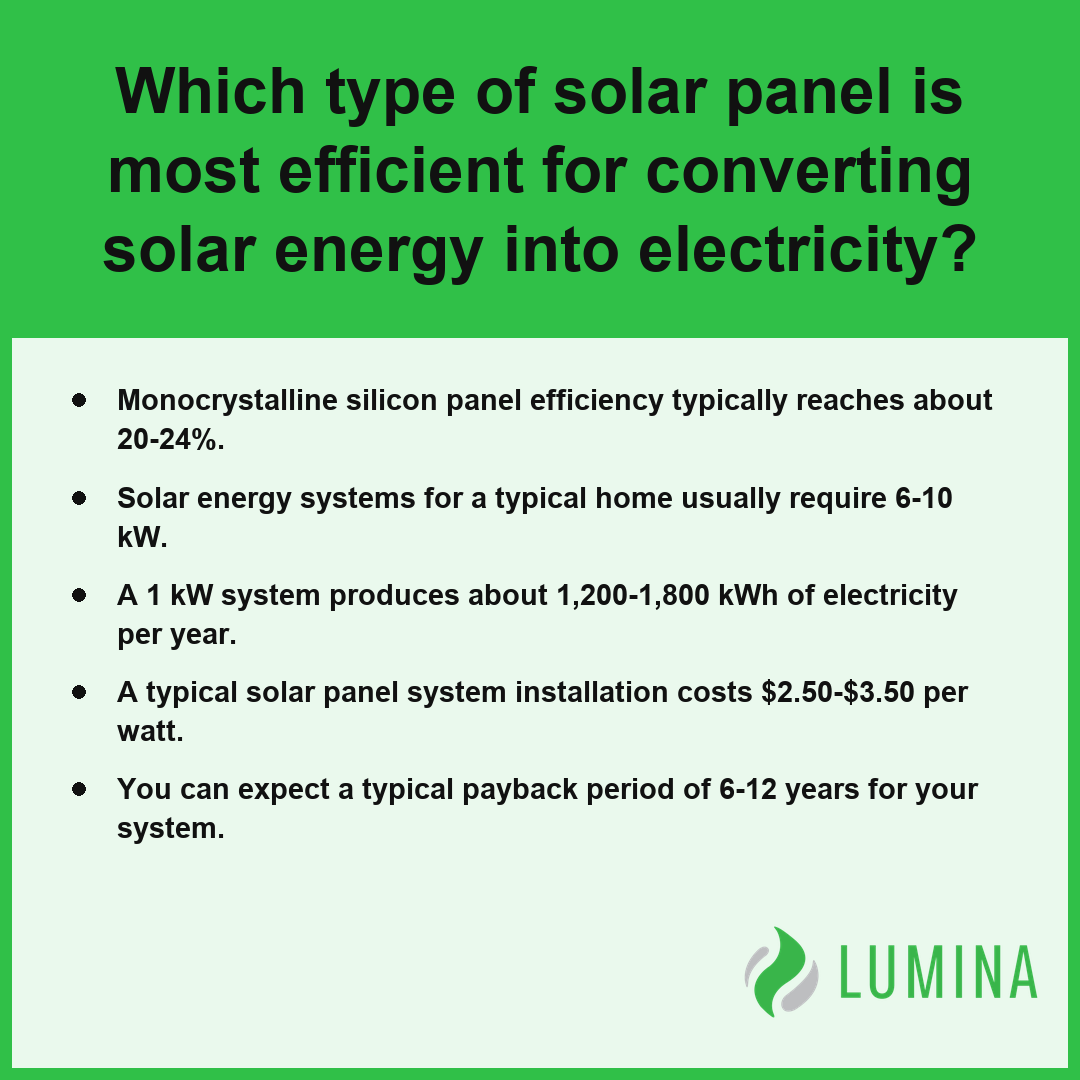
- Monocrystalline silicon panel efficiency typically reaches about 20-24%.
- Solar energy systems for a typical home usually require 6-10 kW.
- A 1 kW system produces about 1,200-1,800 kWh of electricity per year.
- A typical solar panel system installation costs $2.50-$3.50 per watt.
- You can expect a typical payback period of 6-12 years for your system.
Which Type of Solar Panel Is Most Efficient for Converting Solar Energy Into Electricity?
The monocrystalline silicon panel is the most efficient choice for converting solar energy into electricity, typically achieving higher conversion rates than other commercially available technologies.
| Solar Panel Technology | Typical Efficiency Range | Primary Composition Advantage | Spatial Efficiency Impact |
|---|---|---|---|
| Monocrystalline | 20% – 24% | High-purity single-crystal structure | Highest power density per square foot |
| Thin-Film | 17% – 19% | Flexible, lightweight semiconductor layers | Lower density; requires larger surface area |
| Polycrystalline | 15% – 18% | Fragmented silicon crystal melt | Moderate footprint requirements |
Solar Panel Efficiency Comparison
Monocrystalline Silicon Panel Efficiency
Monocrystalline silicon panels are widely considered the gold standard for residential setups, offering an efficiency of about 20-24%. According to the National Renewable Energy Laboratory, these panels currently offer the highest commercial efficiency ratings, typically converting between 17% and 23% of incident sunlight into usable electricity. This high performance is due to the purity of the single-crystal silicon structure, which allows electrons to move more freely when exposed to the photovoltaic (PV) effect. Because they generate more electricity per square foot, you require less roof space to meet your energy targets.
How Nameplate Rating Reflects Efficiency
While the nameplate rating indicates the power a panel produces under standard test conditions of 1,000 W/m², efficiency determines how much physical space is needed to achieve that rating. A higher efficiency means a smaller panel can hold a higher nameplate rating.
Polycrystalline and Thin-Film Panels Compared
While monocrystalline silicon panels dominate the market, other technologies exist with varying trade-offs in efficiency and physical composition:
- Polycrystalline panels: Offer about 15-18% efficiency and are identified by their distinct blue, multi-crystalline appearance.
- Thin-film panels: Generally provide 16-19% efficiency and are often lighter or flexible, though they typically require a larger footprint for equivalent output.
Does Higher Efficiency Always Mean a Better Choice?
No, a higher efficiency panel is not always the best choice for your specific situation. If you have an expansive, unshaded roof, you may find that the lower upfront cost of a less efficient panel provides better value than paying a premium for the highest-performing monocrystalline silicon panel available. Compare your available roof square footage against your total energy requirements to determine if space constraints necessitate the highest efficiency tiers.
Consider these practical factors when evaluating solar panels for your specific installation site:- Temperature coefficient: Monocrystalline panels typically maintain performance better in high-heat environments compared to other silicon-based alternatives.
- Degradation rate: High-purity crystals generally experience slower annual efficiency loss, extending the long-term functional lifespan of the system.
- Light sensitivity: Certain thin-film variants may outperform crystalline options during diffuse light or overcast conditions, despite lower overall peak output.
- Aesthetic preference: The uniform, dark appearance of single-crystal cells is often selected for its streamlined visual integration on residential rooflines.
How Much Does It Cost to Install Solar Panels on a Typical Home?
The cost to install solar panels on a typical home ranges from $2.50 to $3.50 per watt before incentives, leading to a total system investment that scales with your specific energy requirements. Because a standard residence typically needs a 6-10 kW system to offset its annual electricity usage, you can expect an upfront gross cost between $15,000 and $35,000. Per the Solar Energy Industries Association, the average cost of a residential solar system in the United States typically falls in the range of $15,000 to $25,000 before applying federal tax incentives. This price covers the procurement of high-efficiency equipment, the mounting infrastructure, and the professional labor necessary to ensure your system effectively captures solar energy.
| System Scale / Tier | Estimated Capacity (kW) | Gross Investment Range |
|---|---|---|
| Compact Residential | 6.0 kW | $15,000 – $21,000 |
| Standard Industry Average | 8.0 kW | $20,000 – $28,000 |
| High-Output Residential | 10.0 kW | $25,000 – $35,000 |
Estimated Solar System Cost Ranges (USD)
Several variables contribute to the final price tag beyond the basic nameplate rating of the components. When calculating your total expenditure, consider the following primary cost drivers:
- Inverter selection: choosing between centralized string inverters or more expensive microinverter units for individual panel optimization.
- Permitting and labor: regional variations in local building codes, inspections, and professional installer fees.
- Roof condition and access: additional structural reinforcement or surface preparation required to safely hold solar panels.
- System monitoring hardware: optional equipment used to track the real-time production of solar energy.
Compare the equipment warranties provided by different installers to determine if the long-term protection offered for your hardware justifies a higher initial expenditure.
Several external factors can significantly alter the total installation price beyond the baseline equipment costs:- Roof complexity and material, as slate or tile roofs often require specialized mounting hardware and additional labor time.
- Geographic location, which influences local permit fees, labor rates, and the stringency of municipal building codes.
- System orientation and shading, necessitating potentially more complex panel configurations or additional hardware to optimize efficiency.
- Required electrical panel upgrades, which may be mandatory if your existing infrastructure cannot safely support a new solar power output.
- Energy storage integration, such as adding lithium-ion battery backups to provide power during grid outages.
How Long Solar Panels Take to Pay for Themselves
Solar panels typically take between 6 and 12 years to pay for themselves through the accumulated savings on your monthly electricity utility bills. Per the Department of Energy, residential solar energy systems generally reach their payback period within six to ten years, depending on factors like local utility costs, available tax incentives, and site-specific sunlight conditions. This timeframe, often referred to as the solar payback period, depends on how much you spend on the initial system installation compared to the value of the solar energy generated over time. As your system begins producing electricity via the photovoltaic (PV) effect, it offsets the need to purchase power from the grid. Because your panels experience an annual degradation rate of about 0.4-0.5% output loss per year, your financial return remains consistent even as the system ages slightly, provided you factor in rising utility electricity rates over the lifetime of your equipment.
Solar Payback Period Estimates (Years)
| Factor | Impact on Payback Speed |
|---|---|
| Local electricity rates | Higher rates shorten the payback period. |
| System size | Larger systems require more initial capital. |
| Insolation | More peak sun hours increase annual output. |
| Net metering policies | Exporting excess solar energy accelerates returns. |
To determine your specific return on investment, calculate your current monthly utility bill against the expected annual production of a 6-10 kW system based on your local peak sun hours.
To determine your specific return on investment, follow these steps to calculate your financial outlook:- Sum your total annual electricity costs from the previous twelve months.
- Subtract any available federal, state, or local tax credits and rebates from your total system installation quote.
- Divide the net installation cost by your estimated annual savings to determine your projected break-even year.
- Adjust your final calculation to account for your utility provider’s historical annual rate increase percentage.
How Much Electricity a 1 kW Solar Panel System Produces in a Year
A 1 kW solar panel system produces about 1,200-1,800 kWh of electricity in a year, though the final output depends heavily on your specific geography and local climate. Per the Energy Information Administration, variations in average annual solar energy output for a 1 kW system across the United States are heavily influenced by geographic latitude and average cloud cover patterns specific to the local region. This production range is dictated by the amount of solar energy that reaches your rooftop, which is measured by peak sun hours. While some regions receive roughly 3 peak sun hours per day, others in desert climates may see 6-7 hours, significantly altering the yearly yield of your installation.
| Regional Climate Type | Avg. Peak Sun Hours/Day | Annual Yield Estimate (per 1 kW) | Production Tier |
|---|---|---|---|
| Cloudy/High Latitude | 3 Hours | ~1,200 kWh | Baseline |
| Moderate/Variable | 5 Hours | ~1,500 kWh | Intermediate |
| Desert/Clear Skies | 7 Hours | ~1,800 kWh | High Yield |
Peak Sun Hours per Day by Region
Several environmental and technical variables determine whether your system hits the high or low end of these production estimates:
- Tilt and Orientation: South-facing panels aligned with your local latitude typically maximize collection, while east or west orientations cause a 10-20% reduction in total annual output.
- Temperature Sensitivity: Solar panel efficiency drops as temperatures rise, with a temperature coefficient of -0.26% to -0.40% per degree Celsius above 25°C.
- System Maintenance: Accumulated dirt, debris, or persistent shading on a single cell can restrict the flow of electricity across the entire string of panels.
- Atmospheric Conditions: Even on days with heavy cloud cover, your panels continue to function, typically producing about 10-25% of their clear-sky capacity.
Before installing your system, verify your local roof shading profile to ensure that no nearby obstructions will trigger significant drops in your annual production.
Beyond environmental factors, several technical maintenance and site conditions impact your system’s efficiency:- Shading Obstructions: Nearby trees, chimneys, or neighboring buildings can create localized shadows that disproportionately reduce energy harvest even on sunny days.
- Soiling and Debris: Accumulated dust, pollen, bird droppings, or heavy snowfall can block light absorption and may require periodic cleaning to maintain optimal output.
- Inverter Efficiency: The conversion process from DC electricity to usable AC power incurs minor energy losses, which can vary based on the age and quality of the inverter technology installed.
- Wiring Losses: Long cable runs between your solar array and the electrical panel can result in voltage drops, slightly reducing the total energy delivered to your home.
How Many Solar Panels You Need to Power an Average Home
To determine how many solar panels you need to power an average home, you must account for your annual household energy usage. Per the US Energy Information Administration, the average annual electricity consumption for a typical U.S. residential utility customer is approximately 10,500 kilowatt-hours. Because a standard residential system size ranges from 6 to 10 kW, you can calculate your specific panel count by dividing your target system capacity by the wattage of your chosen solar panel. Since a typical modern solar panel is rated between 350 and 450 watts, the number of units required fluctuates based on your available roof space and the intensity of solar energy reaching your location.
| Requirement Factor | Baseline Metric | Impact on System Quantity |
|---|---|---|
| Annual Energy Demand | 10,500 kWh | Sets total system capacity (kW) target |
| Individual Panel Output | 350W – 450W | Inversely dictates total number of units |
| Physical Roof Footprint | 17 – 21 sq. ft. per panel | Limits maximum allowable array size |
| Solar Irradiance | Variable Peak Sun Hours | Adjusts array size to compensate for location |
| Total Estimated Array | 16 – 28 Panels | Final range to meet average consumption |
Estimated Solar Panel Quantity Range
- System Size: A standard setup for an average home requires 6 to 10 kW of capacity.
- Panel Wattage: High-efficiency panels typically provide a nameplate rating between 350 and 450 watts per unit.
- Space Requirements: Each panel occupies approximately 17 to 21 square feet of roof area.
- Total Count: Based on these figures, you will generally need to install between 16 and 28 solar panels to meet typical household electricity demands.
- Location Variability: If your roof receives fewer peak sun hours, you may need a larger array to reach the same production levels as homes in sunnier regions.
Compare your roof’s available surface area against the physical dimensions of the selected solar panels to ensure your structure can accommodate the required quantity without encountering excessive shading.
Follow these additional considerations to ensure your solar installation meets your specific household needs:- Verify local building codes and obtain necessary permits before purchasing equipment.
- Assess your roof’s orientation and tilt to maximize daily solar energy production.
- Evaluate current utility net-metering policies to determine potential financial credits for excess generation.
- Analyze seasonal shade patterns caused by nearby trees or structures that may reduce overall efficiency.
- Confirm that your current electrical panel capacity can accommodate a grid-tied solar system.
Frequently Asked Questions
How many peak sun hours does my area need for solar panels to be worth it?
Your area needs between 3 and 6-7 peak sun hours per day to make solar panels a viable investment. Peak sun hours measure daily solar energy, where one hour equals 1 kWh/m². While high-sun regions produce more, most locations generate sufficient output for a 6-12 year payback period.
Is a south-facing roof necessary for solar panels, or do east and west roofs still work?
A south-facing roof is the most efficient orientation, but east and west roofs work while losing only about 10-20% of potential output. You should aim for a tilt near your site latitude. If shading occurs, utilize a microinverter or power optimizer to ensure that one shadow does not limit system performance.
Do solar panels work on cloudy days and in winter?
Yes, solar panels work on cloudy days and in winter, though they produce only about 10-25% of clear-sky output. They rely on light rather than heat to function; in fact, panel output actually improves in cooler temperatures because heat reduces the efficiency of the photovoltaic (PV) effect.
How long do solar panels last and how much power do they lose each year?
Solar panels typically experience an annual degradation rate of about 0.4-0.5% output loss per year. Most manufacturers provide warranties guaranteeing 80-92% of the original rated output after 25-30 years of use. This long-term reliability ensures your system remains productive for decades despite the minimal, expected yearly decline in performance.
What happens to solar panels at night or during a power outage, and do I need a battery?
Solar panels stop producing electricity at night and during a power outage, making a battery necessary if you require continuous power without a grid connection. Because standard grid-tied systems shut down for safety during outages, you need storage to continue using your generated solar energy when the utility grid fails.