
Conversion Efficiency: Technology Types, Typical Range, Temperature Effect, Roof Space, Real-world Output, Degradation Rate, Test Conditions, Formula, Theoretical Limit, Loss Sources
Conversion efficiency is the percentage of sunlight striking a solar panel that the panel turns into usable electrical energy. Key aspects include typical range, technology types, roof space, temperature effect, degradation rate, real-world output, formula, test conditions, loss sources, and theoretical limit. Sunlight strikes the cells, and the semiconductor material frees electrons that flow as direct current, while the remaining energy leaves as heat or reflected light. A typical modern panel converts roughly 15 to 23 percent of the light it receives, and the figure varies with cell technology such as monocrystalline, polycrystalline and thin film. Heat lowers output as panels warm up, and efficiency also determines how much roof space you need for a given system size. A VA solar company that designs systems for Virginia roofs works with these same factors, along with the slow annual degradation that gradually reduces a panel’s output over its lifespan.
Key Takeaways
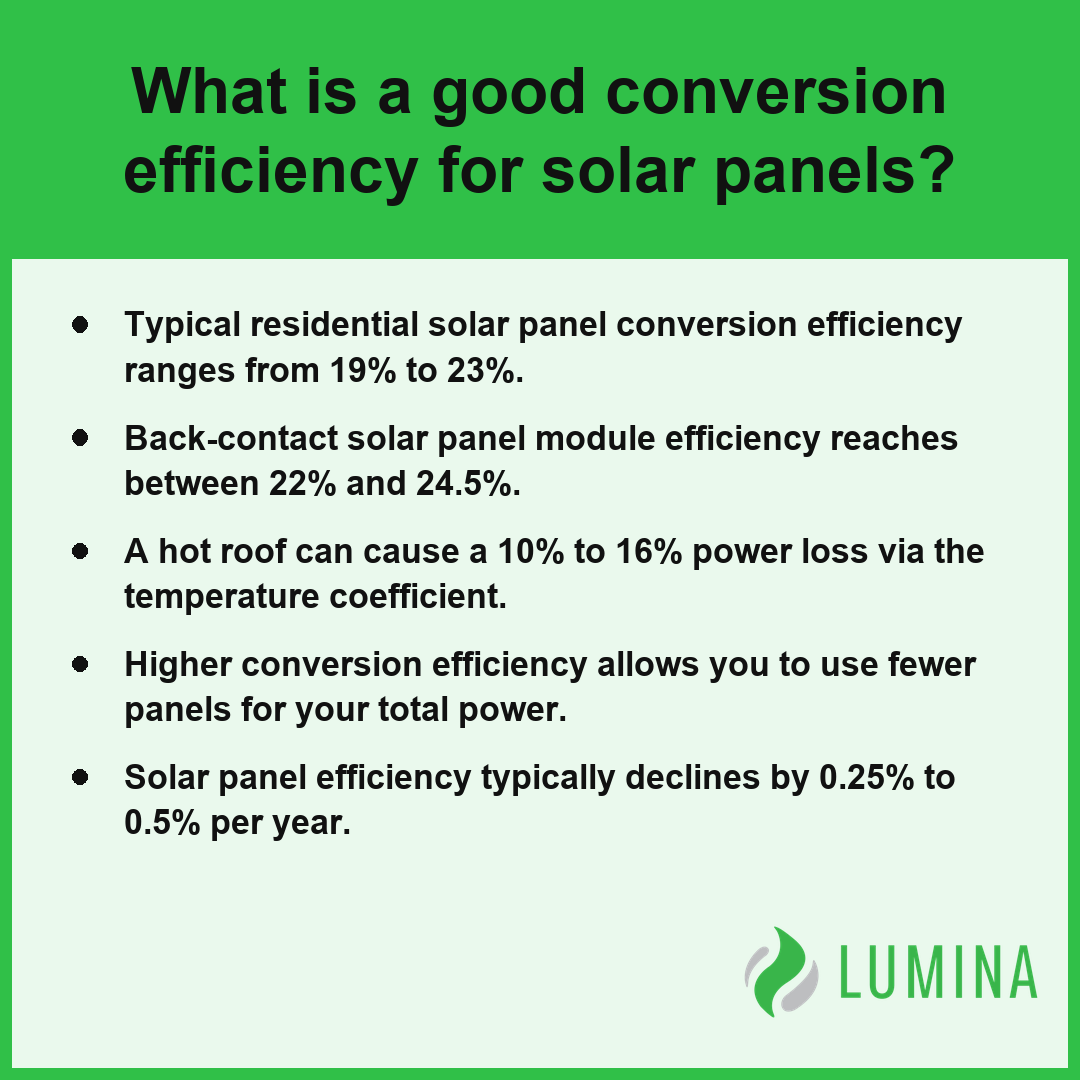
- Typical residential solar panel conversion efficiency ranges from 19% to 23%.
- Back-contact solar panel module efficiency reaches between 22% and 24.5%.
- A hot roof can cause a 10% to 16% power loss via the temperature coefficient.
- Higher conversion efficiency allows you to use fewer panels for your total power.
- Solar panel efficiency typically declines by 0.25% to 0.5% per year.
What Is a Good Conversion Efficiency for Solar Panels?
A good conversion efficiency for solar panels is currently considered to be in the 19% to 23% range, as this represents the standard output for modern residential hardware. National Renewable Energy Laboratory reports that most commercially available silicon-based photovoltaic modules for consumer use currently operate within the 20% to 23% efficiency range. Conversion efficiency describes the percentage of power from sunlight that a solar panel successfully transforms into usable electrical energy. This metric is determined under standard test conditions (STC) using an irradiance of 1,000 W/m² at a 25°C cell temperature. While research indicates the Shockley-Queisser limit for a single-junction silicon cell is about 29% to 30%, practical module efficiency remains lower due to physical constraints such as shading, electrical resistance, and the space occupied by frames or busbars.
| Panel Category | Efficiency Range | Performance Classification |
|---|---|---|
| Budget / Older Modules | 15% – 18% | Entry-level / Legacy Hardware |
| Standard Residential | 19% – 23% | Current Industry Benchmark |
| Premium Monocrystalline | 22% – 24.5% | High-Output Optimization |
| Theoretical Silicon Limit | 29% – 30% | Shockley-Queisser Constraint |
Solar Panel Efficiency Benchmarks
When evaluating which panel to choose, you can use the following benchmarks to categorize the technology:
- Budget or older panels: 15% to 18% conversion efficiency.
- Typical residential panels: 19% to 23% conversion efficiency.
- Premium monocrystalline panels: 22% to 24.5% module efficiency.
It is helpful to remember that conversion efficiency reflects the conversion capability of the hardware itself rather than your total system output, which is further subject to a system derate from components like your inverter. Compare the specific conversion efficiency ratings on the manufacturer’s data sheet against your total available mounting area to determine if a high-efficiency model is required for your installation.
When selecting solar panels for your specific needs, consider these additional practical variables:- Temperature Coefficient: Look for a lower percentage value, as this indicates how well the panel maintains performance as temperatures rise above standard test conditions.
- Degradation Rate: Evaluate the manufacturer’s performance warranty to determine how much power output the panel will lose annually over its 25-year lifespan.
- Space Availability: Higher efficiency panels require less physical roof surface area to reach your target energy production goals.
- Environmental Durability: Check for certifications regarding snow load capacity and wind resistance if you live in an area prone to extreme weather.
Which Solar Panel Type Has the Highest Conversion Efficiency: TOPCon, Heterojunction, or Back-Contact?
Back-contact solar panels currently offer the highest conversion efficiency among the leading high-performance technologies, typically reaching 22% to 24.5% at the module level. While TOPCon and heterojunction designs are highly competitive, the architectural advantage of back-contact technology—which moves all electrical busbars to the rear of the cell—minimizes shading on the front surface and maximizes light absorption. Per the International Energy Agency, heterojunction technology utilizes a combination of crystalline silicon and thin-film silicon layers to reach better temperature coefficients and conversion efficiencies than standard industry cells.
Typical Solar Panel Conversion Efficiency
| Solar Panel Technology | Typical Conversion Efficiency |
|---|---|
| Polycrystalline Silicon | 15% to 18% |
| Monocrystalline PERC | 20% to 22% |
| TOPCon | 21% to 23% |
| Heterojunction | 22% to 24% |
| Back-Contact | 22% to 24.5% |
| Thin-film CdTe | 18% to 20% |
The gap between these technologies is narrowing as manufacturers optimize internal layers, but you will notice that even the best silicon-based panels remain well below the Shockley-Queisser limit of about 29% to 30%. While laboratory cells—such as experimental perovskite-silicon tandems—have pushed past 33%, these have yet to reach the consistent durability required for residential hardware. You should prioritize comparing the module efficiency of your specific model selection against your roof’s total available surface area to determine if the premium cost of back-contact cells is justified by your site’s physical constraints.
Emerging research into next-generation photovoltaic cells focuses on these specific pathways to surpass current efficiency plateaus:- Development of perovskite-silicon tandem cells to capture broader light spectrums.
- Implementation of bifacial module designs to collect reflected light from the rear surface.
- Integration of advanced passivating contact layers to reduce electron recombination losses.
- Refinement of tandem multi-junction architectures to approach the theoretical Shockley-Queisser limit.
How Much Heat Reduces Solar Panel Conversion Efficiency on a Hot Roof
You can calculate the loss in solar panel conversion efficiency by multiplying the degrees Celsius by which your roof exceeds the 25°C standard test conditions (STC) by your panel’s typical temperature coefficient of -0.26% to -0.40% per °C.
| Thermal Sensitivity | Temp Rise Above 25°C | Efficiency Penalty | Performance Outcome |
|---|---|---|---|
| Standard Efficiency (-0.40%/°C) | 40°C | 16.0% | High Thermal Loss |
| High Efficiency (-0.26%/°C) | 40°C | 10.4% | Superior Thermal Resilience |
Power Loss at 40°C Above STC
What a Temperature Coefficient Tells You
Heat reduces solar panel conversion efficiency because the internal semiconductor physics become less effective as temperatures rise above the standard test conditions (STC) of 1,000 W/m² irradiance at 25°C. A typical temperature coefficient is -0.26% to -0.40% per °C above 25°C, which dictates the specific percentage of rated power lost for every degree the cell temperature exceeds the baseline.
Reading the Temperature Coefficient on a Datasheet
You can identify how sensitive your equipment is to thermal stress by checking the datasheet provided by the manufacturer. Lower negative values indicate superior thermal performance during high-heat operation.
- For a panel with a -0.40% coefficient, a 40°C rise above 25°C results in a 16% reduction in output.
- For a panel with a -0.26% coefficient, the same 40°C increase results in only a 10.4% reduction in output.
Why Roof Surface Temperature Differs From Air Temperature
Roof surface temperatures are frequently 20°C to 30°C higher than ambient air temperatures due to solar radiation absorption and convective heat trapped between the panels and the roofing material. According to Lawrence Berkeley National Laboratory, high ambient temperatures and poor ventilation on residential rooftops contribute to thermal losses that significantly decrease the net electricity yield of solar arrays throughout the summer months in the United States. Because solar panels lack active cooling, this heat saturation directly lowers the conversion efficiency of the semiconductor materials, often leading to a 10% to 16% drop in rated power during the hottest hours of the day.
Which Solar Panel Types Handle Heat Best?
Heterojunction and back-contact solar panel designs generally provide the most stable conversion efficiency in hot climates. These architectures often feature lower temperature coefficients compared to standard monocrystalline PERC designs, as their construction manages internal heat-induced electron recombination more effectively. Always compare the specific temperature coefficient on the product datasheet before choosing panels for high-heat environments.
To optimize your system’s performance in high-temperature environments, consider these additional mitigation strategies:- Install panels with a gap of at least 4 to 6 inches between the roof surface and the module to facilitate convective airflow.
- Utilize light-colored or reflective roofing materials to lower the ambient temperature surrounding the solar array.
- Incorporate micro-inverters or DC optimizers, which help manage power output more effectively across individual modules during thermal fluctuations.
- Prioritize the selection of bifacial modules, which often exhibit lower operating temperatures due to their glass-glass construction.
How Solar Panel Conversion Efficiency Affects How Many Panels Fit on Your Roof
How solar panel conversion efficiency affects how many panels fit on your roof is a matter of power density, as higher-rated equipment allows you to generate more electricity from the same physical footprint. Per the Department of Energy, higher conversion efficiency enables homeowners to generate more electricity from a fixed number of panels, which is particularly beneficial for residential roofs with limited sunlight exposure or complex geometries. When you select panels with higher conversion efficiency, you increase the amount of watts produced per square meter, which effectively reduces the total number of solar panels required to meet your specific energy goals. This advantage is particularly valuable if your available roof space is restricted by chimneys, skylights, or limited sun-exposed area.
| Panel Efficiency Class | Power Output (W) | Panels for 6 kW Target | Footprint Efficiency Benefit |
|---|---|---|---|
| Standard Efficiency | 330 W | 18 Panels | Requires larger roof surface area |
| High Efficiency | 400 W | 15 Panels | Optimizes limited or complex geometry |
Panels Required for 6 kW System
- System Size and Footprint: To achieve a 6 kW system output, you would typically need about 15 panels if using 400 W units, compared to about 18 panels if using 330 W units with lower efficiency.
- Roof Geometry: High-efficiency modules maximize energy production on small or oddly shaped roof sections where fitting a larger number of standard-efficiency units would be physically impossible.
- System Derate Factors: Because system derate accounts for real-world variables like wiring and soiling—often reducing total output by 14% to 20%—installing more efficient panels helps compensate for these unavoidable losses by providing a higher starting power threshold.
- Future Expansion: Installing high-efficiency technology today preserves remaining roof surface, leaving you with more options if you decide to add battery storage or EV charging infrastructure that increases your home electricity demand later.
Measure the exact usable square footage of your roof sections while accounting for mandatory fire-code setbacks to determine if you must prioritize high-efficiency modules to reach your desired total system capacity.
Consider these additional factors when evaluating how solar panel efficiency influences your installation project:- Higher efficiency panels often feature advanced cell architecture, such as PERC or heterojunction technology, which can improve performance in low-light or high-temperature conditions.
- Choosing high-efficiency modules can lead to lower balance-of-system costs, including reduced expenses for racking, mounting hardware, and electrical wiring.
- A smaller total panel count results in a less cluttered roof aesthetic and may simplify the permitting and inspection process for complex roof layouts.
How Fast Conversion Efficiency Declines Over 25 Years
Conversion efficiency declines over 25 years as a result of the gradual annual degradation rate of solar panel materials. Even high-quality silicon cells experience minor molecular changes and mechanical stresses over time, which reduce their ability to convert sunlight into electricity. Under typical outdoor conditions, most manufacturers guarantee a specific performance level, with the annual degradation rate of solar panel efficiency generally falling between 0.25% and 0.5% per year. Per the National Renewable Energy Laboratory, standard degradation rates for residential solar panels in the United States typically range from 0.5% to 0.8% annually.
| Degradation Metric Source | Annual Performance Loss Rate | Projected Efficiency After 25 Years |
|---|---|---|
| Manufacturer Industry Standard | 0.25% – 0.50% | 87.5% – 93.75% |
| NREL Residential Findings | 0.50% – 0.80% | 80.0% – 87.5% |
Annual Solar Panel Degradation Rates
This slow reduction in performance is expected, and your system will continue to generate power well beyond the initial 25-year warranty period, albeit at a lower capacity. Factors that contribute to this persistent drop in conversion efficiency include:
- Micro-cracks in the silicon cells caused by thermal expansion and contraction.
- Yellowing or delamination of the protective backsheet or encapsulant materials.
- Corrosion of the metal contacts and busbars due to moisture ingress.
- Light-induced degradation where the crystalline structure undergoes permanent changes upon initial exposure to sunlight.
Compare the linear performance warranty of different manufacturers to determine the guaranteed conversion efficiency retained at the end of the 25-year service life.
Beyond environmental degradation, these external variables can accelerate the loss of your solar system’s output:- Accumulation of dirt, pollen, or bird droppings on panel surfaces that obstruct light absorption.
- Shading from newly grown trees, chimneys, or neighboring structures that disrupt cell performance.
- Inverter efficiency drops, which can influence the total usable energy monitored at the utility meter.
- Extreme localized weather events, such as persistent hail or high-velocity wind loads, that exceed standard mechanical tolerance.
Frequently Asked Questions
How do you calculate solar panel conversion efficiency from watts and panel size?
You calculate solar panel conversion efficiency by dividing the output watts by the product of irradiance and panel area, then multiplying by 100. For example, at standard test conditions irradiance of 1,000 W/m², a 20% efficient panel yields about 200 W per square meter of total surface area.
What are standard test conditions and why do they matter for a solar panel’s efficiency rating?
Standard test conditions (STC) matter because they establish a uniform baseline of 1,000 W/m² irradiance at 25°C cell temperature and air mass 1.5 spectrum. This allows you to compare the nameplate rated power of different solar panels fairly, as these lab conditions ensure every product is measured consistently.
What is the maximum possible conversion efficiency of a solar cell, and could perovskite tandems break it?
The Shockley-Queisser limit for a single-junction silicon cell is about 29% to 30%, though perovskite-silicon tandem cells have exceeded 33% in the lab. While these tandem designs can theoretically break the single-junction ceiling, commercial durability and scale-up remain significant challenges for reaching high conversion efficiency in standard residential solar panel products.
Why do solar panels convert only about 20% of sunlight into electricity?
Solar panels convert only about 20% of sunlight because energy is lost through reflected light, photons with unsuitable energy levels, electrical resistance, and charge carrier recombination. While cell efficiency is higher, module efficiency remains lower due to physical gaps, frames, and busbars that waste space on the solar panel surface.
Why is my solar system’s real-world output lower than the panel conversion efficiency suggests?
Your real-world output is lower than the solar panel conversion efficiency due to a typical system derate of 14% to 20%, caused by inverter efficiency, wiring, shading, and soiling. Furthermore, the temperature coefficient of -0.26% to -0.40% per °C means a hot roof can significantly reduce your total conversion efficiency.