
Temperature Coefficient: Power Loss, Good Value Range, Climate Impact, Module Technology, Datasheet Location, Heat Reduction Methods, NOCT Rating, Voltage and Current Types, Cold Weather Effect
A temperature coefficient is the percentage change in a solar panel’s power output for each degree Celsius of temperature rise. Key aspects include good value range, power loss, module technology, climate impact, heat reduction methods, datasheet location, voltage and current types, NOCT rating, and cold weather effect. Panels lose some output as their cells heat up, and this figure shows how steeply that loss occurs under real operating conditions. It is printed on every datasheet, usually as a negative percentage per degree Celsius above 25 degrees, the standard test temperature. In a solar installation Maryland summers can push roof surfaces well above that test level, so the rating influences how much energy you actually collect. This article explains what counts as a good value range, how power loss builds up, how module technology changes the numbers, how climate shapes results, and which heat reduction methods help.
Key Takeaways
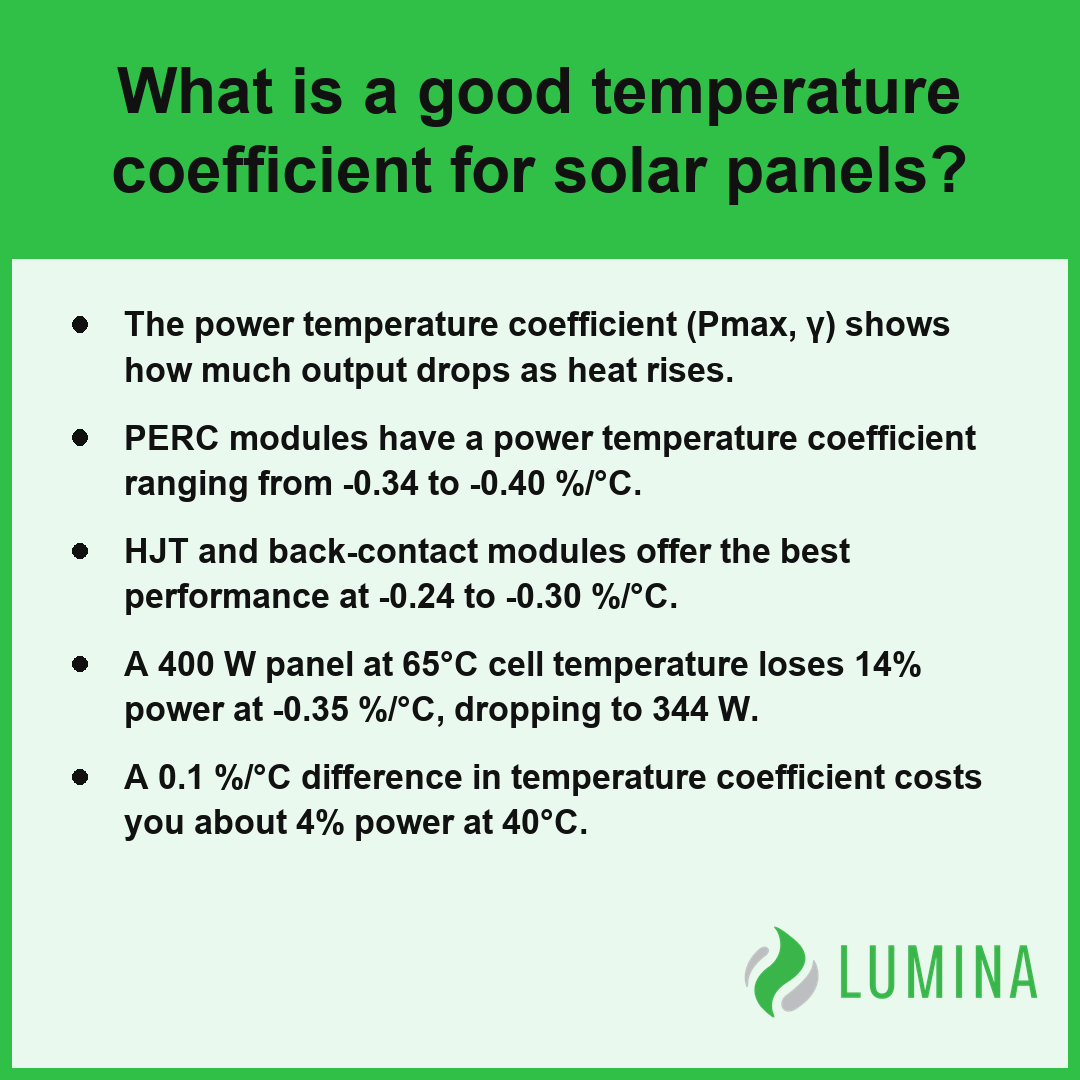
- The power temperature coefficient (Pmax, γ) shows how much output drops as heat rises.
- PERC modules have a power temperature coefficient ranging from -0.34 to -0.40 %/°C.
- HJT and back-contact modules offer the best performance at -0.24 to -0.30 %/°C.
- A 400 W panel at 65°C cell temperature loses 14% power at -0.35 %/°C, dropping to 344 W.
- A 0.1 %/°C difference in temperature coefficient costs you about 4% power at 40°C.
What Is a Good Temperature Coefficient for Solar Panels?
A good temperature coefficient is one that remains as close to zero as possible, effectively minimizing the drop in energy production as your solar panels heat up during operation. Because the power temperature coefficient (Pmax, γ) measures how much a module’s output changes for each degree of temperature rise beyond standard test conditions (STC, 25°C), lower absolute values indicate superior performance in warm environments. Per the National Renewable Energy Laboratory, most crystalline silicon solar panels generally exhibit a power temperature coefficient between -0.3% and -0.5% per degree Celsius.
Thermal Sensitivity of Electrical Characteristics
When you evaluate a module datasheet, you will typically find three distinct metrics that describe how thermal energy affects electrical output. Understanding these values helps you determine how resilient a panel will be when the midday sun drives the cell temperature significantly higher than the ambient air:
- Power temperature coefficient (Pmax, γ): Represents the overall loss in wattage. Lower values, such as those found in HJT and back-contact modules, signify better heat resistance.
- Voltage temperature coefficient (Voc, β): Strongly negative, typically ranging from -0.25 to -0.30 %/°C, explaining why total voltage drops as cells get hotter.
- Current temperature coefficient (Isc, α): Slightly positive, generally +0.03 to +0.06 %/°C, though this minor gain in current is insufficient to counteract the voltage-related losses.
For context on how these figures impact real-world performance, consider the following performance tiers for modern technologies:
| Technology | Power Temperature Coefficient Range |
|---|---|
| Conventional p-type PERC | -0.34 to -0.40 %/°C |
| n-type TOPCon | -0.29 to -0.32 %/°C |
| HJT and back-contact | -0.24 to -0.30 %/°C |
Compare the nominal operating cell temperature (NOCT/NMOT) listed on the module datasheet against your local average summer peak to estimate the actual percentage of power loss you should expect.
Consider these practical implications for optimizing solar installations in high-heat environments:- Prioritize mounting systems that allow for at least 4-6 inches of clearance between the panel and the roof to facilitate natural convection cooling.
- Design array layouts with sufficient inter-row spacing to prevent shading and promote airflow, which helps mitigate localized heat pockets.
- Opt for light-colored roofing materials under the array, as they reduce the ambient temperature immediately beneath the modules via higher solar reflectance.
- Ensure that inverters are installed in shaded, well-ventilated areas, as they also experience derating and efficiency losses at elevated temperatures.
How Much Power a Solar Panel Loses in Summer Heat Based on Its Temperature Coefficient
Power loss in summer heat based on its temperature coefficient is calculated by measuring how much a module’s electrical output drops for every degree of increase beyond the 25°C standard test conditions (STC, 25°C). Because cell temperature often runs 20 to 35°C above ambient temperature during a sunny day, your panels rarely operate at their peak rated wattage. The power temperature coefficient (Pmax, γ) quantifies this sensitivity, reflecting the degradation of the internal silicon bandgap and increased carrier recombination as heat builds up. Per the Department of Energy, solar photovoltaic cells operate with decreased voltage as internal temperatures increase, which directly leads to a decline in total power conversion efficiency during peak summer heat.
| Metric Type | Symbol | Typical Coefficient (%/°C) | Impact on Performance |
|---|---|---|---|
| Power Temperature Coefficient | Pmax (γ) | -0.24% to -0.40% | Primary indicator of total output degradation |
| Voltage Temperature Coefficient | Voc (β) | -0.25% to -0.30% | Primary driver of voltage-related power loss |
| Current Temperature Coefficient | Isc (α) | +0.03% to +0.06% | Minor gain partially offsetting thermal losses |
Typical Temperature Coefficients (%/°C)
To understand the impact of the temperature coefficient on your potential energy production, consider how the three distinct components of this rating interact during high-heat operation:
- Power temperature coefficient (Pmax, γ): Typically ranges from -0.24 %/°C to -0.40 %/°C depending on the module technology.
- Voltage temperature coefficient (Voc, β): Generally ranges from -0.25 to -0.30 %/°C, representing the primary driver of power loss as heat causes voltage to plummet.
- Current temperature coefficient (Isc, α): Ranges from +0.03 to +0.06 %/°C, acting as a minor offset that is insufficient to compensate for the significant voltage drop.
For a practical example, if you have a 400 W panel with a -0.35 %/°C rating operating at a cell temperature of 65°C, it is 40°C above standard; this results in a loss of about 14%, or roughly 344 W of actual output. A difference of just 0.1 %/°C in this rating translates to an output cost of about 4% when the cells are 40°C above standard. Look for the nominal operating cell temperature (NOCT/NMOT) on your module datasheet to gain a more realistic expectation of heat-related performance than STC ratings provide.
Verify the specific nominal operating cell temperature (NOCT/NMOT) on your module datasheet to estimate how often your system will reach its peak power threshold during the hottest months.
You can calculate the actual performance loss of your solar array by following these steps:- Determine the cell temperature by adding 25°C to the current ambient temperature.
- Subtract the 25°C standard test condition temperature from the calculated cell temperature to find the temperature delta.
- Multiply the temperature delta by your specific Pmax coefficient to determine the total percentage loss.
- Apply this percentage reduction to your panel’s peak wattage rating to estimate real-world output under thermal stress.
Which Solar Panel Technology Has the Best Temperature Coefficient: PERC, TOPCon, HJT, or Thin-Film?
Heterojunction (HJT) and back-contact modules offer the best temperature coefficient performance among current solar technologies, consistently minimizing power loss as cell temperatures rise. By utilizing advanced architectures to reduce recombination, these modules maintain higher voltage output under intense heat compared to standard crystalline silicon designs. According to the International Technology Roadmap for Photovoltaics, thin-film technologies like cadmium telluride are widely recognized for maintaining superior temperature coefficients compared to standard crystalline silicon architectures, which results in less power degradation as operating temperatures increase.
Typical Power Temperature Coefficient (Midpoint value in %/°C)
| Module Technology | Power Temperature Coefficient (Pmax, γ) |
|---|---|
| Conventional PERC | -0.34 to -0.40 %/°C |
| n-type TOPCon | -0.29 to -0.32 %/°C |
| HJT and Back-Contact | -0.24 to -0.30 %/°C |
| Cadmium Telluride (Thin-Film) | -0.25 to -0.32 %/°C |
| CIGS (Thin-Film) | -0.32 to -0.36 %/°C |
The performance gap between these technologies is driven by how each cell type manages its internal voltage temperature coefficient (Voc, β) and current temperature coefficient (Isc, α). While the current temperature coefficient (Isc, α) generally provides a slight boost of +0.03 to +0.06 %/°C as heat increases, this is insufficient to counteract the sharper voltage decline, which ranges from -0.25 to -0.30 %/°C. Consequently, choosing a technology like HJT can prevent significant degradation; a difference of just 0.1 %/°C in a temperature coefficient rating typically results in a 4% disparity in power output when cells reach 40°C above standard test conditions (STC, 25°C).
Review the module datasheet for the specific nominal operating cell temperature (NOCT/NMOT) to verify how a panel’s output will behave in your local high-heat environment.
The following factors contribute to the variation in thermal performance across different solar cell architectures:- Bandgap sensitivity: Wider bandgap materials typically exhibit a less negative voltage temperature coefficient, helping to stabilize power output at elevated temperatures.
- Surface passivation quality: Advanced passivation layers reduce carrier recombination rates, which helps maintain higher open-circuit voltage even as thermal energy excites electrons.
- Series resistance: Higher internal series resistance can exacerbate power losses when heat increases, making low-resistance contact designs critical for thermal stability.
- Carrier mobility: Thin-film materials with high carrier mobility can compensate for thermal scattering, mitigating the degradation of the fill factor during peak heat.
Does the Temperature Coefficient Matter More in Hot Climates Like Deserts and the Sun Belt?
The temperature coefficient matters significantly more in hot climates like deserts and the Sun Belt because high cell temperature causes substantial efficiency losses that vary based on the specific power temperature coefficient (Pmax, γ) listed on your module datasheet, where even a 0.1 %/°C difference can result in an output cost of about 4% when operating 40°C above standard test conditions (STC, 25°C).
| Operating Environment | Avg. Ambient Temp | Typical Cell Temp | Temp. Delta (vs. STC) | Relative Efficiency Impact |
|---|---|---|---|---|
| Desert / Sun Belt | 35°C – 45°C | 65°C – 80°C | 40°C – 55°C | High (Significant Loss) |
| Moderate Zone | 15°C – 25°C | 35°C – 45°C | 10°C – 20°C | Low (Minimal Deviation) |
| Cold Climate | -5°C – 10°C | 10°C – 25°C | -15°C – 0°C | Positive (Voltage Gain) |
Estimated Efficiency Losses by Operating Environment
Why Hot Climates Raise Cell Temperature
Yes, the temperature coefficient matters significantly more in hot climates because solar cells operate at temperatures well above standard test conditions (STC, 25°C). In intense sun, your module’s cell temperature typically runs 20 to 35°C hotter than the surrounding air. When ambient temperatures reach 35°C, your cells often hit 60 to 70°C. This extreme heat forces the silicon bandgap to narrow and increases carrier recombination, which causes the voltage temperature coefficient (Voc, β) to drop sharply, typically between -0.25 and -0.30 %/°C.
How Much Does the Temperature Coefficient Matter in Mild and Cold Climates?
While the temperature coefficient is critical in deserts, its impact is minimized in mild or cold regions where panels stay closer to the 25°C baseline. In cooler environments, the higher voltage maintained by the cells can actually lead to peak performance. However, you must still account for the voltage temperature coefficient (Voc, β) when designing your electrical system:
- Power loss in moderate zones: Often remains below 5% of rated capacity.
- Performance in cold zones: Voltage rises above STC values, potentially exceeding inverter input limits.
- Current behavior: The current temperature coefficient (Isc, α) provides a slight boost of +0.03 to +0.06 %/°C, though it is insufficient to counteract voltage drops in heat.
Cold-Weather Voltage Limits and String Length
In cold climates, your primary concern is not power loss but the risk of over-volting your equipment. Because voltage rises as temperature falls, you must calculate your maximum string length based on the lowest recorded ambient temperature in your region to ensure the total system voltage does not exceed the inverter’s maximum input rating.
When a Lower Temperature Coefficient Pays Back
A lower temperature coefficient pays back in regions with high average annual solar irradiance. Because a difference of 0.1 %/°C results in roughly 4% more power output at 40°C above standard, investing in modules with lower coefficients—such as HJT or back-contact technology—yields greater cumulative energy production over the life of your system. Lawrence Berkeley National Laboratory reports that performance monitoring of installations across the United States confirms that systems utilizing lower temperature coefficients consistently maintain higher energy yields during the peak heat of summer in warmer geographic zones.
Compare the nominal operating cell temperature (NOCT/NMOT) on your module datasheet against local historical high-temperature averages to ensure your inverter sizing accounts for the expected voltage fluctuations.
To mitigate these performance issues in high-heat environments, consider these installation and hardware adjustments:- Maintain a minimum of 4–6 inches of clearance between the modules and the roof surface to promote convective airflow.
- Prioritize modules with N-type TOPCon or HJT cell architectures, which naturally exhibit lower temperature coefficients than standard PERC cells.
- Select panels with light-colored or white backsheets to reduce heat absorption compared to black-on-black aesthetic designs.
- Utilize microinverters or DC optimizers to prevent thermal degradation in one module from disproportionately impacting the entire string’s output.
Ways to Reduce Heat Loss on Rooftop Solar Panels With a Poor Temperature Coefficient
Ways to reduce heat loss on rooftop solar panels with a poor temperature coefficient involve implementing structural and environmental modifications that help keep the modules closer to the standard test conditions (STC, 25°C). Because the power temperature coefficient (Pmax, γ) dictates that voltage drops as heat rises, limiting the rise in cell temperature is essential for maintaining rated output.
| Thermal Mitigation Strategy | Primary Mechanism of Action | Impact on Cell Temperature |
|---|---|---|
| Structural Air Gap (4-6 inches) | Facilitates natural convection | Maintains NOCT/NMOT range (41-47°C) |
| High-Albedo Roofing | Reduces surface radiation absorption | Lowers convective heat transfer to modules |
| Orientation for Prevailing Breezes | Increases wind-induced cooling | Prevents heat stagnation |
Nominal Operating Cell Temperature (NMOT/NOCT) Range (°C)
- Maximize Airflow: Ensure a gap of at least 4 to 6 inches between the roof surface and the solar array to allow natural convection, which helps dissipate heat and keeps cells closer to the nominal operating cell temperature (NOCT/NMOT) range of 41 to 47°C. Per the National Renewable Energy Laboratory, maintaining a minimum air gap of several inches between the solar array and the roof deck facilitates convective cooling that mitigates performance degradation caused by high panel temperatures.
- Utilize High-Albedo Roofing: Install light-colored or reflective roofing materials under the array to decrease the amount of solar radiation absorbed by the roof surface, which in turn reduces the convective heat transferred upward to the modules.
- Optimize Array Orientation: If your site allows, position panels to favor prevailing breezes; even a minor increase in wind speed can significantly lower cell temperature compared to stagnant, high-heat conditions.
- Avoid Over-tightening String Length: While electrical design often focuses on voltage, keeping your string length within optimal parameters ensures that inverters operate efficiently even when the voltage temperature coefficient (Voc, β) causes a dip in DC input due to extreme summer heat.
Compare the nominal operating cell temperature (NOCT/NMOT) listed on your module datasheet against local seasonal averages to determine if your planned mounting height is sufficient to counteract expected efficiency drops.
Additional site-specific considerations can further improve thermal performance:- Install microinverters or DC optimizers beneath the shade of the modules to minimize thermal stress on power electronics.
- Use light-colored module backsheets to reflect infrared radiation away from the panel circuitry.
- Apply thermally conductive mounting hardware to create a supplemental heat sink between the module frame and the racking system.
- Integrate ambient temperature sensors to automate module washing schedules, as dust accumulation accelerates heat absorption.
Frequently Asked Questions
Where do I find the temperature coefficient on a solar panel datasheet?
You find the temperature coefficient in the electrical specifications section of your module datasheet. It lists the power temperature coefficient (Pmax, γ), voltage temperature coefficient (Voc, β), and current temperature coefficient (Isc, α), typically expressed in %/°C to indicate how electrical output shifts from standard test conditions (STC, 25°C).
What is the difference between the Pmax, Voc, and Isc temperature coefficients on a solar panel?
The power temperature coefficient (Pmax, γ) shows how total wattage drops as heat rises, ranging from -0.24 to -0.40 %/°C. The voltage temperature coefficient (Voc, β) is strongly negative at -0.25 to -0.30 %/°C, causing voltage to fall. The current temperature coefficient (Isc, α) is slightly positive at +0.03 to +0.06 %/°C.
What is NOCT on a solar panel datasheet and how does it relate to the temperature coefficient?
Nominal operating cell temperature (NOCT/NMOT) is the expected cell temperature under real-world conditions, usually 41 to 47°C. It relates to the temperature coefficient by providing a more realistic baseline for heat, as cells often run 20 to 35°C above ambient air temperature, significantly impacting your module’s actual daily performance.
Does the temperature coefficient matter in cold climates, and how does it affect string sizing?
Yes, the temperature coefficient is critical in cold climates because power output rises below 25°C and voltage increases as temperatures drop. Installers must use the coldest expected temperature to calculate string length to ensure the voltage does not exceed the maximum input rating of your inverter, protecting the equipment from failure.
Is a 0.1 %/°C difference in solar panel temperature coefficient worth paying more for?
Yes, a 0.1 %/°C difference is often worth paying for, as it costs about 4% of your total output when your cell temperature is 40°C above standard. In regions with high heat, choosing modules with a better temperature coefficient ensures higher annual energy yield compared to standard PERC, TOPCon, HJT, and back-contact modules.