
Off-Grid System: Sizing, Cost, Battery Storage, Battery Type, Inverter, Components, Lifespan, Power Limits, Charge Controller
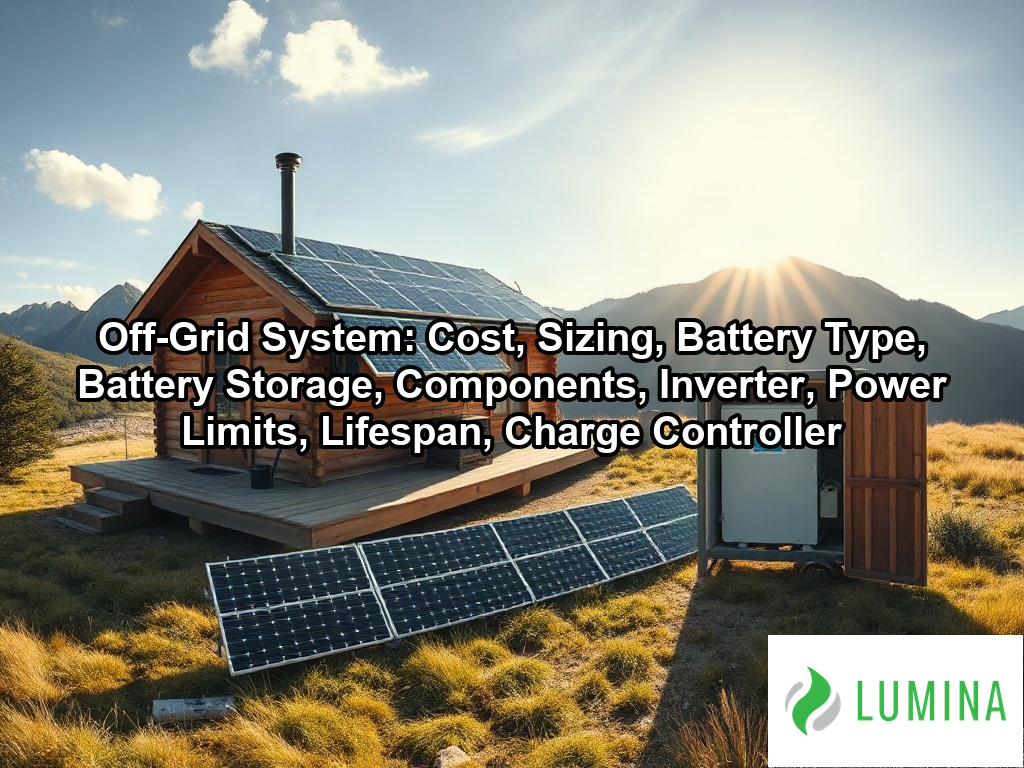
Everything you need to know about “off-grid system”: cost, sizing, battery type, battery storage, components, inverter, power limits, lifespan, and charge controller. Solar panels collect sunlight and convert it into direct current, which an inverter changes into usable household power, while a battery bank holds surplus energy for night and cloudy periods. Because nothing backs it up from the utility, every part of the setup must be matched to the loads you run each day. This role makes it a distinct branch of solar power, separate from grid-tied installations that exchange energy with the utility. Projects such as solar panels for home Maryland face seasonal swings in sunlight, so winter production strongly influences how the equipment is planned. The article goes on to explain cost, sizing of the array and batteries, battery chemistry types, and how battery storage capacity is calculated.
Key Takeaways
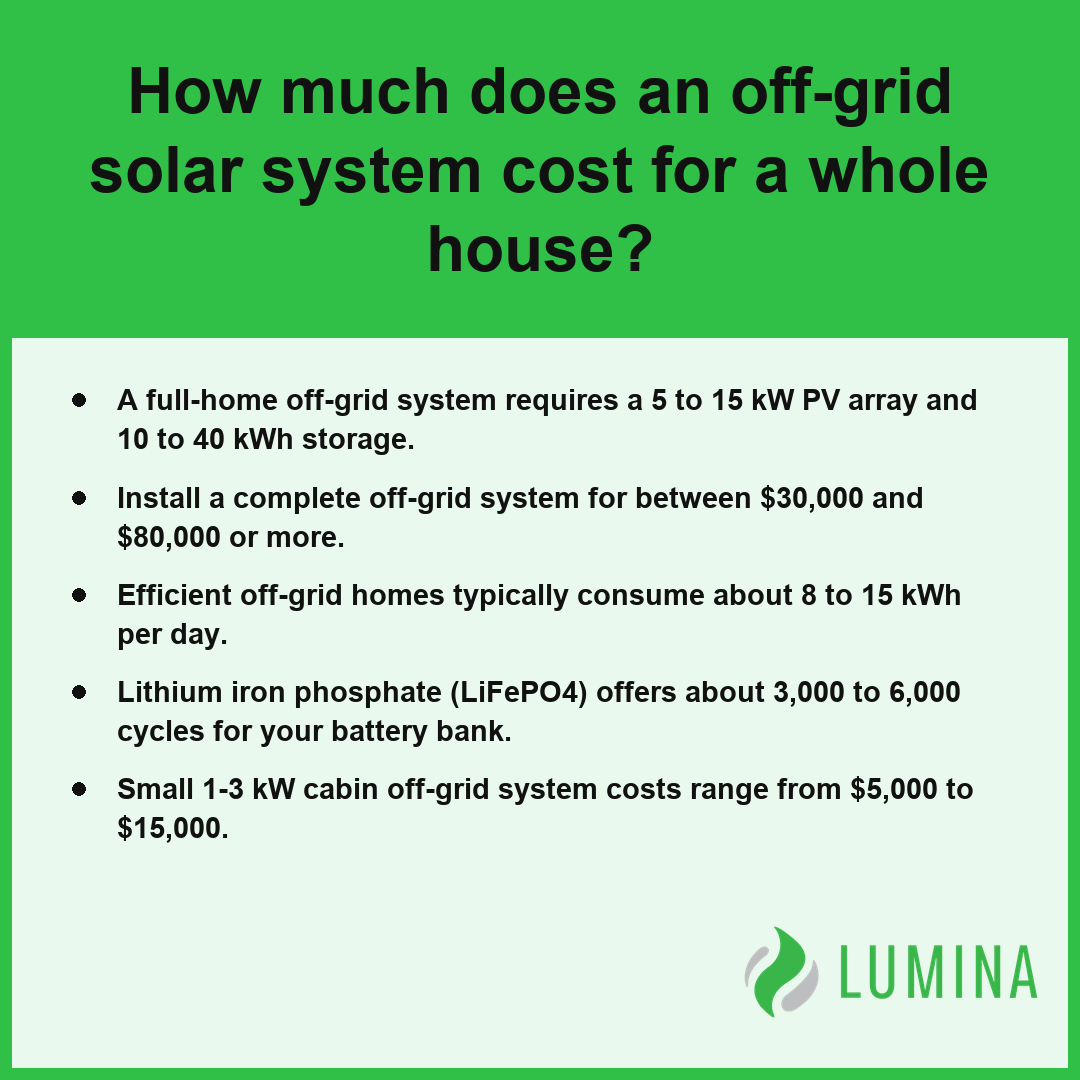
- A full-home off-grid system requires a 5 to 15 kW PV array and 10 to 40 kWh storage.
- Install a complete off-grid system for between $30,000 and $80,000 or more.
- Efficient off-grid homes typically consume about 8 to 15 kWh per day.
- Lithium iron phosphate (LiFePO4) offers about 3,000 to 6,000 cycles for your battery bank.
- Small 1-3 kW cabin off-grid system costs range from $5,000 to $15,000.
How Much Does an Off-Grid System Cost for a Whole House?
The cost of a complete residential off-grid system typically ranges from $30,000 to $80,000 or more, though small setups for cabins sized between 1 and 3 kW generally cost between $5,000 and $15,000. These figures encompass the primary infrastructure required to generate and store all of your household electricity, including the PV array, charge controller, inverter-charger, and the essential battery bank. Because you are not connected to a utility line, your investment must cover the entirety of your energy infrastructure rather than just the generation equipment.
| Component Category | Role in Off-Grid Independence | Estimated Budget Allocation |
|---|---|---|
| Battery Storage Bank | Energy autonomy and nighttime/overcast operation | 30% – 50% |
| PV Array & Mounting | Primary generation (5–15 kW full-home scale) | 20% – 30% |
| Inverter-Charger System | Load management and AC conversion (5–12 kW) | 10% – 20% |
| Balance of System | Grounding, wiring, safety disconnects, and monitoring | 5% – 10% |
| Backup Generator | Redundancy for extreme weather and peak surges | 5% – 10% |
Cost Allocation for Off-Grid Solar Systems
When budgeting for your off-grid system, keep in mind that the battery bank and power electronics are significant drivers of the total price. Per the Department of Energy, the total cost of an off-grid solar installation is heavily influenced by the load requirements of the home, as larger energy demands necessitate more extensive battery banks and solar hardware to maintain independent operation. Financial planning often involves allocating costs across the major hardware categories:
- Battery bank: Represents 30 to 50 percent of the total project investment.
- PV array and mounting hardware: Sized between 5 to 15 kW for a full-home installation.
- Inverter-charger: Typically ranging from 5 to 12 kW to handle household surge loads.
- Balance of system: Includes essential grounding, wiring, disconnects, and monitoring equipment.
- Backup generator: Recommended for supplementing production when battery state of charge drops below 20 to 30 percent.
Before committing to a specific hardware package, conduct a thorough load audit to determine your exact daily kilowatt-hour requirements, as this calculation dictates the size and cost of every component in your setup.
Beyond the primary equipment costs, consider these additional site-specific expenses that impact your final investment:- Permitting and inspection fees charged by local building departments.
- Professional site assessment and structural engineering for roof-mounted arrays.
- Utility-grade electrical trenching and conduit installation for ground-mount systems.
- System commissioning and specialized labor for off-grid load balancing.
- Long-term maintenance reserves for periodic inverter replacements and battery cycle management.
How Many Solar Panels You Need for an Off-Grid System
You determine how many solar panels you need for an off-grid system by calculating the total energy requirements of your residence to ensure your PV array compensates for local environmental variables. According to the National Renewable Energy Laboratory, solar energy system sizing involves calculating the total daily energy load in watt-hours and dividing that figure by the peak sun hours available at your specific geographic location. Because you rely entirely on your own generation, you must first perform a load audit to establish your daily watt-hour consumption. You then divide this daily total by your site’s peak sun hours, further adjusting the result by a system efficiency factor of roughly 70 to 80 percent to account for energy losses through wiring, your charge controller, and the conversion process within your inverter-charger.
| System Scale | Daily Energy Capacity | Recommended PV Array Range | Load Management Requirement |
|---|---|---|---|
| Minimalist/High Efficiency | 5–8 kWh | 5 kW | Strict conservation required |
| Standard Full-Home | 10–12 kWh | 10 kW | Moderate load balancing |
| High-Consumption/Large Array | 15+ kWh | 15 kW | Baseline usage optimization |
Typical Off-Grid PV Array Size (kW)
For most full-home installations, a PV array ranging from 5 to 15 kW is necessary to meet typical household demands. While efficient off-grid homes often manage their usage to roughly 8 to 15 kWh per day, your specific panel count fluctuates based on your geographic location and seasonal sunlight patterns. Consider the following variables when finalizing your PV array size:
- Peak sun hours: Areas with lower average solar intensity require more panels to achieve the same daily energy harvest.
- System voltage: Operating at 48 V DC helps minimize current and reduces the thickness of the wiring required between your array and the charge controller.
- Seasonal production: Northern regions may experience winter production drops of 30 to 60 percent, necessitating a larger array to maintain performance during low-light months.
- Controller efficiency: Selecting an MPPT charge controller over a PWM unit provides roughly 10 to 30 percent more energy harvest from the same number of panels.
Analyze your local historical weather data for winter months to ensure your PV array size provides enough buffer for the lowest expected daily solar gain.
Follow these supplemental steps to optimize your off-grid system performance:- Install an active battery monitoring system (BMS) to track real-time depth of discharge.
- Orient your solar array towards true south (in the Northern Hemisphere) with a tilt angle matching your site’s latitude.
- Implement programmable timers on high-draw appliances to operate only during peak sunlight hours.
- Clean your solar panels quarterly to mitigate efficiency losses caused by dust, pollen, or debris accumulation.
- Incorporate a backup generator or auxiliary power source to maintain battery health during extended periods of low irradiance.
Is Lithium or Flooded Lead-Acid Better for Your Off-Grid System Battery Bank?
While lithium iron phosphate (LiFePO4) offers a superior lifespan of about 3,000 to 6,000 cycles and high efficiency, you might choose flooded lead-acid for your off-grid system if you prefer a lower initial investment and do not mind the regular maintenance required to support your battery bank.
Battery Cycle Life Comparison (Typical Cycles)
How LiFePO4 Performs in a Battery Bank
Lithium iron phosphate (LiFePO4) is generally the superior choice for your off-grid system battery bank due to its high efficiency and longevity. These batteries typically last about 3,000 to 6,000 cycles and require a replacement interval every 10 to 15 years.
What Depth of Discharge Does LiFePO4 Allow?
You can reliably utilize 80 to 100 percent of the capacity of these batteries, making them highly effective for consistent power needs. Because they maintain a higher voltage throughout the discharge cycle, your inverter-charger can operate more efficiently.
How Flooded Lead-Acid Performs in a Battery Bank
Flooded lead-acid batteries are a traditional option for an off-grid system, though they require more maintenance, such as regular watering. According to the U.S. Department of Energy, flooded lead-acid batteries require regular maintenance including the periodic addition of distilled water to maintain electrolyte levels, while lithium iron phosphate batteries are sealed and maintenance-free. These batteries typically last about 500 to 1,500 cycles. You should limit their depth of discharge to about 50 percent to prevent permanent damage, which means you must oversize your battery bank to achieve the same usable energy capacity as a lithium setup.
Which Battery Type Fits Your Budget and Use?
Choosing the right technology depends on your upfront investment versus your long-term maintenance preferences and cycle requirements. The following table compares their operational characteristics:
| Feature | LiFePO4 | Flooded Lead-Acid |
|---|---|---|
| Typical Depth of Discharge | 80-100% | 50% |
| Cycle Life | 3,000-6,000 | 500-1,500 |
| Replacement Interval | 10-15 Years | 5-10 Years |
Compare the total life-cycle cost of both chemistries against your daily load audit before finalizing your battery bank capacity.
When considering the physical installation of these battery types, keep the following environmental and safety requirements in mind:- Flooded lead-acid batteries must be housed in a well-ventilated enclosure to safely vent hydrogen gas produced during the charging process.
- LiFePO4 batteries require an integrated Battery Management System (BMS) to protect against overcharging, over-discharging, and temperature fluctuations.
- Lead-acid batteries are position-sensitive and must be kept upright to prevent electrolyte leakage, whereas lithium batteries can often be mounted in various orientations.
- LiFePO4 systems are significantly lighter, often weighing one-third to one-half less than equivalent lead-acid capacity, which simplifies floor loading and mounting requirements.
How Many Days of Autonomy Your Battery Storage Needs for Cloudy Weather
How many days of autonomy your battery storage needs for cloudy weather is typically planned as a 1-3 day reserve to maintain reliable power for your off-grid system during periods of low sunlight. Because your PV array production often drops by 30 to 60 percent during winter months compared to summer, these extra kilowatt-hours act as a vital buffer against prolonged weather events. Designing for autonomy involves balancing your daily load audit against the reality that deep discharge cycles can shorten the lifespan of your storage assets. Per American Solar Energy Society, it is a recommended practice to keep your battery state-of-charge above 50 percent during cloudy intervals to avoid excessive depth-of-discharge and maximize the service life of lead-acid or lithium-ion systems. If you choose to rely on a backup generator to bridge these gaps, you can generally decrease the total battery bank capacity, whereas living without a generator requires a larger storage reservoir to survive consecutive overcast days.
| Autonomy Level | Ideal Use Case | Generator Reliance | System Cost Profile | Risk Tolerance |
|---|---|---|---|---|
| 1 Day | Managed low-load systems | Required (Primary Backup) | Lowest Initial Investment | High (Dependent on fuel/mechanics) |
| 2 Days | Typical residential homes | Optional (Seasonal Assist) | Moderate | Balanced |
| 3 Days | Remote, off-grid properties | Not Required | Highest Initial Investment | Low (Optimized for storm cycles) |
Recommended Days of Battery Autonomy
- 1 day of autonomy: Appropriate for setups with a reliable backup generator and low, strictly managed daily usage.
- 2 days of autonomy: Standard for typical residential setups, offering a balance between upfront cost and moderate reliability.
- 3 days of autonomy: Recommended for remote properties in regions with frequent extended storm cycles or limited winter peak sun hours.
Analyze your local historical weather patterns to determine the maximum number of consecutive sunless days you expect to encounter before deciding on the final capacity of your battery bank.
To optimize your specific off-grid configuration, consider these additional factors:- Calculate your total “critical load” in watt-hours to ensure the reserve capacity covers essential appliances rather than your entire home consumption.
- Account for inverter efficiency losses, which typically consume 5 to 15 percent of your stored energy during conversion.
- Factor in ambient temperature variables, as extreme cold significantly reduces the effective capacity of most battery chemistries.
- Perform a seasonal energy audit to adjust your reliance on stored power based on historical regional irradiance data.
Off-Grid System vs. Utility Line Extension for a Remote Property
Choosing between an off-grid system and a utility line extension for a remote property requires a balance between initial capital investment, long-term maintenance, and the reliability of your power source. While utility extensions provide a virtually limitless supply of electricity, the per-foot costs of installing new poles and lines can quickly exceed the budget of a robust standalone solar installation.
Cost Threshold Comparison (USD)
| Consideration | Off-Grid System | Utility Line Extension |
|---|---|---|
| Upfront Cost | $30,000 to $80,000+ | Variable (per-foot pricing) |
| Ongoing Maintenance | User-managed; battery replacement | Utility-managed; monthly bills |
| Reliability | Defined by battery bank capacity | Subject to grid outages |
| Autonomy | Complete control | None; tethered to the provider |
When evaluating these options, calculate the total cost of the line extension provided by your local utility company, as quotes often scale significantly over distance. Per the Rural Utilities Service, property owners situated far from existing electrical distribution lines often face prohibitive connection fees, which can make stand-alone renewable energy systems a more economically viable alternative for remote electrification. If the utility quote exceeds the $80,000 range for a standard residential setup, an off-grid system frequently becomes the more cost-effective choice. However, remember that an off-grid system requires you to actively manage your load audit and battery state of charge to ensure consistent performance during extended periods of low sunlight. When comparing the two, request a formal line extension estimate from your utility to determine if your site qualifies for a standard connection fee or if you face high-voltage infrastructure surcharges.
Analyze your property’s average monthly electricity consumption against the quoted per-mile installation fee provided by your local utility to determine the break-even point for your investment.
Before committing to a specific power strategy, evaluate these site-specific requirements:- Assess the solar irradiance (peak sun hours) of your specific property to determine necessary battery bank sizing.
- Inventory all high-draw appliances to calculate your total daily kilowatt-hour (kWh) consumption.
- Investigate local zoning laws and building codes regarding the height and placement of ground-mounted solar arrays.
- Verify the availability of professional service technicians within your region who can perform long-term system maintenance.
- Check if your local municipality offers tax incentives or rebates for standalone renewable energy installations.
Frequently Asked Questions
What components do you need to build an off-grid solar system?
You need a PV array, charge controller, battery bank, and inverter-charger to build an off-grid system. Essential hardware also includes disconnects, breakers, proper grounding, wiring, and a monitoring system. You may also include a backup generator to ensure your electricity supply remains consistent during periods of low sunlight.
Is an MPPT or PWM charge controller better for an off-grid solar system?
An MPPT charge controller is better for an off-grid system because it provides roughly 10 to 30 percent more harvest than a PWM unit, particularly in cold weather. While both regulate power, MPPT technology maximizes the electrical output by matching the array voltage to the battery bank requirements.
What size inverter do I need to start a well pump in an off-grid system?
You need an inverter capable of handling 3 to 7 times the running wattage of your well pump to accommodate high startup surges. When sizing an inverter for an off-grid system, ensure the surge rating covers the motor load, as pumps demand significant power to initiate movement from a standstill.
Can an off-grid solar system run air conditioning and electric heating?
Yes, an off-grid system can run air conditioning and electric heating if you design the capacity to support your specific load audit requirements. Efficient off-grid homes typically manage their total usage to about 8 to 15 kWh per day, requiring robust battery storage and a correctly sized PV array.
How long do off-grid solar panels and batteries last before replacement?
Solar panels typically last over 25 years with a 0.5 percent annual degradation rate, while lithium iron phosphate (LiFePO4) batteries require replacement every 10 to 15 years. Flooded lead-acid batteries have a shorter lifespan of 5 to 10 years, making them a less durable component for an off-grid system.