Shading: Module-level Electronics, Output Loss, Series String Effect, Solar Access, Mitigation Options, Timing, Sources, Types, Measurement Tools, Bypass Diodes
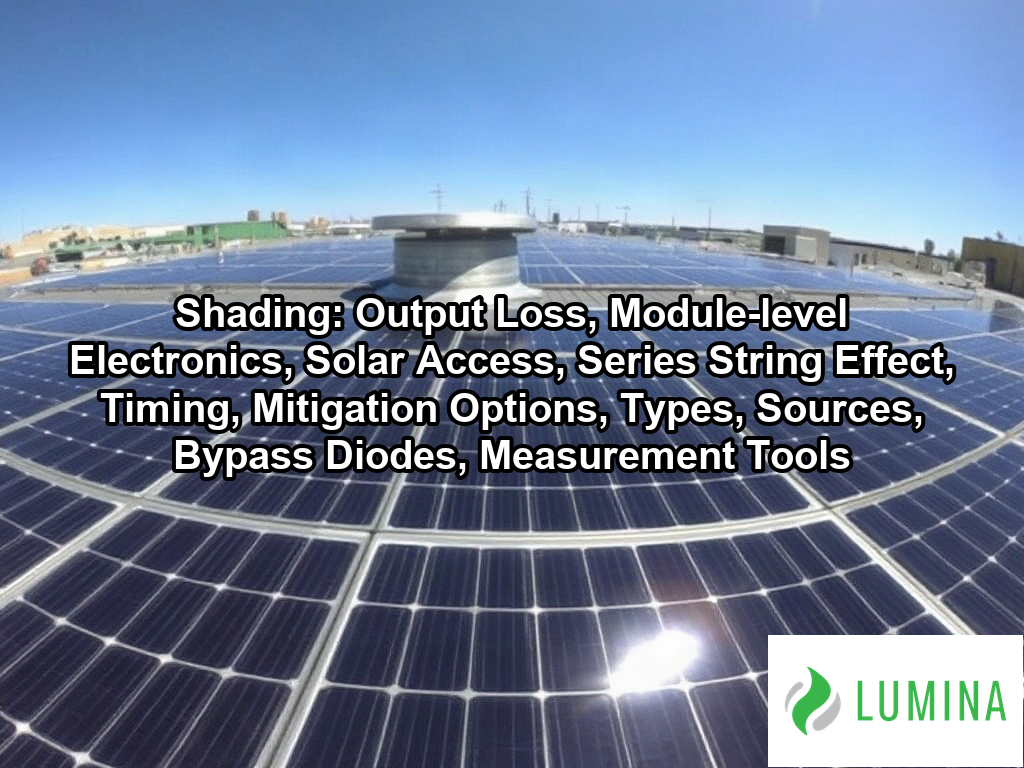
Shading is the partial or full blocking of sunlight from reaching solar cells, which reduces the electricity a panel produces. Key aspects include output loss, module-level electronics, solar access, series string effect, timing, mitigation options, types, sources, bypass diodes, and measurement tools. Because cells in a panel are wired in series, a shadow across even one cell can pull down the output of the whole module, and in a connected string it can limit every panel in that string. Module-level electronics such as microinverters and power optimizers let each panel operate independently, so a shaded panel affects your system less. Solar access describes how much unobstructed sunlight reaches your roof, and it changes with trees, chimneys, nearby buildings and the angle of the sun through the seasons. Timing matters too, since a shadow in the early morning costs you far less energy than one at midday. In a Maryland solar panel installation, these factors shape panel placement, wiring layout and expected annual production, and the sections below explain output loss, the series string effect, module-level electronics, solar access and timing in turn.
Key Takeaways
- Light shading typically causes 2-5% annual production loss for a solar panel.
- Heavy shading on a string inverter system can cut output by 20-40% or more.
- Microinverters and DC power optimizers cost roughly $0.10-$0.40 per watt extra.
- Target a Total Solar Resource Fraction (TSRF) or solar access of 80-85% or higher.
- Solar access levels below roughly 75% are often considered marginal for systems.
How Much Power Will Shading Cost Your Solar Panels Each Year?
You can expect shading to cause a typical annual production loss of 2-5% for light obstruction, though heavy shading on a series string system can result in an annual output loss of 20-40% or more.
| Shading Severity Type | Primary Cause Characteristics | System Impact Mechanism | Estimated Annual Energy Loss |
|---|---|---|---|
| Light Shading | Thin branches, distant poles, atmospheric haze | Reduced solar intensity across module surface | 2% – 5% |
| Heavy Shading (String Inverter) | Persistent obstructions (chimneys, tall trees, structures) | Current bottlenecking; “weakest link” performance throttling | 20% – 40%+ |
Typical Annual Solar Production Loss
What Light Shading Typically Costs
Light shading will typically cost your solar panels an annual production loss ranging from 2% to 5%. This level of impact often results from transient or diffuse sources like thin branches, distant utility poles, or haze, which do not completely block the solar cells but reduce the intensity of light reaching the module. While this percentage seems small, it reflects a consistent decrease in the total energy harvested throughout the year.
What Heavy Shading Does to a String Inverter System
Heavy shading on a string inverter system can result in an annual output loss of 20-40% or more. Because these systems connect every solar panel in a series string, the current is restricted to the weakest module. National Renewable Energy Laboratory reports that shading on a single solar cell can disproportionately reduce the power output of an entire series-connected module or string due to the current-limiting nature of the shaded cell. If a single obstruction causes a significant drop in power, the entire string experiences a proportional decline in performance. When cells are blocked, bypass diodes help by allowing current to skip affected substrings, yet the overall system efficiency remains throttled by the worst-performing module in the array.
When Small Losses Add Up Over Time
Cumulative production impacts are influenced by the consistency and placement of obstructions:
- Permanent Obstructions: Chimneys, dormers, and vent pipes cause localized, daily drops in output.
- Temporary Obstructions: Seasonal accumulation of leaves, snow, or bird droppings can create severe, short-term performance dips.
- Hardware Risks: Without bypass diodes, unprotected cells under heavy shade can reach internal temperatures exceeding 150°F above normal, potentially causing permanent damage to the module.
Does a Little Shading Justify Changing Your Design?
Yes, a little shading justifies changing your design if your projected solar access falls below the standard threshold of 75%, as this marginal level may fail to deliver a reasonable return on your investment. Before finalizing your layout, ensure you perform a rigorous shade analysis to determine if you can bypass the affected areas or if the added system cost of $0.10-$0.40 per watt for module-level electronics will effectively mitigate those specific losses.
Use a professional-grade shade analysis tool to map the horizon profile against your specific roof pitch to ensure your final design avoids the most obstructive objects.
To mitigate the impact of shading on your solar array, consider the following optimization strategies:- Install Module-Level Power Electronics (MLPE), such as microinverters or DC power optimizers, to isolate individual panel performance.
- Conduct a shade analysis during the design phase using solar pathfinder tools to map seasonal obstruction patterns.
- Implement physical site maintenance, such as strategic tree trimming, to remove persistent light-obstructing foliage.
- Segment your panel array into multiple strings or independent MPPT channels to bypass shaded sections of the roof.
Why Shading on One Solar Cell Reduces the Output of the Whole Module
Shading on one solar cell reduces the output of the whole module because the individual cells are connected in a series string, meaning the current flowing through the entire module is throttled to match the lowest-performing cell. Per the U.S. Department of Energy, shading even a small portion of a single solar cell can create a bottleneck that significantly reduces the power output of the entire module because the shaded cell acts as a resistor to the current flowing from the unshaded cells. When sunlight is obstructed by sources like leaves, bird droppings, or structural elements, the affected cell cannot generate electricity effectively. Because the current is restricted by the weakest cell, the module’s electrical output drops disproportionately compared to the physical area covered by the obstruction.
| Shading Classification | Primary Obstruction Sources | Irradiance Impact Level | Electrical System Response |
|---|---|---|---|
| Hard Shading | Chimneys, vent pipes, building structures | Complete blockage of direct beam | Bypass diode activation to prevent hot spots |
| Soft Shading | Dust, haze, distant tree canopy | Diffuse reduction of light intensity | Reduced current flow across the series string |
Typical Temperature Characteristics (F)
To prevent this single-cell performance bottleneck from collapsing the output of the entire module, manufacturers integrate bypass diodes. These components allow the electrical current to circumvent the shaded section entirely. While this design saves the rest of the module, it still results in a measurable drop in energy production.
- Hard shading: Solid, opaque obstructions such as chimneys, vent pipes, or neighboring buildings that fully block direct beam irradiance.
- Soft shading: Diffuse, translucent, or partial obstructions such as haze, dust, or distant tree branches that reduce intensity without complete blockage.
- Reverse-bias effect: A condition where heavily shaded cells dissipate power as heat, leading to a hot spot that can exceed 150°F above normal and cause permanent damage.
Inspect your roof for localized obstructions like overhanging tree branches or debris that might cause permanent or seasonal shading on specific modules.
Mitigation strategies for minimizing the impact of shading on solar installations include the following:- Utilize Module-Level Power Electronics (MLPE) like microinverters or DC optimizers to decouple individual panel performance from the rest of the string.
- Perform professional site assessments using a solar pathfinder to identify and remove dynamic shading risks like overgrown vegetation.
- Implement regular maintenance schedules for cleaning panels to prevent the accumulation of organic debris that causes soft shading.
- Optimize panel orientation and tilt angles to maintain consistent irradiance levels across the entire array surface throughout the day.
Do You Need DC Power Optimizers or Microinverters if Your Solar Panels Are Partly Shaded?
Yes, you need DC power optimizers or microinverters if your solar panels are partly shaded, as these module-level power electronics prevent a single obstructed solar panel from dragging down the performance of the rest of your system. In a standard series string, the current is restricted by the weakest module, but these devices isolate each unit so that only the shaded module experiences a production drop. Per the Solar Energy Industries Association, systems using panel-level power conversion technology generally achieve better energy harvest and enhanced monitoring compared to traditional central string inverters in locations with uneven sun exposure. While this technology provides a meaningful recovery of output, you must weigh the performance gains against the initial investment, which typically adds roughly $0.10-$0.40 per watt to the total system cost.
| Technology Type | Primary Function in Shaded Conditions | Granularity of Control | Cost Impact ($/Watt) |
|---|---|---|---|
| Microinverters | Converts DC to AC at the module level to eliminate string bottlenecks | Individual Module | High |
| DC Power Optimizers | Conditions DC power per panel before sending to a central string inverter | Individual Module | Moderate |
| Bypass Diodes | Bypasses current around shaded internal substrings to prevent total failure | Sub-module | Negligible (Integrated) |
Estimated Cost Premium ($ per watt)
- Microinverters: Convert direct current to alternating current at each individual solar panel, effectively eliminating string-wide bottlenecks.
- DC Power Optimizers: Maintain the efficiency of a string inverter system by adjusting the voltage and current of each solar panel independently to account for partial shading.
- Bypass Diodes: Integrated components that allow current to skip shaded substrings within a module, though they do not provide the same granular control as power electronics.
- Economic Tradeoff: The decision to use these electronics should be based on whether the expected recovery of energy output justifies the added $0.10-$0.40 per watt premium.
Compare the anticipated annual energy losses of your roof layout with the price premium of these electronics to determine if the payback period aligns with your financial goals.
Consider these additional factors when evaluating whether module-level electronics are right for your specific installation:- Warranty Compatibility: Ensure your panel manufacturer’s warranty remains valid when paired with third-party optimizers or specific microinverter brands.
- Rapid Shutdown Compliance: Check if your local jurisdiction requires module-level rapid shutdown (NEC 690.12), which these devices inherently satisfy.
- Future Expansion: Microinverters allow for easier system scaling if you plan to add more solar panels at a later date.
- Maintenance Accessibility: Microinverters require servicing on the roof, whereas central string inverters are typically mounted at ground level for easier access.
What Is a Good Solar Access or TSRF Percentage, and When Is It Too Low?
A good solar access or Total Solar Resource Fraction (TSRF) percentage is typically 80-85% or higher, whereas levels falling below roughly 75% are often considered marginal for project viability. Per the United States Department of Energy, a TSRF score of 70 percent or higher is widely accepted by industry standard guidelines as the minimum threshold for a cost-effective solar energy installation. These metrics quantify how much potential solar energy reaches your solar panel array after accounting for shading from objects like trees, chimneys, or neighboring structures throughout the year.
Minimum TSRF Thresholds
| Solar Access/TSRF Rating | Project Outlook |
|---|---|
| 85% and above | Excellent; minimal impact from shading. |
| 80-84% | Good; standard for most high-performing arrays. |
| 75-79% | Acceptable; requires careful design consideration. |
| Below 75% | Marginal; potential performance and financial drawbacks. |
Installers determine these figures by conducting a formal shade analysis using specialized tools such as the Solmetric SunEye or drone-based 3D modeling, which map the horizon’s obstructions against the sun’s path. While you might reach your energy goals with a lower score through advanced panel placement or the addition of module-level electronics, a lower percentage directly increases the financial payback period. Use a shade analysis tool to verify the specific obstruction profile of your roof before committing to a final array layout.
To optimize your solar installation’s performance regardless of your initial TSRF score, consider these strategic adjustments:- Optimize roof orientation to prioritize south-facing surfaces for maximum year-round exposure.
- Install module-level power electronics, such as microinverters or DC optimizers, to isolate the impact of localized shading on individual panels.
- Implement string-level design adjustments to avoid routing electrical circuits through arrays affected by chimney or vent pipe shadows.
- Evaluate the cost-benefit ratio of trimming or removing physical obstructions like encroaching tree limbs before finalizing your system design.
Which Hours and Seasons Make Shading Hurt Solar Panel Production the Most?
The hours and seasons that make shading hurt solar panel production the most are those when the sun resides at lower altitudes in the sky, specifically during the winter months and the early morning or late afternoon hours. Because the sun follows a lower arc during winter—reaching a noon altitude of only about 25 to 35 degrees at mid-latitudes—even minor obstructions can cast long, intrusive shadows across your array, significantly reducing the duration of peak solar access.
| Seasonal Shading Variable | Impact on Solar Array Efficiency | Primary Mitigation Factor |
|---|---|---|
| Winter Solstice (Low Solar Arc) | Highest shadow projection; severe potential loss | Permanent structure positioning |
| Early Morning / Late Afternoon | Reduced duration of peak solar access | Roof vent and chimney clearance |
| Summer Canopy Growth | Increased density; potential full-panel blockage | Foliage and limb maintenance |
| Mid-day (9 a.m. – 3 p.m. Window) | Optimal energy production baseline | Solar access threshold monitoring |
Solar Access Threshold Metrics
- Assess your roof for obstacles like vent pipes or chimneys that cast shadows during the 9 a.m. to 3 p.m. window, as these hours provide the highest potential for energy collection.
- Observe the movement of tree limbs and foliage throughout the year, noting that leafless winter branches may allow more light through than summer canopy coverage.
- Identify permanent structures, such as neighboring buildings, that block sunlight during the winter solstice when the sun is at its lowest point in the sky. According to the Department of Energy, shading impacts are most severe during winter months in the United States because the sun follows a lower arc, causing nearby shadows to be significantly longer than those cast during the summer.
- Compare your site’s physical obstructions against the sun path chart for your specific latitude to determine if specific seasons will cause your system to fall below the typical 80-85% solar access threshold.
Review the historical trajectory of neighboring trees and building developments to ensure future growth or construction does not obstruct these critical low-angle winter sunlight hours.
To ensure maximum performance, follow these maintenance and assessment practices:- Conduct a physical site survey using a solar pathfinder tool to map precise shadow patterns across all four seasons.
- Install module-level power electronics, such as microinverters or power optimizers, to isolate the impact of partial shading to individual panels.
- Coordinate annual vegetation trimming during late autumn to clear branches that will reach peak density by the following summer.
- Adjust system tilt angles during initial installation to compensate for local latitude-specific winter sun arcs.
- Check for secondary shadow sources, such as power lines or neighboring building expansions, that may have emerged since the initial installation.
Frequently Asked Questions
What are the different types of shading on solar panels, such as hard shade versus soft shade?
Hard shading involves solid objects that block sunlight completely, such as leaves or chimneys, while soft shading consists of diffuse obstructions like haze or distant tree branches. You may also categorize shading as permanent, seasonal, or temporary, depending on how long the obstruction remains in the path of sunlight.
What common things cause shading on solar panels besides trees?
Common sources of shading include chimneys, vent pipes, dormers, neighboring buildings, utility poles, antennas, snow, bird droppings, and other rows of panels. Any obstruction that blocks direct sunlight from reaching your module reduces its total energy output, regardless of whether the source is a natural object or man-made structure.
Do bypass diodes protect solar panels from shading damage and hot spots?
Yes, bypass diodes protect solar panels by allowing current to skip a shaded substring, which prevents a heavily shaded cell from becoming reverse-biased and developing a hot spot that can exceed 150°F above normal. These diodes typically limit the loss to one-third of the module instead of the entire unit.
What tools measure shading on a roof for solar panels, and how accurate are they?
You can measure shading using tools like a Solmetric SunEye, Solar Pathfinder, drone-based 3D modeling, or smartphone apps that plot the sun path against horizon obstructions. These tools determine your solar access or Total Solar Resource Fraction (TSRF), with installers targeting 80-85% or higher, while considering levels below 75% marginal.
How can I fix or reduce shading on my solar panels without removing the whole system?
You can mitigate energy losses by installing microinverters or a DC power optimizer, which isolate each panel so shaded modules only reduce their own output. While these add roughly $0.10-$0.40 per watt to your system cost, they help recover losses from shading that otherwise affect the entire series string.