
Warranty: Length, Types, Labor Coverage, Guaranteed Output, Remedies, Exclusions, Transferability, Claim Requirements, Provider Backing, Inverter and Battery Terms
A warranty is a written promise from a manufacturer or installer to repair, replace, or compensate for defects or underperformance. Key aspects include types, length, guaranteed output, labor coverage, exclusions, remedies, claim requirements, transferability, inverter and battery terms, and provider backing. In solar panels, coverage usually falls into two main categories: product protection against defects and performance protection tied to power output over time. Terms often run from 10 to 25 years or more, and the length depends on which part of the system is covered. For a residential solar installation Maryland owners rely on, the paperwork also states whether labor costs for removal and reinstallation are included. This article explains the types of coverage, typical lengths, guaranteed output levels, labor coverage, and the exclusions that commonly limit claims.
Key Takeaways
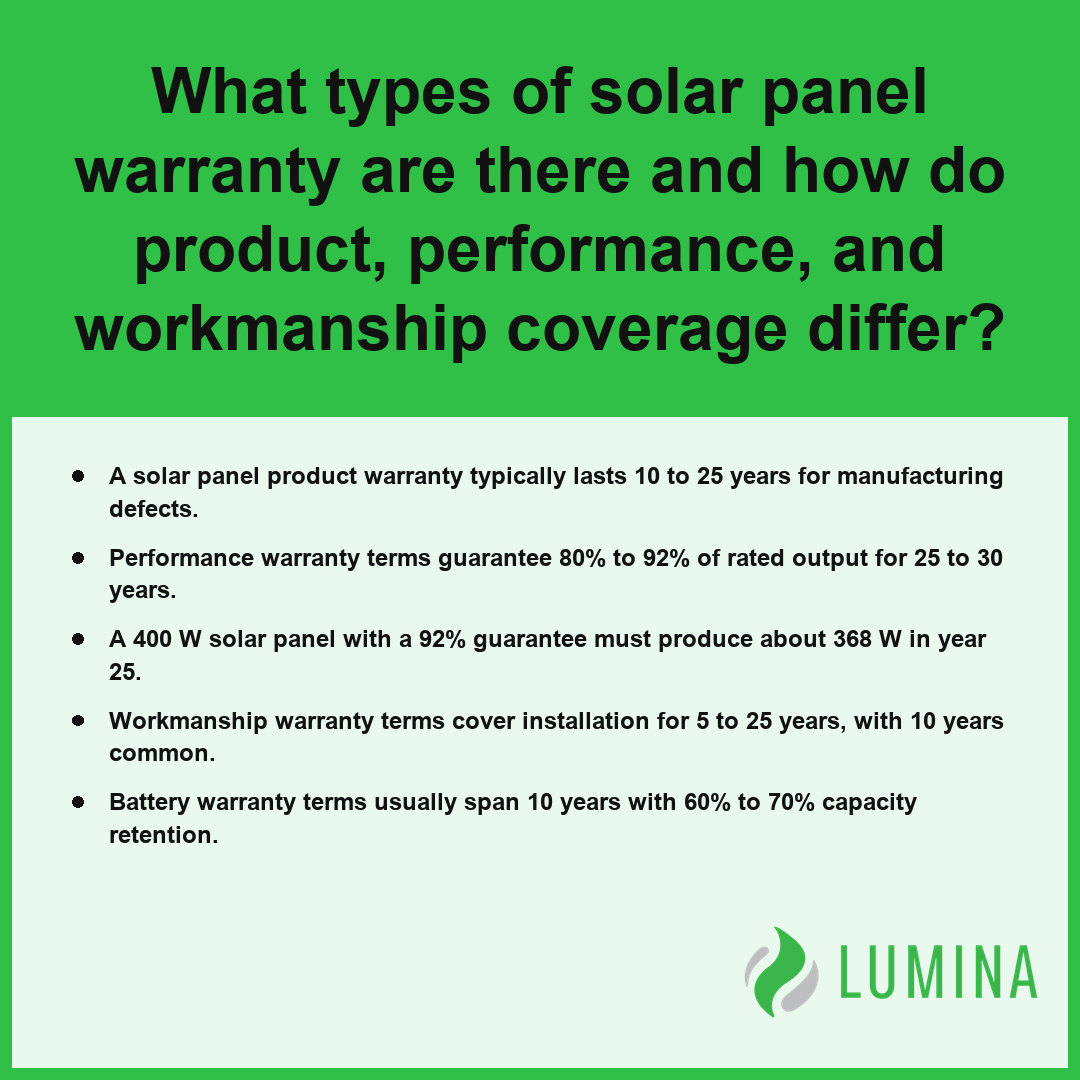
- A solar panel product warranty typically lasts 10 to 25 years for manufacturing defects.
- Performance warranty terms guarantee 80% to 92% of rated output for 25 to 30 years.
- A 400 W solar panel with a 92% guarantee must produce about 368 W in year 25.
- Workmanship warranty terms cover installation for 5 to 25 years, with 10 years common.
- Battery warranty terms usually span 10 years with 60% to 70% capacity retention.
Types of Solar Panel Warranty: How Product, Performance, and Workmanship Coverage Differ
Types of solar panel warranty coverage differ based on whether the protection applies to the physical hardware, the energy generation capacity, or the quality of the installation service. Each distinct warranty ensures you are protected against specific failures throughout the lifespan of your system.
Maximum Warranty Terms (in Years)
| Warranty Type | Covers | Typical Term |
|---|---|---|
| Product Warranty | Manufacturing defects like delamination, cell failure, or frame issues | 10 to 25 years |
| Performance Warranty | Guaranteed minimum power output and degradation limits | 25 to 30 years |
| Workmanship Warranty | Installation errors such as roof leaks, wiring, and mounting faults | 5 to 25 years |
The product warranty addresses physical equipment integrity, while the performance warranty focuses on electrical output metrics over time, typically promising 80% to 92% of the rated output at the end of the term. Per the United States Department of Energy, workmanship warranties are distinct from manufacturer warranties and are provided by the installation contractor to cover issues arising from the physical mounting and electrical integration of the system. While these warranties often overlap, they are distinct agreements that may have different claim processes, transferability rights, or expiration dates.
Review the specific documentation provided by your installer to confirm whether the workmanship warranty includes a clear procedure for how to transfer to a new owner should you sell your property.
To maximize the security of your solar investment, follow these best practices for managing your coverage documentation:- Register your solar equipment directly with the manufacturer to activate the full product warranty term.
- Request a formal copy of the installer’s workmanship warranty certificate before the final system commissioning.
- Store digital and physical copies of all warranty terms in a secure location for the duration of the system’s life.
- Verify if your warranty contracts include provisions for transferability to new homeowners in the event of a property sale.
- Schedule periodic maintenance inspections to ensure that you remain compliant with manufacturer-mandated care requirements.
How Long Does a Solar Panel Warranty Last, and Do Panels Stop Working at 25 Years?
A solar panel typically includes a product warranty ranging from 10 to 25 years and a performance warranty lasting 25 to 30 years, meaning your equipment will continue to function well past that term, albeit at about 80% to 92% of its original rated output due to gradual degradation.
Estimated Annual Solar Panel Efficiency Degradation Rate
Product Warranty Length vs. Performance Warranty Term
The duration of a solar panel warranty varies significantly between the equipment itself and its energy output. A product warranty typically lasts 10 to 25 years, covering manufacturing defects, whereas a performance warranty covers the rated output for 25 to 30 years. These timelines often overlap but protect you against different risks.
What Happens to Your Panels After the Warranty Ends?
No, your solar panels do not stop working at 25 years; they continue to generate electricity, albeit at a lower efficiency due to natural degradation. The warranty provides a contractual endpoint for specific claims, but the hardware remains functional beyond these dates. You can expect your system to produce power long after the initial coverage expires.
Why Degradation Continues Slowly Past Year 25
Physical components undergo constant environmental stress, leading to a linear decline in efficiency of roughly 0.25% to 0.55% per year after the first year. According to the National Renewable Energy Laboratory, degradation rates for modern solar panels generally average about 0.5 percent per year, meaning panels continue to generate useful energy long after their initial performance guarantees conclude. This gradual reduction does not halt at the warranty expiration but continues at a measured pace as the internal cells age.
| System Component | Typical Warranty Term |
|---|---|
| Product Warranty | 10 to 25 years |
| Performance Warranty | 25 to 30 years |
| String Inverter | 10 to 12 years |
Inverter Warranty and Battery Warranty Terms Compared
While solar panels are built for long-term use, other components often require replacement sooner. Inverter warranty lengths depend on the technology used, and a battery warranty is generally limited by both time and energy throughput.
- String inverters: 10 to 12 years
- Microinverters and power optimizers: 25 years
- Battery capacity retention: 60% to 70% over 10 years
Review the manufacturer documentation to confirm if your specific inverter model allows for a paid extension to match the length of your solar panel coverage.
To extend the lifespan and efficiency of your solar system beyond the initial warranty period, consider these maintenance best practices:- Perform professional cleanings every one to two years to remove debris, pollen, and dust that can artificially reduce output.
- Monitor your system’s output via your inverter’s app to identify sudden drops in production that may indicate a non-degradation-related fault.
- Ensure trees and vegetation are trimmed annually to prevent shading, which accelerates panel-level stressors.
- Inspect mounting hardware and wiring connections every few years to ensure structural integrity and prevent electrical resistance buildup.
How Much Power Must a Solar Panel Still Produce in Year 25?
In year 25, a solar panel must still produce about 80% to 92% of its original rated output under standard test conditions, depending on the terms of your performance warranty. This guarantee accounts for the natural degradation of photovoltaic cells over time, ensuring that your investment maintains a functional level of energy generation throughout the life of the system. Per the Solar Energy Industries Association, these performance warranties serve as contractual guarantees from manufacturers to ensure that panel degradation remains within specific limits over a typical 25-year lifespan.
| Degradation Metric | Industry Standard / Cap | Impact on System Longevity |
|---|---|---|
| First-Year Efficiency Loss | 1.0% – 2.0% | Initial settling of cell material performance |
| Annual Degradation Rate (Years 2-25) | 0.25% – 0.55% | Linear decline of photovoltaic conversion capability |
| Minimum Output Threshold (Year 25) | 80% – 92% | Contractual end-of-term energy generation guarantee |
Typical Performance Warranty Retention (Year 25)
Manufacturers typically structure these guarantees by setting a maximum threshold for annual efficiency loss. While the specific degradation curve varies by brand, the following figures illustrate how your panel’s output is protected:
- Initial Year Degradation Cap: Most plans allow for a 1% to 2% reduction in output during the first year of operation.
- Subsequent Annual Decline: After the first year, manufacturers usually guarantee a linear degradation rate of roughly 0.25% to 0.55% per year.
- Example Calculation: If you install a 400 W panel with a 25-year performance warranty set at 92% output, that panel is contractually required to produce at least about 368 W at the end of the term.
Compare the degradation rates offered by different manufacturers to determine which panel will provide the highest energy yield near the expiration of your performance warranty.
To maximize the performance and longevity of your solar installation, consider the following maintenance and operational best practices:- Keep panels clear of debris, dust, and bird droppings to prevent localized hotspots that can accelerate cell degradation.
- Monitor inverter data regularly to ensure the system output tracks consistently with the manufacturer’s expected annual degradation curve.
- Ensure proper ventilation beneath the array, as high operating temperatures can prematurely stress photovoltaic materials beyond the standard degradation rates.
- Schedule periodic professional inspections to verify that all electrical connections remain secure and free of corrosion, which can cause power loss unrelated to cell aging.
What Voids a Solar Panel Warranty or Is Excluded, Such as Hail, Shading, or Improper Installation
What voids a solar panel warranty or is excluded, such as hail, shading, or improper installation, typically involves events outside the manufacturer’s control or errors during the mounting process. You must understand that while a product warranty covers manufacturing flaws like delamination or junction box failures, it does not act as comprehensive insurance against environmental damage or negligence. If the system suffers from issues not directly tied to equipment construction, your claim will likely be denied.
| Issue Category | Primary Root Cause | Impact on Coverage | Recommended Action |
|---|---|---|---|
| Improper Installation | Unauthorized labor or failure to follow technical guidelines | Voided workmanship and equipment warranty | Utilize certified installers and verify adherence to manufacturer manuals |
| Environmental Hazards | Force majeure, lightning, fire, or large-scale hail | Excluded from manufacturer warranty; covered by homeowner insurance | Review and maintain supplemental property or hazard insurance |
| External Shading | Post-installation growth or adjacent construction | Performance warranty invalid (no defect present) | Conduct site assessment before installation and monitor vegetation |
| Neglect or Modification | Unauthorized system changes or maintenance lapses | Potential total or partial warranty cancellation | Adhere to scheduled maintenance and consult manufacturer before upgrades |
- Improper Installation: Workmanship warranties or manufacturer agreements may be voided if the system is installed by unauthorized personnel or fails to follow technical guidelines, potentially affecting roof penetration integrity.
- Environmental Hazards: Damage caused by natural disasters, extreme weather events like large hail, lightning strikes, fire, or vandalism is generally excluded from standard coverage. According to the Department of Energy, damage resulting from force majeure events like extreme weather or natural disasters is typically excluded from standard manufacturer warranties unless specifically covered by supplemental homeowner insurance policies.
- External Shading and Site Conditions: While shading reduces energy production, it is an external factor and not a manufacturing defect, meaning the performance warranty will not cover output drops caused by new trees or adjacent construction.
- Neglect or Modification: Unauthorized repairs, system modifications, or failures to conduct recommended maintenance as specified in the manual can result in the loss of your protection.
- Roofing Compatibility: Installing panels in a way that damages the roof or interferes with the existing roofing materials may void your underlying roof protection, separate from the solar equipment coverage.
Review the specific exclusions document provided by your installer to confirm how your roof’s existing coverage interacts with the new solar array components.
To ensure your warranty remains valid and your system stays protected, follow these additional best practices:- Document the installation process with photos or a commissioning report to establish a baseline of proper setup.
- Register your equipment serial numbers with the manufacturer immediately after activation to ensure you are in their active database.
- Request written approval from the manufacturer before adding third-party components or smart home monitoring devices.
- Keep a digital folder of all invoices and service records to provide proof of professional maintenance if a future claim arises.
- Conduct routine visual inspections for signs of pest damage, such as chewed wiring, which is often excluded under standard equipment warranties.
Does a Solar Panel Warranty Cover Labor Costs for Removing and Reinstalling a Defective Panel?
No, a standard solar panel warranty generally does not cover labor costs for removing and reinstalling a defective panel, often leaving you responsible for these expenses. According to the Department of Energy, manufacturer equipment warranties typically cover the cost of replacing a defective solar panel unit but often exclude the labor costs associated with the removal, shipping, and reinstallation of the hardware. While many manufacturers provide the replacement equipment under a product warranty, they frequently exclude the practical costs associated with the physical logistics of the repair.
| Service Component | Manufacturer Responsibility | Installer Responsibility | Potential Financial Burden |
|---|---|---|---|
| Hardware Replacement | Covers cost of the new panel unit | Rarely covers equipment procurement | Shipping and logistics fees |
| Labor & Logistics | Excluded | Varies (often limited to workmanship) | Removal, crane rental, and reinstallation |
| Roof Access | Excluded | Excluded unless specified in contract | Specialized labor and safety equipment |
| Extended Protection | Not applicable | Available as optional add-on | Upfront premium for labor coverage |
Because labor coverage is separate from equipment protection, you may face significant out-of-pocket fees if you need to access a failed component. When reviewing your agreements, pay close attention to which specific items are supported by the manufacturer versus the installer:
- Equipment Replacement: The manufacturer typically ships the replacement solar panel but excludes the costs of freight, crane rentals, or specialized roof access.
- Workmanship Warranty: Your installer may provide limited labor coverage, but this is usually tied to the initial installation quality rather than replacing components that fail due to manufacturing defects.
- Third-Party Protection: Some installers offer optional extended labor plans for an additional fee to bridge the gap between manufacturer coverage and real-world service requirements.
Review the fine print of your installation contract specifically for clauses that define whether the company will provide complimentary reinstallation services for components that fail during the term of the manufacturer’s product warranty.
To minimize your risk of unexpected expenses, consider these additional proactive steps when managing solar system warranties:- Verify if your installer offers a “labor warranty” or “workmanship guarantee” that extends beyond the first year of operation.
- Check your original contract to see if the solar installation company is still in business, as manufacturers rarely honor labor claims if the original installer has gone bankrupt.
- Inquire about “transferable” warranties, which can be a valuable selling point if you decide to sell your home.
- Request written clarification from your installer regarding who is responsible for the costs of troubleshooting and diagnostic site visits before a hardware failure is officially confirmed.
Frequently Asked Questions
If a solar panel is defective, will the manufacturer repair it, replace it with a different model, or refund me?
If a solar panel is defective, the manufacturer chooses between repairing the item, replacing it with an equivalent product, or refunding the current market value of the lost power. You should check if your specific agreement includes labor coverage, as many manufacturers cover the replacement panel but exclude removal and reinstallation costs.
What documents and registration do I need to file a solar panel warranty claim?
To file a solar panel warranty claim, you typically need the original purchase receipt, proof of professional installation, and the serial numbers for the affected units. You should register your system with the manufacturer immediately after installation, as this process ensures your documentation is verified for any future claim you may submit.
Is a solar panel warranty transferable to a new homeowner when I sell my house?
Yes, a solar panel warranty is often transferable to a new owner when you sell your house, provided you follow the manufacturer’s specific process. You must notify the company of the ownership change to ensure the transfer to a new owner is successfully recorded and the remaining term stays valid for them.
How long are solar inverter and battery warranties compared with the panel warranty, and is extending an inverter warranty worth it?
String inverter warranties typically last 10 to 12 years, while microinverters and batteries usually cover 10 to 25 years. Extending an inverter warranty for a few hundred dollars can be a valuable choice to bridge the gap toward the 25 to 30 years covered by your solar panel performance warranty.
What happens to my solar warranty if the installer or panel manufacturer goes out of business?
If a panel manufacturer goes out of business, your product warranty and performance warranty may become impossible to enforce, leaving you without support for defects or power issues. Similarly, if your installer ceases operations, you might lose your workmanship warranty, which typically covers issues like roof leaks and structural failure under warranty.