
Backsheet: Failure Signs, Material, Cost, Repair Options, Electrical Insulation Rating, Color, Layer Structure, Durability Testing, Thickness and Weight, Glass-glass Alternative
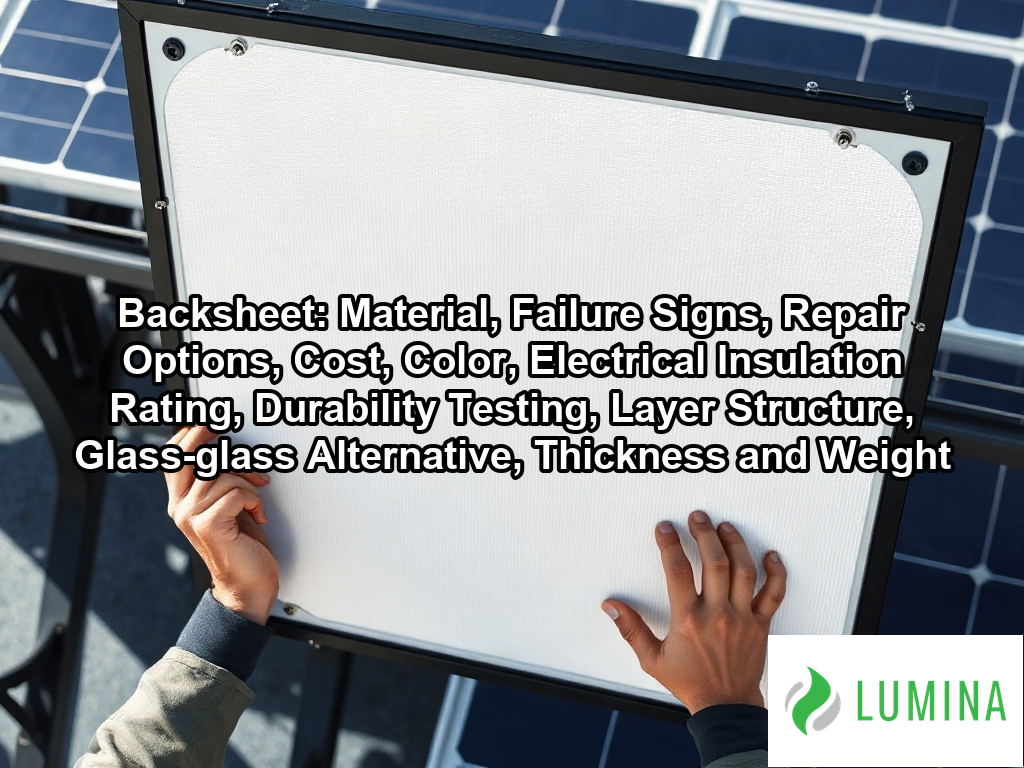
Everything you need to know about “backsheet”: material, failure signs, repair options, cost, color, electrical insulation rating, durability testing, layer structure, glass-glass alternative, and thickness and weight. The backsheet works as an insulating barrier, keeping current inside the module while blocking water vapor, ultraviolet light and dirt from reaching the cells and wiring. It sits beneath the encapsulant and bonds to the frame and edge seals, so its condition affects how long a panel keeps producing power safely. Virginia solar installers deal with humid summers, cold snaps and strong storms, all of which stress this layer over many years. This article explains the materials used, typical costs, available colors, signs that a backsheet is failing, and the repair options that exist for you to understand.
Key Takeaways
- A backsheet acts as a vital electrical insulator and barrier for a solar module.
- The backsheet accounts for under about 3 to 5 percent of total material costs.
- White backsheet surfaces provide a power gain of about 0.5 to 1 percent.
- A backsheet must withstand system voltages of 1,000 V or 1,500 V DC.
- The backsheet has a typical thickness of 0.25 to 0.40 mm.
What Is a Solar Panel Backsheet Made Of?
A solar panel backsheet is typically constructed as a multi-layered composite, most commonly featuring a central core of polyethylene terephthalate (PET) protected by outer layers of either a fluoropolymer backsheet or a non-fluoro backsheet to provide essential electrical insulation and environmental durability for your solar module. Per the National Renewable Energy Laboratory, these backsheets are generally manufactured from multi-layer polymer films that frequently use polyvinyl fluoride or polyethylene terephthalate to ensure both moisture resistance and necessary electrical insulation.
| Layer Component | Material Composition | Primary Functional Role | Environmental/Electrical Benefit |
|---|---|---|---|
| Outer Shield (Fluoropolymer) | PVF or PVDF (TPT/KPK types) | Environmental Protection | UV resistance and weather shielding |
| Structural Core | Polyethylene Terephthalate (PET) | Mechanical Backbone | Dielectric strength and structural integrity |
| Electrical Safety Threshold | Standard High Voltage Ratings | Operational Insulation | Supports 1,000 V to 1,500 V system operation |
Solar Module Operating Voltages
Fluoropolymer Backsheet Structures
Fluoropolymer backsheet structures use advanced synthetic films, often identified by acronyms like TPT or KPK, to provide the highest level of environmental resistance for a solar module. These high-performance materials are specifically engineered to withstand harsh ultraviolet radiation and extreme weather conditions over several decades. They typically utilize a robust outer layer of polyvinyl fluoride (PVF) or polyvinylidene fluoride (PVDF) to act as an impermeable shield for the internal electrical components.
Polyethylene Terephthalate (PET) Core Layers
At the center of most conventional three-layer laminates lies the polyethylene terephthalate (PET) core. This layer serves as the primary structural backbone, providing the necessary mechanical strength and essential dielectric withstand to ensure the safety of the solar panel at high operating voltages of 1,000 V or 1,500 V DC. The core is bonded to an inner layer that allows for a secure, long-term attachment to the encapsulant.
Non-Fluoro Backsheet Structures
Non-fluoro backsheet options are characterized by the use of polyolefin, polyamide (PA), or simple multi-layer PET/PET laminates. These materials are generally less expensive to manufacture but rely on additives to compensate for the natural weathering resistance that fluoropolymers provide by default. While they effectively protect the internal cells under normal operating conditions, their structural integrity can vary significantly between manufacturers.
Which Material Lasts Longer in Hot Climates?
Fluoropolymer backsheet types generally last longer in hot, high-humidity climates because they resist the hydrolysis that can degrade other polymers over time. While standard damp heat tests require modules to withstand 85°C and 85 percent relative humidity for 1,000 hours, early PA-based materials often struggle, showing signs of cracking in roughly 5 to 10 years in extreme heat.
- Fluoropolymer: Superior UV resistance and long-term durability.
- Non-Fluoro: Lower initial cost; reliability varies by polymer choice.
- PET Core: Provides the required dielectric withstand and mechanical rigidity.
Examine the technical data sheet of your module for the specific material composition to determine its suitability for your regional temperature extremes.
The primary functions of these backsheet layers contribute to the long-term reliability of photovoltaic installations through the following mechanisms:- Prevents internal electrical arcing by maintaining high dielectric isolation between the cells and the external frame.
- Reduces the rate of hydrolytic degradation by acting as a vapor barrier against moisture ingress.
- Facilitates thermal management by maintaining structural stability under constant exposure to high operating temperatures.
- Minimizes module potential induced degradation (PID) through the use of low-surface-energy fluoropolymer coatings.
How Much Does a Solar Backsheet Cost Compared to the Whole Panel?
The cost of a solar backsheet is relatively low, typically falling under about 3 to 5 percent of the total bill-of-materials cost for a finished solar module. While this component is critical for the long-term integrity of the solar panel, the bulk material expense ranges from $1 to $3 per square meter. Despite this small financial footprint, the backsheet serves as a vital safeguard for the system, ensuring that the internal circuit remains isolated from the environment throughout the decades of expected service. Per the International Energy Agency, while the backsheet is a low-cost component compared to the total module price, it serves as a critical protective layer that represents a primary failure point for long-term module reliability and field durability in the United States.
| Economic and Performance Metric | Specification / Impact Value |
|---|---|
| Module Bill-of-Materials Cost Share | < 5% |
| Bulk Material Market Price | $1.00 – $3.00 / sqm |
| Efficiency Enhancement (White Variant) | 0.5% – 1.0% |
| Failure Consequence | Total Module Replacement Required |
| Primary Functional Role | Environmental Isolation & Field Durability |
Solar Backsheet Cost and Performance Variables
When you evaluate the financial impact of the backsheet within the context of a total solar array investment, consider the following economic and performance variables:
- Cost share: Represents less than 5 percent of the module’s total raw material expense.
- Bulk pricing: $1 to $3 per square meter of backsheet material.
- Replacement risk: A failed backsheet often necessitates the complete replacement of the solar module, regardless of the initial cost of the material.
- Efficiency impact: The choice of backsheet design can influence light capture, providing a performance gain of about 0.5 to 1 percent for white-colored variants.
Compare the manufacturer’s reported extended reliability test durations, such as those exceeding the baseline 1,000-hour damp heat test, against the cost of the module to determine if the premium aligns with your local environmental risks.
When evaluating the long-term economic implications of backsheet selection, consider these critical factors:- Degradation Rates: High-quality backsheets mitigate hydrolysis and UV-induced brittleness, preventing significant power output loss over 25 years.
- O&M Expenses: Selecting durable materials reduces the frequency of site visits and localized repair costs associated with partial delamination.
- Insurance Premiums: Using industry-standard, certified backsheet materials can lower risk profiles for utility-scale project financing and insurance underwriting.
- End-of-Life Recyclability: Certain backsheet polymer compositions facilitate easier separation from the glass and silicon cells, reducing future disposal costs.
Does Backsheet Color Affect Solar Panel Performance, and Should You Choose White or Black?
Yes, backsheet color affects solar panel performance because it influences the amount of light reflected back into the solar cells and the overall temperature of the solar module. Per the International Electrotechnical Commission, solar module testing standards indicate that the backsheet material selection influences electrical performance parameters like open-circuit voltage and short-circuit current as an approximation based on the albedo and thermal emissivity of the chosen color. The choice between white and black is primarily a trade-off between electrical output and architectural aesthetics.
| Feature Category | White Backsheet Impact | Black Backsheet Impact |
|---|---|---|
| Optical Efficiency | High (Reflects light into cells) | Low (Absorbs stray light) |
| Relative Power Output | Baseline +0.5% to 1.0% | Baseline (0%) |
| Thermal Performance | Cooler (Superior heat dissipation) | Warmer (Increased heat absorption) |
| Primary Use Case | Utility/Commercial yield optimization | Residential aesthetic integration |
Estimated Relative Power Gain (White vs. Black Backsheet)
- White backsheet: Acts as an optical reflector that bounces unused light back into the silicon cells, providing a power gain of about 0.5 to 1 percent compared to darker variants.
- Black backsheet: Often preferred for residential designs to blend with roofing materials, though the pigment absorbs more light, which may slightly reduce the potential for light-trapping efficiency.
- Thermal impact: Darker colors absorb more solar radiation, which can lead to higher operating temperatures; since solar modules lose efficiency as they get hotter, the white backsheet inherently supports better thermal management.
- Aesthetic integration: Selecting a black backsheet is an elective visual choice that prioritizes the visual uniformity of your installation over the minor increase in energy yield.
Balance your desire for a discreet, monochromatic look against the minor energy loss when deciding if the visual benefit of a black backsheet justifies the lower power output.
How Can You Tell if Your Solar Panel Backsheet Is Failing?
You can identify a failing solar panel backsheet by visually inspecting the rear of your solar module for specific physical markers of degradation that compromise the electrical integrity of the system. Because the backsheet provides the essential dielectric withstand required to safely handle system voltages of 1,000 V or 1,500 V DC, any structural compromise acts as a precursor to a potential ground fault or significant power loss.
| Degradation Indicator | Primary Physical Marker | Underlying Structural Implication | Risk Level |
|---|---|---|---|
| Cracking | Spider-web fissures or center-cell fractures | Compromised dielectric barrier | High |
| Chalking | Powdery residue on finger touch | Surface polymer erosion | Moderate |
| Yellowing | Color shift to amber or brown | Chemical breakdown of PET core | Moderate to High |
| Delamination | Bubbles, gaps, or edge separation | Loss of moisture and electrical seal | High |
| Exposed Wiring | Visibility of metallic or grid layers | Direct path for ground faults | Critical |
- Cracking: Look for fine, spider-web patterns or deep fissures on the surface, which often appear in the center of the solar module or between the cells.
- Chalking: Check for a powdery white residue that rubs off on your fingers when you touch the surface, indicating the protective polymer outer layer is eroding under UV exposure.
- Yellowing: Note if the material has turned from its original color to a yellowish or brown tint, which signals that the polyethylene terephthalate (PET) core or the outer layers are undergoing chemical breakdown. According to Sandia National Laboratories, this yellowing or embrittlement of the backsheet material acts as a primary indicator of chemical degradation driven by long-term exposure to ultraviolet radiation and thermal cycling in outdoor environments.
- Delamination: Identify sections where the outer layer has begun to pull away from the internal layers, often appearing as bubbles or gaps at the edges of the solar module.
- Exposure of Internal Wiring: Inspect for any visible metallic or dark grid patterns that indicate the protective layers have completely worn away, exposing the conductive circuit to the open air.
Inspect the rear surface for these signs during the hours of peak solar radiation to ensure clear visibility of surface hairline fractures that might otherwise remain hidden under low-light conditions.
Beyond the primary visual indicators, observe these secondary environmental and performance signals that confirm backsheet failure:- Ground fault errors on the inverter display indicate that moisture has breached the backsheet and reached the conductive internal layers.
- Voltage drops exceeding standard degradation rates often point to internal shorting caused by compromised insulation.
- Localized burn marks or soot deposits on the backsheet surface reveal hotspots caused by electrical arcing.
- Brittle or flaking textures around the junction box suggest an accelerated loss of material elasticity due to localized heat cycling.
Can a Cracked Backsheet Be Repaired With Tape or Coating, or Does the Panel Need Replacing?
No, a cracked backsheet cannot be effectively repaired with tape or specialized coatings because the structural and electrical integrity of the solar module depends on the material’s ability to remain an airtight, dielectric barrier. Once the backsheet is compromised, environmental contaminants, moisture, and oxygen permanently alter the internal chemistry of the cells and the encapsulant, often leading to a ground fault or a complete failure of the solar panel. Per the Department of Energy, environmental degradation of polymer-based backsheets via hydrolysis or photo-oxidation is a systemic failure that cannot be remediated in the field, as adhesive patches fail to replicate the original moisture vapor transmission rate of the factory-laminated layers.
| Repair Strategy | Effectiveness | Safety Risk |
|---|---|---|
| Standard Adhesive Tape | Negligible | High (Voltage Exposure) |
| Liquid Polymer Coating | Very Low | Moderate (Chemical Mismatch) |
| Module Replacement | High | Negligible |
The materials used to construct a backsheet, such as polyethylene terephthalate (PET) or fluoropolymers, require precise factory-level bonding to ensure they meet dielectric withstand requirements of 1,000 V or 1,500 V DC. Attempting to bridge a crack with aftermarket sealants or tapes introduces non-rated materials that cannot replicate the manufacturer’s lamination process, failing to prevent moisture ingress during damp heat conditions. Furthermore, standard tapes degrade rapidly under the extreme thermal cycling from -40°C to 85°C, ensuring the repair will ultimately fail.
Inspect the rear of your solar module for signs of whitening or brittle texture near the edges, as these often indicate the material is becoming too fragile to maintain its insulation properties.
The following factors contribute to the permanent nature of backsheet failure and the necessity of module decommissioning:- Arcing Potential: Cracks create localized paths for leakage current, which can carbonize the encapsulant and turn a minor breach into a fire hazard.
- Delamination Acceleration: Once the outer layer is breached, moisture ingress induces chemical reactions that cause the remaining layers to separate from the silicon cells.
- Insulation Resistance Drop: Field measurements will consistently show a decline in insulation resistance (R-iso) values, eventually falling below the safety thresholds defined by IEC 61215 standards.
- Inverter Sensitivity: Modern string inverters are designed to detect ground faults triggered by moisture-compromised backsheets, rendering the panel electrically non-functional regardless of surface patches.
Frequently Asked Questions
What are the layers of a solar backsheet and what does each one do?
A solar backsheet typically consists of a three-layer laminate structure, including an outer weather-facing layer, a polyethylene terephthalate (PET) core for electrical insulation and strength, and an inner layer that bonds to the encapsulant to provide environmental protection and mechanical support for the solar module.
How thick and heavy is a typical solar panel backsheet?
A typical backsheet has a thickness of 0.25 to 0.40 mm (250 to 400 micrometers) and weighs roughly 0.3 to 0.5 kg per square meter of module. This thin, lightweight material accounts for less than 3 to 5 percent of the total bill-of-materials cost for your solar panel.
What voltage and insulation rating does a solar backsheet need to meet?
A backsheet must support system voltages of 1,000 V or 1,500 V DC, requiring dielectric withstand and partial discharge ratings verified under safety standards. These ratings ensure the layer provides necessary electrical insulation to protect people and equipment from the internal circuitry of your solar module.
What tests prove a solar backsheet will last, such as damp heat and UV exposure?
Manufacturers prove a backsheet will last by conducting standard damp heat testing at 85°C and 85 percent relative humidity for 1,000 hours under IEC 61215. They also utilize extended tests of 2,000 to 3,000 hours, thermal cycling from -40°C to 85°C, and rigorous UV exposure to ensure stability.
Is a glass-glass solar panel without a backsheet better than a glass-backsheet panel?
No, a glass-glass module is not inherently better than a traditional design, as it simply replaces the standard backsheet with a second glass sheet. While traditional modules rely on a backsheet for protection, they can gain about 0.5 to 1 percent more power when using white material to reflect light.