
Encapsulant (EVA): Failure Modes, Alternatives, Curing Process, Lifespan, Electrical Insulation, Light Transmittance, Thickness, Composition, Cost, Gel Content
An encapsulant (EVA) is a transparent ethylene-vinyl acetate polymer film that bonds and seals the solar cells inside a panel. Key aspects include alternatives, failure modes, lifespan, curing process, light transmittance, electrical insulation, composition, thickness, gel content, and cost. During manufacturing, sheets of the film are laid above and below the cells and heated in a laminator, where they melt, flow and cross-link into a durable, rubbery layer. This layer cushions the fragile cells, keeps out moisture and oxygen, and holds the glass and backsheet firmly in place. Any Virginia solar company that installs modules relies on this layer to keep panels performing through humid summers, freezing winters and constant sunlight. This article explains the curing process, how much light the film transmits, the materials used as alternatives, the ways it can fail, and how those factors shape the lifespan you can expect from a panel.
Key Takeaways
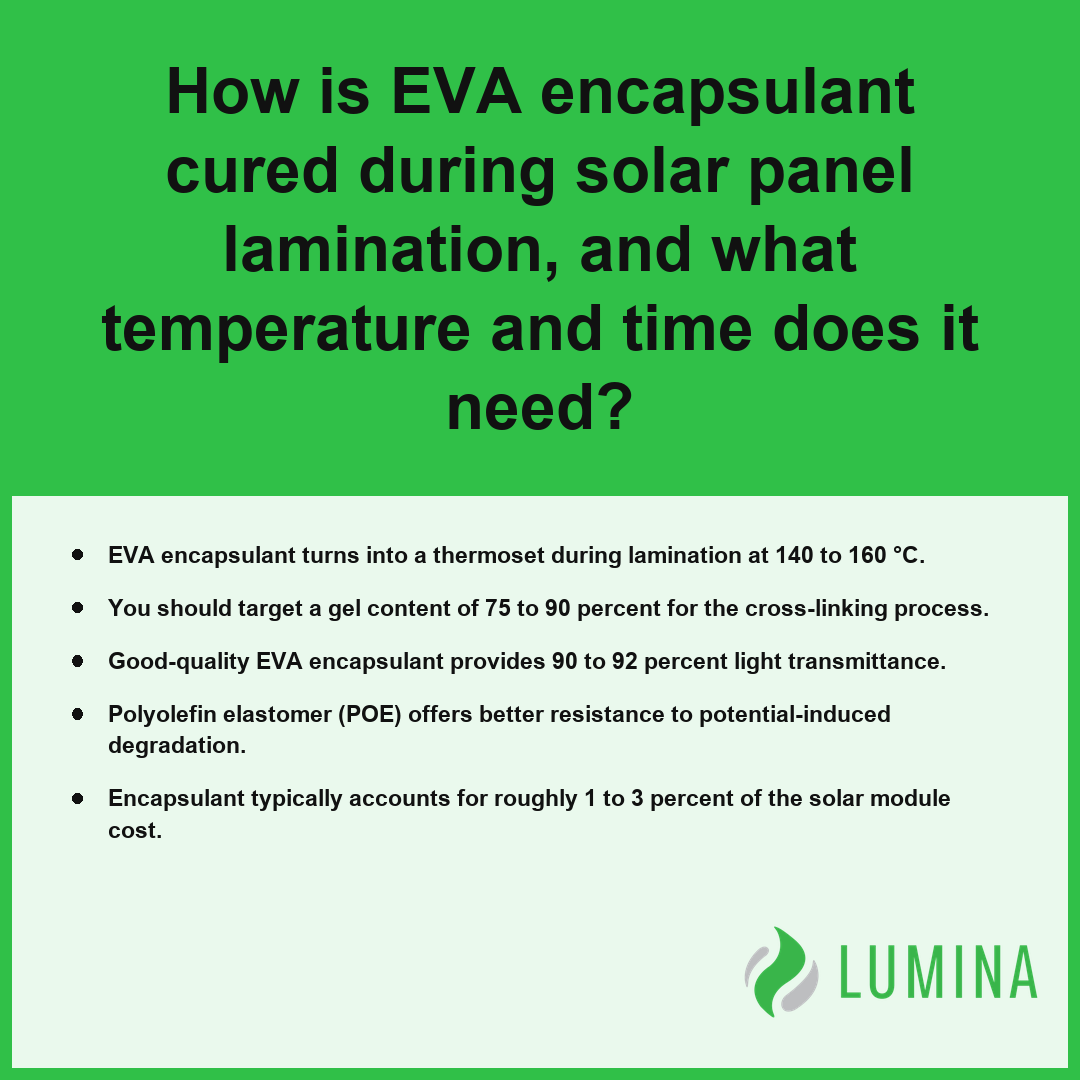
- EVA encapsulant turns into a thermoset during lamination at 140 to 160 °C.
- You should target a gel content of 75 to 90 percent for the cross-linking process.
- Good-quality EVA encapsulant provides 90 to 92 percent light transmittance.
- Polyolefin elastomer (POE) offers better resistance to potential-induced degradation.
- Encapsulant typically accounts for roughly 1 to 3 percent of the solar module cost.
How Is EVA Encapsulant Cured During Lamination, and What Temperature and Time Does It Need?
EVA encapsulant is cured during lamination through a chemical process triggered by heat, which transforms the ethylene-vinyl acetate (EVA) from a thermoplastic state into a durable, thermoset structure that permanently locks the solar module components together. To achieve the required structural integrity, you must manage the heat and pressure cycles within a vacuum laminator to ensure the material reaches the ideal degree of cross-linking.
| Lamination Metric | Gel Content Target (%) | Regulatory/Quality Standard |
|---|---|---|
| Standard Production Goal | 75% – 90% | Optimal Structural Integrity |
| ASTM Minimum Threshold | 70% – 80% | Baseline Mechanical/Thermal Stability |
Target Gel Content Percentages
- Load the glass, the first layer of encapsulant (eva), the solar cells, the second layer of encapsulant (eva), and the backsheet into the vacuum laminator to form the module stack.
- Apply a vacuum to evacuate air from the stack to prevent bubbles, followed by the application of mechanical pressure to ensure uniform contact.
- Heat the module to a range of 140 to 160 °C for a duration of roughly 12 to 20 minutes to activate the peroxide additives.
- Maintain these conditions until the gel content reaches the target of 75 to 90 percent, effectively preventing the film from melting during subsequent high-temperature field operations.
Per American Society for Testing and Materials, the encapsulation curing process should typically aim for a gel content exceeding 70 to 80 percent to confirm that the solar module has attained adequate thermal and mechanical stability. Monitor your laminator’s temperature uniformity across the heating platen to ensure that the gel content remains consistent throughout the entire surface area of the solar module.
How Much Light Does EVA Encapsulant Let Through, and Does UV-Blocking EVA Reduce Output?
Good-quality EVA encapsulant lets through approximately 90 to 92 percent of available sunlight across the 380 to 1100 nm range, ensuring that most photons reach the solar cells to generate electricity. This high level of light transmission is achieved because the refractive index of the ethylene-vinyl acetate (EVA) is near 1.48 to 1.49, which is effectively matched to the properties of the glass front sheet to minimize reflection losses at the interface.
| EVA Formulation Type | Light Transmission Range | Primary Optical Function | Durability Rationale |
|---|---|---|---|
| Standard EVA | 90% – 92% | Maximizing photon delivery to cells | Optimized for high-transparency output |
| UV-Blocking EVA | ~90% | Filters wavelengths < 360–380 nm | Prevents yellowing and photo-degradation |
| Fast-Cure EVA | Varies by additive | Rapid cross-linking during lamination | Optimized for manufacturing throughput |
Light Transmission Efficiency by EVA Type
Yes, UV-blocking EVA encapsulant can theoretically reduce output by absorbing light below 360 to 380 nm, but this is a deliberate trade-off. According to the National Renewable Energy Laboratory, UV-blocking additives are incorporated into EVA formulations to prevent polymer degradation and backsheet yellowing, although these additives must be carefully balanced to avoid absorbing wavelengths that contribute to the spectral response of the solar cells. By filtering these high-energy wavelengths, the encapsulant (eva) protects itself and the underlying cell components from accelerated photo-degradation, which preserves the overall power output of the solar module over its multi-decade lifespan. Manufacturers balance these optical and protective requirements based on the specific cell technology used within the laminate.
- Standard EVA: High transparency, typically 90 to 92 percent light transmission.
- UV-Blocking EVA: Absorbs light below 360 to 380 nm to prevent polymer discoloration.
- Fast-Cure EVA: Designed for higher UV transmittance, often prioritized for specific sensitive cell architectures.
- Refractive Index: Matches glass at 1.48 to 1.49 to enhance light capture.
Evaluate the spectral response of your specific solar cell technology to determine if you require high UV-transmittance variants or standard UV-blocking films for optimal long-term energy yield.
Selecting the appropriate EVA grade requires consideration of several operational factors beyond transmission rates:- Thermal Stability: High-grade EVA must maintain structural integrity at operating temperatures often exceeding 85°C.
- Adhesion Strength: The encapsulant must form a robust chemical bond with both the glass cover and the backsheet to prevent delamination.
- Vapor Transmission Rate: Formulations are selected to minimize moisture ingress, which can corrode metallic cell interconnects over time.
- PID Resistance: Additives are often included to mitigate Potential Induced Degradation, ensuring leakage current is minimized in high-voltage system configurations.
Why Does EVA Encapsulant Turn Yellow or Brown, and What Other Failures Can It Cause?
EVA encapsulant turns yellow or brown primarily due to the photo-oxidative degradation of the ethylene-vinyl acetate (EVA) polymer chains when exposed to high temperatures and intense ultraviolet light over extended periods. This degradation often leads to the release of acetic acid, which can further accelerate chemical breakdown, corrode internal metal contacts, and weaken the adhesion between the encapsulant (eva) and the cell surfaces. When this chemical stability is compromised, the module may suffer from physical and electrical performance issues that manifest throughout its service life.
| Degradation Phenomenon | Primary Chemical Driver | Primary Impact on Solar Module | Operational Consequence |
|---|---|---|---|
| Discoloration (Yellowing) | Conjugated double bond formation | Reduced light transmission | Decreased photocurrent generation |
| Delamination | Loss of polymer adhesion strength | Physical gaps and interface separation | Moisture ingress and electrical leakage |
| Acetic Acid Outgassing | Vinyl acetate component breakdown | Chemical corrosion of metal contacts | Rapid degradation of silver metallization |
| Brittleness | Excessive cross-linking/weathering | Loss of structural elasticity | Mechanical fatigue and crack susceptibility |
- Discoloration: The formation of conjugated double bonds within the polymer chain absorbs visible light, causing a visible shift from clear to yellow, amber, or deep brown, which reduces the light reaching the solar cells.
- Delamination: As the chemical structure degrades, the encapsulant (eva) loses its bonding strength, resulting in gaps where moisture can ingress and corrode the internal components. According to Sandia National Laboratories, this loss of adhesion between the encapsulant and the solar cells or glass superstrate can create pathways for moisture ingress, ultimately leading to electrical leakage and reduced long-term reliability.
- Acetic Acid Formation: The chemical breakdown of the vinyl acetate component releases acetic acid, which can attack the silver metallization on the cells and cause rapid electrical performance decay.
- Brittleness: Excessive cross-linking or chemical weathering causes the layer to lose its elasticity, making it unable to cushion the cells against mechanical stress or thermal expansion, which leads to micro-cracking.
Monitor your solar module for any visible darkening of the transparent layers, as this coloration serves as an early indicator of potential chemical instability within the package.
Beyond these chemical changes, several environmental and manufacturing factors influence the severity of EVA degradation:- Temperature cycling: Frequent thermal expansion and contraction cycles stress the bond between the encapsulant and the glass or backsheet, accelerating fatigue.
- Formulation additives: The concentration and quality of ultraviolet (UV) stabilizers and antioxidants directly dictate the material’s lifespan under field conditions.
- Manufacturing precision: Incomplete curing during the lamination process leaves residual vinyl acetate, which significantly lowers the material’s threshold for chemical breakdown.
- Moisture permeability: High humidity levels react with acetic acid to amplify corrosive pathways that reach the silicon wafer and interconnects.
Is EVA or POE Encapsulant Better for Bifacial and N-Type Solar Modules?
Whether you choose an encapsulant (eva) or polyolefin elastomer (POE) for bifacial and n-type solar modules depends primarily on the required environmental durability and electrical performance of your system. While traditional ethylene-vinyl acetate (EVA) remains a dominant, cost-effective choice for many applications, the rise of advanced cell architectures has increased the industry’s reliance on POE to manage specific material limitations. According to Lawrence Berkeley National Laboratory, the adoption of N-type cell technology has accelerated the transition toward POE or co-extruded EPE encapsulants in the United States market to mitigate the long-term reliability risks associated with EVA-based acidic degradation.
Encapsulant Cost as Percentage of Total Module Cost
Where EVA Encapsulant Still Makes Sense
You may find that standard EVA encapsulant remains the best choice for traditional monofacial modules where the cost-to-performance ratio is the priority. Because it represents only roughly 1 to 3 percent of the total module cost, it is an economical solution for applications not subject to extreme environmental stress or high-voltage bias. Its proven processing reliability and strong adhesion to glass and backsheet materials provide a robust, long-term barrier against moisture for standard crystalline silicon cells.
Why Does POE Suit Bifacial and N-Type Cells?
POE is increasingly preferred for modern cell technologies because it offers lower water vapor transmission rates and superior chemical stability compared to standard ethylene-vinyl acetate (EVA). Bifacial modules, which often utilize glass-glass configurations, benefit significantly from the reduced moisture intake that POE provides, preventing the accumulation of acetic acid that can occur as EVA degrades over time.
Resistance to Potential-Induced Degradation (PID)
The chemical composition of POE makes it highly resistant to the ion migration that leads to potential-induced degradation (PID) in high-voltage strings. Consider these primary differences between the two materials:
| Feature | EVA Encapsulant | POE Encapsulant |
|---|---|---|
| Water vapor permeability | Moderate | Very Low |
| PID resistance | Requires additives | High (inherent) |
| Acetic acid release | Potential | Negligible |
Co-Extruded EVA-POE-EVA Structures
To capture the mechanical benefits of EVA encapsulant while leveraging the moisture resistance of POE, manufacturers often employ a co-extruded sandwich approach. This structure places the high-performance POE in the center to protect the active cell surfaces, while keeping EVA on the outer edges to maintain strong bonding to the glass covers. Evaluate the expected moisture levels and bias voltage of your deployment site before selecting an encapsulant structure for your modules.
Key considerations for selecting between EVA and POE encapsulants include:- Thermal Stability: POE demonstrates superior resistance to thermal degradation at high temperatures, which is critical for bifacial modules that operate with increased heat load.
- Cross-linking Speed: EVA typically offers faster lamination cycles, contributing to higher manufacturing throughput and lower assembly line energy consumption.
- Volume Resistivity: POE maintains higher volume resistivity under damp-heat conditions, minimizing leakage currents that can degrade module performance over time.
- Compatibility: EVA is generally more compatible with a wider variety of backsheet polymers, whereas POE may require specialized primers to achieve optimal adhesion.
How Long Does EVA Encapsulant Last, and How Is It Tested to Survive 25 to 30 Years?
The lifespan of encapsulant (eva) is designed to match the typical module warranty of 25 to 30 years, during which it must maintain its structural integrity, electrical insulation, and optical clarity. To ensure this longevity, manufacturers subject the material to accelerated aging protocols that simulate decades of harsh environmental stress. The most critical benchmark for this endurance is the damp heat test under IEC 61215; per the International Electrotechnical Commission, this standard requires modules to undergo testing at 85 degrees Celsius and 85 percent relative humidity for 1,000 hours to ensure the material maintains its necessary integrity over the expected module lifespan.
| Performance Metric | Acceptance Criteria | Critical Failure Risk |
|---|---|---|
| Volume Resistivity | > 10^14 ohm-cm | Potential-Induced Degradation (PID) |
| Gel Content | 75% to 90% | Creeping or Material Brittleness |
| Light Transmittance | 90% to 92% (380-1100 nm) | Optical Efficiency Loss |
| Damp Heat Exposure | 1,000 Hours (85°C / 85% RH) | Structural Delamination |
Encapsulant Performance Benchmarks (Scale Comparison)
During these rigorous testing phases, the material is evaluated for its stability in several key performance areas that dictate whether it will survive its intended service life:
- Volume resistivity: Ensuring the film maintains levels above 10^14 ohm-cm to prevent potential-induced degradation (PID).
- Gel content: Verifying that cross-linking reached the target range of 75 to 90 percent to prevent creeping or brittleness.
- Adhesion strength: Confirming that the bond between the glass, cells, and backsheet remains secure under cyclic thermal expansion.
- Optical stability: Monitoring that light transmittance stays within the 90 to 92 percent range across the 380 to 1100 nm spectrum.
Verify that your chosen solar module’s data sheet explicitly references compliance with the 1,000-hour damp heat test to confirm the manufacturer has qualified the specific formulation of encapsulant (eva) for long-term climate resilience.
Beyond the core performance metrics, manufacturers utilize several supplemental evaluation techniques to confirm long-term encapsulant reliability:- Differential Scanning Calorimetry (DSC) to verify the degree of cross-linking and thermal transition properties.
- Peel Strength Testing to measure the mechanical bond force between the encapsulant and the glass or backsheet layers.
- Acetic Acid Migration analysis to monitor potential chemical degradation and corrosion risks for solar cells.
- UV Fluorescence aging to assess yellowing resistance and color stability over extended exposure to high-energy radiation.
Frequently Asked Questions
What is EVA encapsulant in solar panels made of, and why is vinyl acetate content important?
EVA encapsulant consists of ethylene-vinyl acetate (EVA) polymer, typically containing 28 to 33 percent vinyl acetate content by weight. This ratio is critical because it determines the flexibility, optical clarity, and processing characteristics of the film, ensuring the material effectively bonds the solar module components together during the lamination process.
How thick is EVA encapsulant film in a solar panel, and why is 0.45 mm so common?
EVA encapsulant film is typically supplied in rolls ranging from 0.3 to 0.6 mm thick, with 0.45 mm being the common standard for both front and rear layers. This specific thickness provides an optimal balance for mechanical cushioning, moisture barrier protection, and efficient electrical insulation within the solar module.
What is gel content in EVA encapsulant, and what happens if the cross-linking is too low or too high?
Gel content measures the degree of cross-linking in EVA encapsulant, with a target range of 75 to 90 percent. If cross-linking is too low, the module experiences creep and delamination; if the level is too high, the film becomes brittle and susceptible to cracking over its long operational life.
Does EVA encapsulant insulate electrically, and how does its resistivity affect PID in solar panels?
Yes, EVA encapsulant acts as an effective electrical insulator with a volume resistivity typically above 10^14 ohm-cm. High resistivity is essential to minimize leakage current and prevent potential-induced degradation (PID), which can otherwise compromise the performance and longevity of the solar module over its 25 to 30 years design life.
How much does EVA encapsulant add to the cost of a solar panel?
EVA encapsulant represents roughly 1 to 3 percent of the total solar module cost. Given that a typical residential unit requires 3 to 4 m² of material, this encapsulant (eva) provides an essential adhesive and protective barrier while remaining an economical component within the overall manufacturing budget.