
Tempered Glass: Thickness, Strength, Light Transmittance, Hail Resistance, Anti-reflective Coating, Load Rating, Durability, Breakage Behavior, Cost, Weight
Tempered glass is glass heat-treated to create compressive surface stress, making it far stronger than ordinary annealed glass. Key aspects include strength, thickness, hail resistance, light transmittance, load rating, anti-reflective coating, breakage behavior, durability, weight, and cost. In a solar panel, tempered glass forms the front layer that shields the cells from hail, wind, snow, and debris. You can think of its strength as coming from rapid cooling after heating, which locks the outer surfaces in compression and lets the sheet flex under pressure without breaking. Panel glass is usually about 3 to 4 millimeters thick, and it must still pass sunlight with very little loss, typically above 90 percent. A Virginia solar installer works with these glass ratings when matching panels to local hail, wind, and snow conditions. This article explains strength, thickness, hail resistance, load rating, and light transmittance so you can understand how each property affects a panel.
Key Takeaways
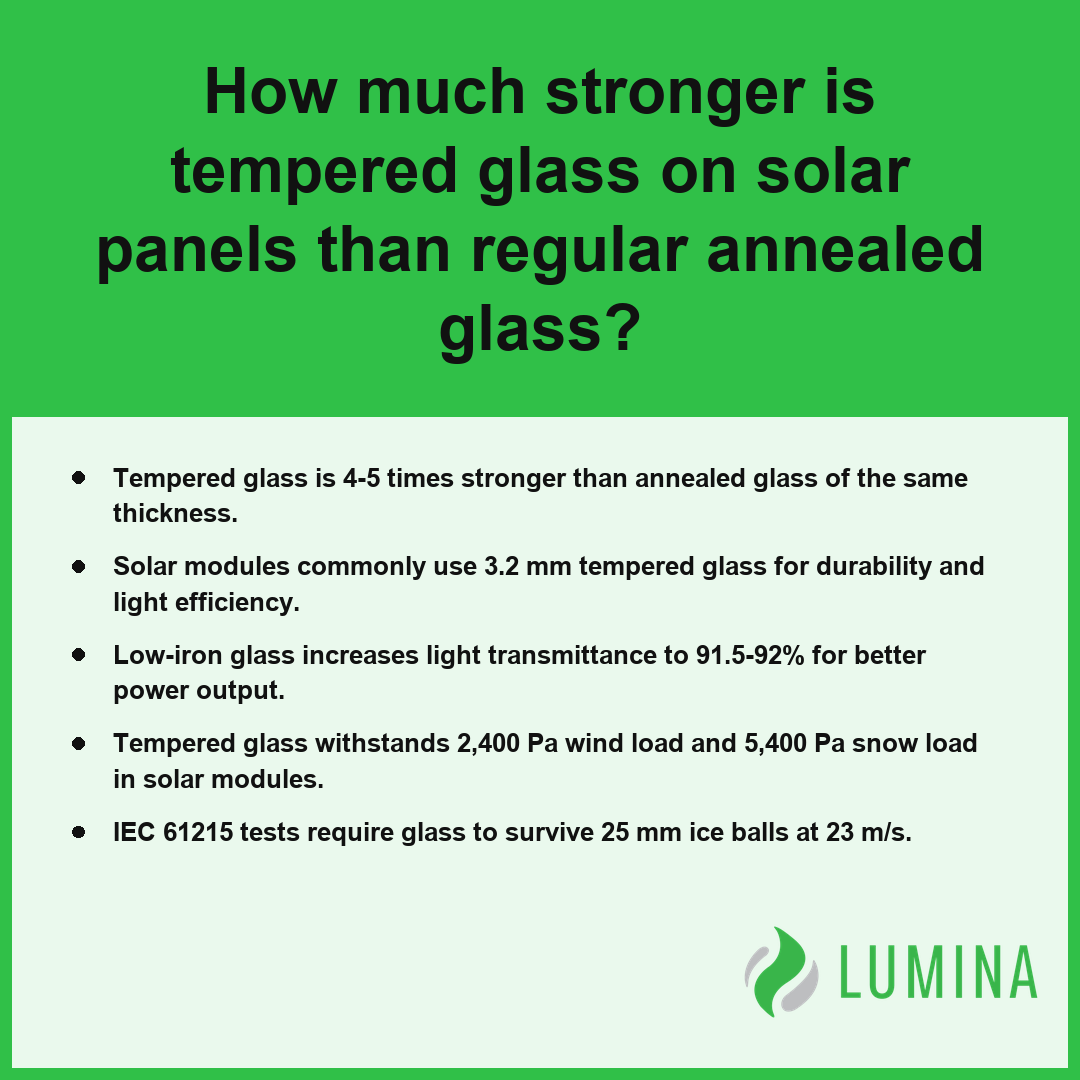
- Tempered glass is 4-5 times stronger than annealed glass of the same thickness.
- Solar modules commonly use 3.2 mm tempered glass for durability and light efficiency.
- Low-iron glass increases light transmittance to 91.5-92% for better power output.
- Tempered glass withstands 2,400 Pa wind load and 5,400 Pa snow load in solar modules.
- IEC 61215 tests require glass to survive 25 mm ice balls at 23 m/s.
How Much Stronger Is Tempered Glass on Solar Panels Than Annealed Glass?
Tempered glass is approximately 4 to 5 times stronger than annealed glass, offering significantly higher resistance to the mechanical stresses encountered by a solar module. Per the American Society for Testing and Materials, this enhanced durability is a result of processing the material to exceed specific surface or edge compression standards defined in ASTM C1048.
Relative Bending Strength (psi)
What Surface Compression Does to Bending Strength
The superior durability of tempered glass results from a manufacturing process called quenching, which creates intense internal stress profiles. By rapidly cooling the glass surfaces after heating them to between 620-650 °C (1,150-1,200 °F), the material develops a permanent state of surface compression, typically exceeding 10,000 psi (69 MPa). This compression acts as a shield against external bending forces. To understand why this matters for your installation, consider the comparative breaking points of these two materials:
| Glass Type | Bending Stress Capacity |
|---|---|
| Annealed glass | About 6,000 psi (40 MPa) |
| Fully tempered glass | About 24,000 psi (165 MPa) |
Is Heat-Strengthened Glass Ever Enough for a Solar Module?
While fully tempered glass is standard for durability, heat-strengthened glass offers an alternative balance of properties. It provides roughly twice the strength of annealed glass, which can suffice in specific structural configurations.
Where Glass-Glass Module Designs Change the Choice
In modern bifacial module assemblies, designers sometimes opt for two sheets of 2.0 mm heat-strengthened glass. Because these modules rely on lamination between two glass layers, the reduced risk of mechanical impact on the inner sheet allows for lower surface compression levels compared to the single, exposed sheet of a traditional 3.2 mm (about 1/8 inch) tempered glass design.
How Tempered Glass Breaks Differently
Safety is the primary byproduct of the tempering process. Unlike annealed glass, which shatters into dangerous, jagged shards, tempered glass is designed to crumble into small, relatively blunt granules upon failure. Because the glass is laminated to the cells using an encapsulant, these granules are held in place even after a break occurs.
Inspect the manufacturer’s data sheet to confirm the specific impact resistance rating, as variations in tempering levels affect how the module behaves during extreme physical stress events.
Heat-strengthened glass is occasionally selected for solar projects when specific trade-offs are prioritized over the maximum impact resistance of fully tempered glass:- Reduced likelihood of spontaneous breakage caused by nickel sulfide inclusions.
- Lower optical distortion levels compared to fully tempered glass, resulting in a clearer aesthetic.
- Smaller, safer fragment patterns during breakage than annealed glass, though larger than the diced shards of fully tempered glass.
- Superior edge strength retention, which benefits specific frame-mounted module designs.
Why Most Solar Panels Use 3.2 mm Tempered Glass, and When Two 2.0 mm Sheets Step In
Most solar panels use 3.2 mm tempered glass because this specific thickness strikes an optimal balance between structural rigidity, weight management, and light transmission. A 3.2 mm (about 1/8 inch) sheet provides enough surface compression to withstand harsh outdoor conditions while maintaining a manageable weight of about 8 kg/m² (1.6 lb/ft²). This standard thickness is sufficient to protect the sensitive internal layers during transport and installation. Because tempered glass cannot be cut, drilled, or edge-ground after quenching, manufacturers produce these sheets to their final dimensions before the heat-treatment process to ensure the integrity of the surface compression.
| Glass Configuration | Primary Application | Weight Density | Mechanical Focus | Key Benefit |
|---|---|---|---|---|
| Single 3.2 mm Sheet | Standard Monofacial Modules | ~8.0 kg/m² | Maximum Impact Resistance | Structural Rigidity |
| Dual 2.0 mm Sheets | Bifacial / Thin-film Modules | ~10.0 kg/m² (Combined) | Micro-crack Prevention | Rear Light Capture |
Standard Glass Thicknesses (mm)
In contrast, glass-glass modules often incorporate two 2.0 mm sheets of tempered glass instead of one thicker pane. This configuration is primarily employed in bifacial modules, where the rear of the module must also be protected by a durable, transparent surface to allow light capture from both sides. Per the National Renewable Energy Laboratory, thin-film or bifacial solar modules utilize dual 2.0 mm glass configurations to decrease overall weight while preserving the mechanical rigidity needed to avoid cell micro-cracking. The following list outlines the primary factors that dictate why manufacturers select specific glass configurations:
- 3.2 mm tempered glass: The industry benchmark for traditional monofacial modules, offering high impact resistance and standardized manufacturing compatibility.
- 2.0 mm tempered glass: A thinner profile used in pairs to reduce total module weight while providing structural integrity for glass-glass and bifacial designs.
- Heat-strengthened glass: Occasionally substituted for fully tempered glass in specific thin-sheet applications where a different fracture pattern or stress profile is desired.
- Encapsulant compatibility: The glass-to-cell bond must be accounted for when choosing thickness, as thinner glass may experience different deflection rates under load.
Compare the frame design and mechanical mounting requirements of your prospective system to ensure the chosen glass thickness meets your site’s specific structural demands.
Manufacturing considerations for solar glass selection involve several critical technical requirements beyond thickness:- Low-iron content is mandated to minimize light absorption and maximize energy conversion efficiency.
- Anti-reflective coatings are applied to the external surface to reduce glare and increase total photon transmission.
- Thermal tempering must be precisely controlled to ensure uniform surface stress, which prevents spontaneous breakage during field thermal cycling.
- Edge treatment processes, such as seaming or grinding, must be completed prior to the tempering phase to prevent fracture initiation points.
- Solar glass must adhere to IEC 61215 standards to ensure long-term durability under environmental stressors like snow loads and wind pressure.
Can Tempered Glass Survive Hail, and What Size Can It Take?
Yes, tempered glass can survive hail by utilizing its unique internal surface compression to deflect impact energy that would typically shatter annealed glass. To ensure reliability in diverse environments, solar modules undergo rigorous impact testing. According to the International Electrotechnical Commission, solar modules generally undergo the IEC 61215 standard test where the glass is required to withstand an impact from a 25 mm diameter ice ball traveling at approximately 23 meters per second. While this serves as the industry baseline, many manufacturers subject their products to more strenuous evaluations to confirm resilience against extreme weather conditions.
Impact Velocity by Hail Size (m/s)
The following table illustrates how different hail diameters correspond to typical impact force requirements for high-performance solar modules:
| Hail Size (Diameter) | Testing Protocol | Impact Velocity |
|---|---|---|
| 25 mm (1 inch) | Standard IEC 61215 | 23 m/s (51 mph) |
| 35 mm (1.38 inch) | Premium Module Rating | ~27 m/s (60 mph) |
| 45 mm (1.77 inch) | Extreme Impact Rating | ~30 m/s (67 mph) |
Because tempered glass is designed to crumble into blunt granules rather than sharp shards upon failure, it minimizes the risk of collateral damage to the underlying solar cells if the impact limit is exceeded. Furthermore, the encapsulant helps maintain the physical integrity of the front cover even after a crack occurs, preventing moisture ingress that could lead to electrical faults. Examine the specific IEC 61215 certification documentation for your module to confirm it has been validated against ice balls larger than the standard 25 mm diameter if you live in a region prone to severe convective storms.
To maintain the structural performance of your solar array during hail events, consider the following maintenance and precautionary practices:- Inspect the surface of the modules annually for micro-fractures, especially after significant weather events.
- Ensure the mounting angle is optimized to encourage hail to deflect rather than strike the glass surface perpendicularly.
- Verify that your module manufacturer’s warranty explicitly covers impact damage from hail, as coverage varies by supplier.
- Remove debris from the array periodically to prevent localized stress points that could exacerbate impact damage.
How Much Wind and Snow Load Tempered Glass Solar Panels Can Handle
Tempered glass solar panels are designed to handle significant mechanical pressure, typically meeting the industry-standard load requirements established by IEC 61215. Because the manufacturing process introduces internal surface compression, the tempered glass front provides the structural rigidity necessary for a solar module to maintain its integrity under harsh environmental conditions. The ability of the module to resist these forces depends on the mounting configuration and the thickness of the glass, but standardized testing ensures that the tempered glass surface successfully protects the internal components from bowing or permanent deformation during extreme weather events.
| Load Classification | Standard Pressure (Pa) | Environmental Stressor | Structural Objective |
|---|---|---|---|
| Wind Load | 2,400 Pa | High-Velocity Gusts | Prevent surface bowing and deformation |
| Snow Load | 5,400 Pa | Accumulated Precipitation | Prevent glass fracture and cell damage |
Solar Module Load Resistance (Pa)
- Mechanical Load Benchmarks: Solar modules are tested to withstand a 2,400 Pa wind load, simulating high-velocity gusts that exert force across the entire module surface.
- Snow Load Resilience: To account for the weight of accumulated winter precipitation, modules must demonstrate the ability to support a 5,400 Pa snow load without suffering glass fracture or cell damage. Per the American Society of Civil Engineers, structural building codes for solar installations require that tempered glass assemblies account for site-specific wind speed maps and ground snow load data to ensure the glass does not exceed its maximum allowable stress under regional environmental pressures.
- Weight Distribution: The 3.2 mm tempered glass provides a durable shield while maintaining a weight of about 8 kg/m² (1.6 lb/ft²), balancing load-bearing capacity with ease of installation.
- Structural Integrity: The tempered glass remains stable under pressure because the internal tension balanced against surface compression prevents the propagation of micro-cracks during cycles of contraction and expansion.
Review the specific mounting instructions provided by your manufacturer to ensure that the support rails are positioned correctly to prevent glass deflection under your region’s maximum expected snow depth.
Proper installation and maintenance are essential for ensuring that solar modules maintain their structural integrity throughout their operational lifespan.- Ensure mounting clamps are positioned at the manufacturer’s specified points to prevent localized stress concentrations on the glass.
- Verify that the mounting structure provides enough clearance to allow for thermal expansion and contraction of the module frame.
- Regularly inspect the module frame and mounting hardware for corrosion or loosening, which can compromise the panel’s ability to distribute mechanical loads evenly.
- Confirm that the installation angle complies with regional snow shedding requirements to prevent loads from exceeding the 5,400 Pa limit.
Why Solar Panel Tempered Glass Is Low-Iron and How Much More Light It Transmits
Solar panel tempered glass is low-iron to minimize light absorption caused by metal oxides, ensuring the maximum amount of sunlight reaches the active solar cells. According to Lawrence Berkeley National Laboratory, minimizing iron content in tempered solar glass significantly reduces parasitic absorption, allowing a higher percentage of the solar spectrum to pass through the front surface compared to standard architectural glass. Ordinary float glass contains high concentrations of iron oxide, which absorbs light and casts a noticeable green tint, whereas low-iron glass is formulated to be ultra-clear. By reducing these metallic impurities, you improve the efficiency of your solar module through superior optical clarity.
| Optical Characteristic | Low-Iron Solar Glass | Standard Float Glass | Impact on Solar Efficiency |
|---|---|---|---|
| Light Transmittance | 91.5% – 92% | 89% | Increased photon capture for cells |
| Iron Oxide Content | Minimized | High | Reduces parasitic light absorption |
| Visual Appearance | Ultra-clear | Green-tinted | Higher clarity increases spectrum throughput |
| Surface Treatment | Optional Anti-Reflective (Silica) | None (Standard) | Adds 1-3% output boost |
Light Transmittance Comparison
The light transmittance improvements provided by low-iron glass, combined with specialized surface treatments, are summarized below:
- Low-iron glass light transmittance: about 91.5-92% versus about 89% for ordinary float glass.
- Anti-reflective coating: a layer of porous silica, typically 100-150 nm thick, boosts module output by roughly 1-3%.
- Textured surfaces: many manufacturers apply patterns to the sun-facing side to trap light and minimize glare.
Because tempered glass cannot be altered after the manufacturing process, you must ensure that your choice of glass texture and coating aligns with the expected installation angle and environmental light conditions. Inspect the technical datasheet of your potential module to verify the specific transmittance gains achieved through the manufacturer’s chosen anti-reflective coating application.
Beyond optical clarity, these additional factors influence the performance and durability of solar glass:- Thermal Tempered Strength: Solar glass undergoes a high-heat tempering process to withstand extreme weather, such as heavy snow loads and high-velocity wind impacts.
- Chemical Durability: The glass composition is engineered to resist environmental degradation and surface pitting over a 25-year lifespan.
- Spectral Response: Low-iron formulations are specifically optimized to transmit wavelengths in the 380nm to 1100nm range, which matches the peak sensitivity of silicon photovoltaic cells.
- Self-Cleaning Capabilities: Many solar glass units feature hydrophilic coatings that break down organic pollutants and allow rainwater to wash away debris effectively.
Frequently Asked Questions
Does the anti-reflective coating on tempered solar glass really increase power output?
Yes, an anti-reflective coating increases power output by roughly 1-3%. This thin layer of porous silica, typically 100-150 nm thick, boosts light transmittance by 2-3 percentage points. By reducing reflection on the tempered glass surface, more sunlight reaches the cells to generate electricity, improving the efficiency of your solar module.
What happens when tempered glass on a solar panel breaks, and is a cracked panel safe?
When tempered glass breaks, it crumbles into small, relatively blunt granules instead of sharp shards. While the internal encapsulant keeps the fragments together, a cracked solar module is not entirely safe. It can leak moisture and create electrical hazards, so you should avoid touching the damaged surface.
How much does the tempered glass contribute to the weight of a solar panel?
The tempered glass accounts for roughly 60-70% of a solar module’s total weight. At a standard thickness of 3.2 mm (about 1/8 inch), the tempered glass weighs about 8 kg/m² (1.6 lb/ft²). This substantial mass, combined with the frame, determines the overall weight of your panel.
How long does tempered glass last on a solar panel, and does it wear out before the warranty ends?
Tempered glass is engineered to withstand environmental stresses for the duration of the module’s life, meeting IEC 61215 standards for wind and snow loads. It is designed to resist 2,400 Pa of wind load and 5,400 Pa of snow load, and it does not typically wear out before your warranty expires.
How much does tempered glass cost as a share of a solar panel’s price?
The price share of tempered glass is determined by its manufacturing requirements, including the quenching process and the need for precision sizing before tempering. Because tempered glass cannot be cut or drilled after production, all sizing must be finished beforehand, which is a primary cost factor in constructing your solar module.