
Aluminum Frame: Load Rating, Depth, Grounding, Clamping Zone, Finish, Alloy, Durability, Construction, Weight, Wall Thickness
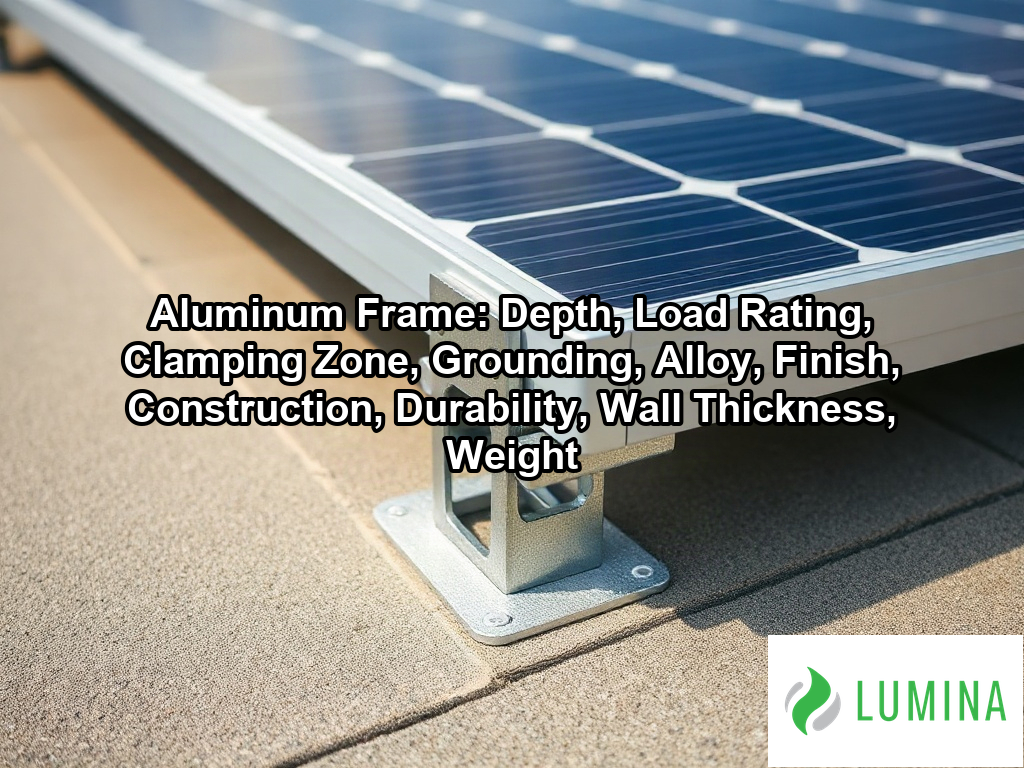
An aluminum frame is the extruded metal border that surrounds a solar panel’s laminate, giving it rigidity and mounting points. Key aspects include depth, load rating, clamping zone, grounding, alloy, finish, construction, durability, wall thickness, and weight. The frame is cut from a specific alloy, usually anodized to resist corrosion, and its depth affects how well the panel resists bending under snow, wind, and handling. Each frame carries a load rating that describes the pressure it can withstand, and that rating depends on the profile shape and wall thickness. Mounting hardware grips the frame only within a defined clamping zone, which keeps stress away from the glass and cells. The frame also serves as a path for electrical bonding, so grounding connections are made to it using approved lugs or bonding clips. Local solar installers Virginia rely on these frame specifications when matching panels to roof racks and regional wind and snow requirements, and the sections below explain each of these topics in turn.
Key Takeaways
- An aluminum frame uses 6063-T5 / 6063-T6 alloy for strength and corrosion resistance.
- A standard solar panel aluminum frame profile depth is 30 mm to 40 mm.
- Clamping outside the designated clamping zone can void your solar panel warranty.
- An aluminum frame provides 5,400 Pa snow load and 2,400 Pa wind load resistance.
- Grounding clips must penetrate the 10 to 20 micrometers thick anodized finish.
What Alloy Is an Aluminum Frame on a Solar Panel Made From?
An aluminum frame on a solar panel is made from 6000-series aluminum alloy, most commonly 6063-T5 or 6063-T6. This specific alloy choice is intentional because it provides the ideal balance of structural strength and ease of extrusion, which is necessary to create the complex internal chambers required for durability. By using 6063-T5 / 6063-T6 alloy, manufacturers ensure that the aluminum frame can maintain its shape while providing the rigidity needed to protect the internal laminate from mechanical stress during installation and long-term environmental exposure. According to the National Renewable Energy Laboratory, anodized 6063 aluminum alloy is the industry standard for solar module frames in the United States to ensure structural integrity and durability against environmental degradation over multi-decade lifespans.
| Material Property | Specification Range | Primary Function |
|---|---|---|
| Aluminum Alloy | 6063-T5 / 6063-T6 | Structural rigidity and extrusion complexing |
| Wall Thickness | 1.5 mm – 2.5 mm | Optimizing weight-to-strength ratio |
| Anodized Finish | 10 µm – 20 µm | Prevention of environmental oxidation |
| Module Weight Contribution | 10% – 15% | Mass reduction for installation efficiency |
Aluminum Frame Material Specifications
The alloy composition is only one part of the material construction; the way the frame is processed determines its longevity in outdoor conditions. The following list summarizes the key characteristics of the aluminum frame material composition:
- Base Material: 6063-T5 / 6063-T6 alloy.
- Wall Thickness: 1.5 mm to 2.5 mm for optimal weight-to-strength ratios.
- Anodized Finish: 10 to 20 micrometers thick to prevent oxidation.
- Weight Contribution: 10% to 15% of the total module weight.
The internal structure of the frame often features hollow chambers that reduce overall mass while maintaining structural integrity. These chambers, combined with the mechanical strength of the 6063-T5 / 6063-T6 alloy, allow the solar panel to support the necessary loads without excessive weight. When evaluating panels, verify the specified alloy grade provided by the manufacturer to ensure it aligns with the environmental durability requirements for your site.
Additional factors influence the overall material performance and lifecycle longevity of the frame:- Thermal expansion coefficients must be matched with the glass laminate to prevent delamination during temperature cycling.
- Corner joints utilize mechanical fasteners or crimping techniques to distribute load-bearing stress evenly across the frame perimeter.
- Pre-drilled mounting holes are precisely positioned to maintain the structural integrity of the extrusions while facilitating racking system compatibility.
- Chemical passivation treatments are applied before anodization to enhance the corrosion resistance of the metal surface against salt spray and acidic environments.
Standard Aluminum Frame Profile Depth and Why It Matters for Racking
The aluminum frame profile depth, which typically ranges from 30 mm to 40 mm with 35 mm being most common, is essential for maintaining the structural integrity of your solar panel to ensure it meets the certified 5,400 Pa front-side snow load and 2,400 Pa wind load requirements during installation.
| Application Tier | Profile Depth (mm) | Wall Thickness (mm) | Load Capacity Focus |
|---|---|---|---|
| Residential Standard | 30 – 40 | 1.5 – 2.0 | Standard Snow/Wind (5400/2400 Pa) |
| Commercial Grade | 40 – 50 | 2.0 – 2.5 | Extended Span/High Mechanical Stress |
Solar Frame Profile Depth (mm)
Common Profile Depth Ranges
Standard aluminum frame profile depth for solar panels generally spans 30 mm to 40 mm, with 35 mm representing the most common specification for residential installations. While these depths are optimized for structural rigidity, commercial-grade modules often utilize deeper profiles between 40 mm and 50 mm to accommodate longer spans and higher mechanical stress requirements. The aluminum frame relies on hollow internal chambers to maintain this structural integrity while minimizing mass.
Wall Thickness and Clamp Strength
The performance of your module is dictated not just by depth, but by the material density. Typical wall thickness of the frame profile ranges from 1.5 mm to 2.5 mm, which directly influences how much torque your mounting hardware can apply before the material yields or deforms.
Does Profile Depth Change Which Racking You Can Use?
Yes, profile depth changes which racking you can use because most mid-clamps and end-clamps are engineered for specific height ranges. If your aluminum frame is significantly thinner or thicker than the clamp’s designed tolerance, the hardware will fail to secure the module flush against the rail, creating a liability during high-wind events. Per Underwriters Laboratories, the profile depth of the aluminum frame must align with the clamping zone specifications defined in the module’s certification listing to ensure the panel can safely withstand dynamic loads without risking frame deformation or glass breakage.
- 30 mm frames: Require specific low-profile clamps or adjustable racking hardware.
- 35 mm frames: Compatible with the vast majority of universal solar mounting systems.
- 40 mm+ frames: Often require specialized deep-channel clamps to ensure a proper fit.
Profile Depth in Frameless Module Comparisons
Profile depth in frameless module comparisons is non-existent, as these units utilize glass-on-glass designs that forgo the aluminum frame entirely. Instead of using standard clamps, these modules rely on specialized fasteners that grip the glass edge through protective gaskets, shifting the mechanical load profile away from a rigid perimeter and into the laminate structure itself.
Verify that your chosen racking clamps are explicitly rated for the exact millimeter depth of your module’s aluminum frame before finalizing your hardware order. Consider these additional factors when evaluating the compatibility of solar frame profiles with your mounting system:- Ensure the frame’s channel geometry matches the specific mid-clamp and end-clamp manufacturer specifications to prevent mechanical interference.
- Verify that the chosen profile depth is compatible with the clamp’s bolt length to ensure proper installation torque.
- Account for the thermal expansion coefficient of the aluminum frame when calculating gaps between modules in long, continuous rows.
- Select anodized or powder-coated finishes that align with the local environmental corrosivity levels to prevent premature frame oxidation.
How an Aluminum Frame Helps Solar Panels Withstand Snow and Wind Loads Under IEC 61215 and UL 61730
An aluminum frame helps solar panels withstand snow and wind loads under IEC 61215 and UL 61730 by providing the necessary structural rigidity to prevent the delicate laminate from twisting or cracking under extreme pressure. Per the International Electrotechnical Commission, certification requires modules to demonstrate structural integrity during static mechanical load tests, where the aluminum frame acts as the primary support to prevent cell cracking during snow accumulation. During testing, the aluminum frame acts as a protective exoskeleton, distributing mechanical stress across the entire length of the module rather than concentrating it on the glass surface. The design utilizes 6063-T5 / 6063-T6 alloy for high tensile strength, while the wall thickness of 1.5 mm to 2.5 mm offers a balance between lightweight construction and the stiffness required to support heavy accumulation.
Frame Mechanical Pressure Thresholds
The following table illustrates the certified mechanical pressure thresholds that a standard aluminum frame must survive to meet these industry benchmarks:
| Load Type | Certified Pressure Capacity |
|---|---|
| Front-side Snow Load | 5,400 Pa (about 113 psf) |
| Wind Load | 2,400 Pa (about 50 psf) |
The structural integrity of the assembly also relies on the secure joining of the corners, typically facilitated by a corner key that prevents the frame from racking or deforming when high-velocity wind exerts suction on the underside of the solar panel. Because the frame accounts for 10% to 15% of the total module weight, it serves as the critical anchor point for all racking attachments, ensuring that the entire assembly maintains its shape under volatile environmental conditions.
Examine the mechanical installation manual for your specific solar panel model to verify that your chosen racking hardware is compatible with the frame’s certified load ratings for your expected local climate conditions.
To ensure the long-term reliability and environmental resilience of solar installations, installers and inspectors should verify these critical mounting and frame characteristics:- Confirm that the frame utilizes anodized coatings (typically 15–25 micrometers) to prevent galvanic corrosion and oxidation when exposed to moisture or salt spray.
- Ensure that grounding points or clips are properly integrated into the frame’s pre-drilled holes to maintain electrical continuity throughout the array.
- Verify that the frame’s clamping zones are compatible with the specific racking hardware to prevent localized stress fractures during installation tightening.
- Check for the presence of weep holes along the bottom edge of the frame to facilitate drainage and prevent freeze-thaw damage during winter months.
Where You Can Clamp an Aluminum Frame Without Voiding the Warranty
Where you can clamp an aluminum frame without voiding the warranty is determined strictly by the specific clamping zone designated by the manufacturer in the installation manual. Because the aluminum frame must distribute structural loads across the laminate without inducing stress fractures or cell damage, placing clamps outside these prescribed regions creates leverage points that jeopardize both the mechanical integrity of the module and your eligibility for coverage under the manufacturer’s warranty. Per the International Electrotechnical Commission 61215 standard, solar modules must undergo mechanical load testing where mounting hardware is applied exclusively to designated clamping points to ensure the structural integrity of the frame-to-laminate bond under wind and snow loads.
| Mounting Parameter | Critical Constraint | Technical Rationale |
|---|---|---|
| Clamping Zone Placement | Typically within 1/4 of panel length from corners | Prevents mechanical leverage and frame distortion. |
| Mid-Span Mounting | Permitted only if explicitly authorized | Required for high wind/snow load rating compliance. |
| Hardware Profile Match | Profile-depth specific hardware | Protects against extrusion wall crushing or twisting. |
| Torque Application | Manufacturer-defined Newton-meters (Nm) | Mitigates risk of micro-cracks in silicon cells. |
| Load Compliance | IEC 61215 Standard certification | Ensures frame-to-laminate bond structural integrity. |
- Standard Clamping Zone: Often restricted to a specific span within 1/4 of the panel length measured from each corner.
- Internal Mounting Rails: Some installations require mid-span clamping to handle extreme wind loads, which must be explicitly authorized in the module datasheet.
- Clamp Compatibility: Use only hardware that matches the profile depth of your aluminum frame, ensuring the clamp does not twist or crush the thin walls of the extrusion.
- Torque Specifications: Adhere strictly to the manufacturer’s recommended torque settings; over-tightening can deform the aluminum frame and cause internal micro-cracks in the silicon cells.
Review the mounting diagram provided in your specific module’s data sheet to confirm the permitted span for your clamps before tightening any hardware.
To ensure long-term structural reliability and warranty compliance, adhere to these additional installation best practices:- Use only non-corrosive, stainless steel mounting hardware to prevent galvanic corrosion between the aluminum frame and the racking system.
- Ensure the module frame is perfectly flush against the racking rail to avoid applying uneven pressure that could result in localized frame deformation.
- Verify that the grounding lugs are attached only to the manufacturer-pre-drilled grounding holes to maintain electrical continuity without compromising frame integrity.
- Inspect for any visible debris or burrs on the clamping surfaces before installation, as these can create stress concentration points during the torquing process.
Grounding an Aluminum Frame: Is It Required and How Clips Cut Through the Anodized Finish
Yes, grounding an aluminum frame is a mandatory safety requirement for every solar panel installation, as the metallic structure must be bonded to the system’s equipment grounding conductor to prevent electrical hazards. Because the anodized finish provides a highly resistant, non-conductive surface, you cannot achieve a reliable electrical path by simple contact. According to the International Association of Electrical Inspectors, proper grounding of module frames requires the use of specialized, listed grounding clips or lugs that are mechanically designed to bite through the hard-coat anodized finish of the aluminum to meet code-compliant bonding requirements. Specialized hardware is engineered to overcome this insulation by physically penetrating the 10 to 20 micrometers thick coating to establish a low-resistance connection with the base 6063-T5 / 6063-T6 alloy.
| Grounding Component | Mechanical Penetration Mechanism | Primary Application Method | Electrical Bonding Function |
|---|---|---|---|
| Grounding Lugs | Stainless steel screw or integrated teeth | Bolted into pre-drilled frame chassis | Direct path to equipment grounding conductor |
| WEEB-style Clips | Hardened, sharp metal teeth | Compression between frame and racking rail | Continuous array-wide metal-to-metal circuit |
Anodized Coating Thickness Range (micrometers)
- Grounding Lugs: These bolt directly into pre-drilled holes on the aluminum frame, using a stainless steel screw or integrated teeth to bite through the anodized layer for a secure electrical bond.
- WEEB-style Clips: These washer-like components are compressed between the aluminum frame and the racking rail during installation; their sharp, hardened teeth slice through the finish to create a continuous, metal-to-metal circuit across the entire array.
- Mechanical Integrity: Proper grounding ensures that in the event of a ground fault, the electrical current flows safely to the equipment grounding conductor rather than energizing the exposed outer border of the panel.
Confirm that your specific grounding clips are listed for use with your chosen module brand to ensure the teeth successfully breach the frame surface during the tightening process.
Follow these best practices to ensure your grounding connections remain compliant and durable over time:- Apply a thin layer of antioxidant joint compound to the penetration point to prevent galvanic corrosion between dissimilar metals.
- Torque all grounding hardware to the manufacturer’s specified inch-pounds to guarantee the mechanical teeth maintain constant pressure on the aluminum.
- Perform a continuity test with a digital multimeter between the furthest frame corner and the grounding electrode system to verify a resistance reading of less than 1 ohm.
- Inspect grounding connections annually for signs of thermal stress, vibration-induced loosening, or oxidation buildup.
Frequently Asked Questions
How thick are the walls of a solar panel aluminum frame, and why are the profiles hollow?
The wall thickness of a solar panel aluminum frame is typically 1.5 mm to 2.5 mm. These profiles are designed with hollow chambers to save weight while simultaneously providing the structural rigidity needed to resist bending when the solar panel is exposed to external environmental pressures.
How much of a solar panel’s weight comes from the aluminum frame?
The aluminum frame accounts for roughly 10% to 15% of a solar panel’s total weight. Depending on the size of the module, this usually adds several pounds to the overall structure, helping to maintain the rigidity of the laminate during transport and installation.
Are black anodized aluminum frames on solar panels any different from silver ones in coating or heat?
No, black anodized aluminum frames are not fundamentally different from silver ones in terms of their protective anodized finish, which is typically 10 to 20 micrometers thick for both colors. The choice between them is primarily aesthetic, as both provide the same durability and corrosion resistance for the solar panel.
How is a solar panel aluminum frame put together, and what are the drain holes for?
A solar panel aluminum frame is assembled by joining the profile edges at the corners using a mechanical corner key or screws. The frame includes drain holes at the bottom edge to allow accumulated water to escape, which prevents moisture buildup that could otherwise damage the integrity of the laminate.
How long does a solar panel aluminum frame last, and what are the common ways it fails, such as galvanic corrosion near copper?
An aluminum frame is built for long-term endurance using 6063-T5 / 6063-T6 alloy for high corrosion resistance. Failure often results from improper clamping outside the designated clamping zone or poor grounding, as the insulating anodized finish must be pierced to bond the frame to the equipment grounding conductor.