Free Solar Panel Program: Ownership, Cost, Contract Length, Savings, Eligibility, Home Sale Impact, Incentive Access, Maintenance, Sales Practices, Net Metering
In reality, there are no “free solar panel programs“; instead, you can utilize a solar lease so you pay nothing for solar panel installation and simply pay a reduced monthly amount in place of your standard utility bill. The key factors are upfront cost, ownership, monthly payment, long-term savings, tax credit eligibility, income eligibility, home sale impact, energy credit earnings, and installer verification. If you are searching for a free solar panel program, you likely want to lower your monthly utility bill without paying thousands of dollars for equipment and labor upfront. According to the Federal Trade Commission, regulators have issued warnings that offers of free or no-cost solar panels are a recurring scam pattern often used to lock homeowners into unfavorable long-term contracts. Before you decide to apply today for a free solar panel program, it is essential to understand that third-party ownership remains the standard model for these arrangements. By learning the free solar panel program requirements you need to meet and identifying if a free solar panel program is legitimate, you will be able to determine whether a lease or outright purchase is the right financial path for your residence. This article provides the objective information you need to evaluate your options and protect your home from misleading marketing claims.
Key Takeaways
- A free solar panel program is a marketing term for a solar lease or power purchase agreement.
- You do not own your solar panel system when using a solar lease or power purchase agreement.
- Find out if you qualify for free solar panels by reviewing your credit and roof condition.
- Solar leases may require you to transfer the contract to a new buyer when selling a home.
- Purchasing a solar panel system outright typically yields higher long-term financial savings.
Do Free Solar Panel Programs Really Cost Nothing, or Will There Be Monthly Payments?
No, a free solar panel program does not actually cost nothing, as these arrangements shift the financial burden from upfront equipment purchases to recurring monthly payments or fixed-rate electricity charges. While you may research how to get solar panels installed for free, the underlying financial structure is typically a solar lease or a power purchase agreement rather than a gift of hardware.
“Residential solar financing options include leases and power purchase agreements that typically require little or no money upfront but necessitate ongoing monthly payments or electricity purchases under long-term contracts for the system’s energy output as of 2022.” — Pennsylvania Public Utility Commission
| Financial Model | Primary Cost Structure | Maintenance Responsibility |
|---|---|---|
| Solar Lease | Fixed monthly payment | Solar installer |
| Power Purchase Agreement | Rate per kilowatt-hour | Solar installer |
| Outright Purchase | Upfront cost or financing | Homeowner |
In a solar lease, you pay a consistent monthly fee regardless of the energy produced, whereas a power purchase agreement fluctuates based on your actual usage measured in kilowatt-hour increments. Because the equipment accounts for approximately 46% of the total installation price and the remaining 54% consists of soft costs like permitting and overhead, these companies recover their investment through the long-term contracts they require you to sign. Even though these programs bypass the substantial initial capital required for an outright system purchase, they involve long-term financial commitments that may exceed the cost of the equipment over time.
Review the total cumulative payments listed in your contract to determine if the long-term expense of the agreement exceeds the estimated market value of the solar panel system.
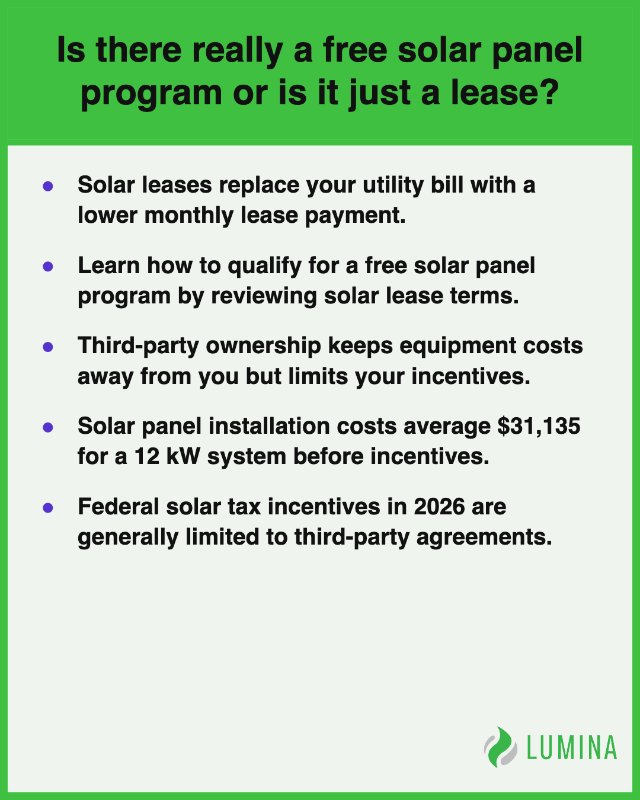
Who Actually Owns the Solar Panel System on Your Roof?
The solar installer retains full ownership of the solar panel system installed on your roof under the terms of a solar lease or a power purchase agreement. When you apply now for the free solar panel program, you are essentially entering a long-term contract where the company that provides the equipment remains the legal owner, allowing them to capture all available tax incentives and depreciation benefits.
“In third-party ownership models such as solar leases or power purchase agreements, the developer finances, installs, and maintains the solar energy system on a customer’s property while retaining ownership of the equipment for the duration of the 10 to 25-year contract term as of 2026.” — Solar Energy Industries Association
What You Give Up When the Solar Installer Retains Ownership
Because the equipment is not yours, you lack the rights typically associated with property ownership. The solar installer is responsible for maintenance and repairs, but they also dictate the terms of equipment removal and potential roof access. Limitations of these programs include:
- Ineligibility for the federal residential solar tax credit, which is claimed by the installer.
- Inability to modify or upgrade the equipment without explicit permission.
- Contractual obligations that often persist even if you wish to remove the system.
Does Ownership Change If You Buy Out the Solar Lease Early?
Ownership does not automatically transfer to you before the end of the term, though many contracts include a provision to purchase the system. If you choose to exercise this option, you must pay a predetermined amount to acquire the hardware.
How a Buyout Price Is Typically Calculated at Contract Midpoint
The buyout price is rarely a nominal fee. Installers generally calculate this figure based on the remaining value of the contract, the expected future electricity production, and the fair market value of the equipment at the time of the request.
Can You Ever Own the Panels Outright Under a Free Solar Panel Program?
No, you generally cannot own the panels outright from the start of these agreements. You should review your contract to determine if a purchase option is available and confirm the specific formula used to calculate the buyout cost before signing any documents.
How a Free Solar Panel Program Could Cut Your Energy Bills
A free solar panel program could cut your energy bills by allowing you to access electricity generated on your property without the significant upfront capital expenditure required for a full system purchase. Qualifying households can join the free solar panel program to lower their monthly utility expenses through either a solar lease or a power purchase agreement, both of which restructure how you pay for your power consumption.
“Expanding small-scale solar development in Pennsylvania could save households and businesses nearly $1 billion in electricity costs over the next two decades, according to an April 2026 analysis.” — Aurora Energy Research
- Solar Lease: You pay a fixed monthly fee to the solar installer for the use of the equipment, regardless of the exact amount of electricity produced during that period.
- Power Purchase Agreement: You pay a predetermined rate per kilowatt-hour for the energy the solar panel system produces, which is often lower than the standard utility rate.
- Net Metering: By feeding excess electricity back into the grid, you may receive credits against your remaining utility charges, further reducing your total monthly expenditure.
- Operational Savings: Because the solar installer retains ownership, they are responsible for maintenance and repairs, shielding you from the long-term costs associated with hardware upkeep.
Compare the projected monthly payment under a lease or power purchase agreement against your historical utility bills to ensure the net savings justify the long-term contractual commitment.
How to Apply for the Free Solar Panel Program
You can initiate your pursuit of a solar installation by following a structured sequence designed to identify legitimate providers. Because the free solar panel program is accepting new applicants through various marketing channels, you must distinguish between verifiable regional incentives and private, third-party agreements that require long-term contracts. Researching the specific terms of a solar lease or power purchase agreement is the primary method to determine if a provider’s offer aligns with your financial goals.
“The state-wide Solar for All program is currently on pause as of August 7, 2025, and is not accepting applications for funding at this time.” — Pennsylvania Department of Environmental Protection
- Verify your eligibility by reviewing any state-sponsored rebate or incentive portals that may exist in your jurisdiction, as these are distinct from private company offers.
- Request a comprehensive written proposal from a solar installer that clearly outlines whether the offer is a solar lease or a power purchase agreement.
- Compare the projected cost per kilowatt-hour against your current utility bills to ensure the long-term rate remains competitive.
- Evaluate the total installation price, noting that equipment costs typically account for approximately 46% of the total, while soft costs like permitting, labor, and overhead comprise the remaining 54%.
- Review the contract for any automatic escalation clauses that could increase your monthly payments or the price of electricity over the lifespan of the solar panel system.
Compare the total cost of the proposed monthly payments against the estimated savings you would achieve if you were to finance the equipment purchase outright instead of entering into a lease.
Do You Qualify for a Free Solar Panel Program Based on Credit and Roof Condition?
Yes, you qualify for a free solar panel program based on specific credit and structural assessments that determine your eligibility for a solar lease or a power purchase agreement. Because these arrangements involve a long-term financial commitment, solar installers evaluate your credit history to ensure your ability to make consistent monthly payments or honor the terms of your electricity purchase agreement. Beyond your financial background, the physical state of your home is a primary factor in the approval process.
“Industry best practices for residential solar installations recommend that a roof have at least 10 to 15 years of remaining service life to ensure the roof outlasts the solar array.” — WattBuild
To find out if you qualify for free solar panels, you must generally meet the following criteria:
- Credit score: Most solar installers require a minimum credit score, typically ranging from 650 to 700, to mitigate the risk of default on a long-term contract.
- Roof condition: Your roof must be in good repair with sufficient structural integrity to support the weight of the solar panel system for the duration of the 20- to 25-year agreement.
- Sunlight exposure: Your roof must have adequate solar access, meaning it is largely free from shade caused by trees, chimneys, or neighboring structures that could diminish energy production.
- Roof orientation and pitch: Ideally, the roof faces south to maximize exposure, though east- or west-facing roofs may be accepted depending on the specific site assessment.
Review the age and remaining lifespan of your roofing materials before signing a multi-decade contract to avoid expensive removal and reinstallation fees later.
Can You Sell Your Home With a Free Solar Panel Program Agreement Attached?
Yes, you can sell your home with a free solar panel program agreement attached, though doing so requires the transfer of the underlying legal obligations to the new homeowner. Because these arrangements are structured as a solar lease or a power purchase agreement, the contract is tied to the property rather than the individual, meaning the buyer must typically qualify for and assume the remaining terms of the agreement. If the buyer refuses to accept the solar equipment, you may be required to pay a significant early termination fee or purchase the system outright to clear the title before closing.
“A research-based analysis of home sales found that while owned solar photovoltaic systems can provide a significant resale premium, homes with leased solar systems sold for about the same price as comparable homes without solar in a 2015 study that remains a standard reference for market impact.” — Lawrence Berkeley National Laboratory
Managing a home sale under these conditions involves several critical steps to ensure the transaction proceeds without delays:
- Review your original contract to identify specific transfer requirements, including credit score thresholds for potential buyers.
- Notify your solar installer as early as possible to initiate the formal assignment process.
- Disclose the monthly payment amount or the kilowatt-hour rate to your real estate agent to ensure full transparency for potential buyers.
- Verify if the existing agreement allows for a buyout, which could simplify the sale by removing the solar equipment encumbrance.
While a free solar panel program could cut your energy bills, the long-term impact on your property’s marketability depends on whether the future owner views the ongoing contract as a financial burden or a benefit. Carefully examine the transferability clause in your agreement before listing your property to understand if the contract grants the buyer the right to reject the equipment.
How to Get Solar Panels Installed for Free
By leveraging options like a solar lease or a power purchase agreement, you can minimize the upfront burden of installing a solar panel system. Qualifying households can join the free solar panel program to offset the standard installation costs that often include 54% in soft costs such as permitting and overhead. You should verify your eligibility and local utility guidelines to see if you can take advantage of these arrangements. Apply now for the free solar panel program to determine if you can secure long-term energy savings.
Frequently Asked Questions
Who is responsible for repairing solar panels under a free solar panel program?
The solar installer is responsible for repairing solar panels under a free solar panel program because they retain ownership of the equipment. Since these programs are actually solar leases or power purchase agreements, the solar company handles all maintenance, while you simply pay a fixed fee or for the electricity generated.
Can I claim the solar tax credit if I get panels through a free solar panel program?
No, you cannot claim the federal residential solar tax credit if you get panels through a free solar panel program. Because the solar company retains ownership of the equipment, they capture all tax incentives themselves, and the federal residential solar tax credit expired for individual homeowners on December 31, 2025.
How does net metering work when solar panels are leased through a free solar panel program in PA, MD, VA, DE, or DC?
Net metering arrangements for a solar panel system depend on your local utility, but when you participate in a free solar panel program, the solar company often retains the rights to the credits. While some regions mandate 1-to-1 net metering at the full retail rate, the lease contract dictates your specific benefits.
Are free solar panel program offers from door-to-door salespeople legitimate?
Aggressive sales tactics promising a free solar panel program are frequently cited in consumer complaints to regulators, so you should exercise extreme caution. These offers are marketing terms for solar leases or power purchase agreements rather than government-provided equipment, and you should always verify that your solar installer is certified by the North American Board of Certified Energy Practitioners.